Meditation · reviewed by a teacher
Body scan: how to do it, step by step
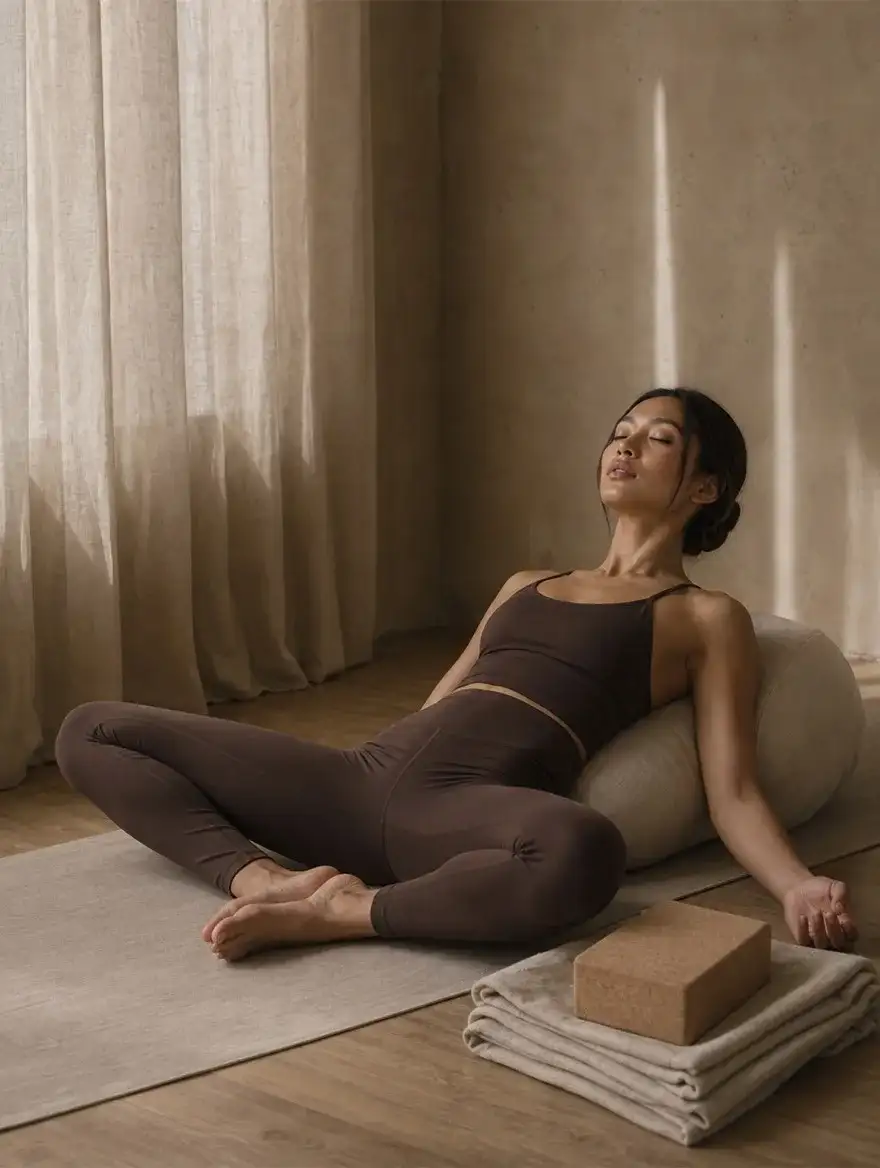
A body scan is a meditation in which you move your attention slowly through the body, usually from the feet to the head, noticing whatever sensations are there without trying to change them. It takes about ten minutes lying down or seated, and a three-minute version works at a desk.
Teacher's note from Joahnna Lee
“Every lesson I teach ends lying down in savasana, and a scan is an easy thing to try on your own in the same shape afterwards.”
A body scan is one of the simplest ways to meditate, because it gives your attention somewhere to go. Instead of resting on the breath alone, you travel slowly through the body, from the soles of the feet to the top of the head, and notice what you find along the way.
It suits people who find sitting with the breath too abstract, and it suits the end of a long day, when the body is tired but the mind is still at work. It sits naturally beside restorative yoga at home, with bolsters and blankets, where the whole practice is built around lying still and supported.
A quick safety note. If attention on the body brings up distress or memories you would rather not meet, stop, open your eyes and move. People with a history of trauma often prefer eyes open and the short version below, and are wise to practise with their therapist’s guidance.
What is a body scan?
The modern body scan is best known from Mindfulness-Based Stress Reduction (MBSR), the eight-week programme Jon Kabat-Zinn created at UMass Memorial Medical Center in 1979, where the body-scan meditation is one of the core practices.
The instruction is plain: move your attention through the body, part by part, and notice sensation without judging it or trying to fix it. Warmth, pressure, tingling, an ache or nothing at all are all acceptable findings. You are not trying to relax each part on purpose. Often it softens anyway, but that is a side effect, not the goal.
How to set up: lying down or seated
Lying down is the classic way. Lie on your back on a mat, a carpet or your bed, with a pillow under your head and another under your knees to ease the lower back. Cover yourself with a light blanket: the body cools as it stills, even in Manila, especially under the aircon.
Seated is better if you tend to fall asleep, if lying flat is uncomfortable, or if you are pregnant and have been advised not to lie on your back. Sit in a chair with your feet flat and your hands on your thighs. Other seated options, from a cushion to a kneeling bench, are set out in meditation postures for every body.
Set a gentle timer for ten minutes, such as the free meditation timer with a bell. Let the breath be natural throughout.
A ten-minute body scan, step by step
Take roughly a minute for each step. There is no need to be exact.
- Settle. Feel the whole weight of your body on the floor or chair. Notice the points of contact: heels, calves, hips, shoulder blades, the back of the head.
- Feet. Bring your attention to the toes, the soles, the heels and the tops of the feet. Notice temperature, the touch of the blanket or the floor, any tingling.
- Lower legs and knees. Move up through the ankles, shins and calves to the knees. Some of this may feel quiet. That is fine.
- Thighs and hips. Notice the weight of the thighs and the hips, and where they meet the floor or the seat.
- Belly and lower back. Feel the belly rise and fall with the breath. Notice the lower back, without trying to press it down or change it.
- Chest and upper back. Notice the ribs moving, the shoulder blades against the floor, perhaps the heartbeat.
- Hands and arms. Travel from the fingertips through the palms, wrists, forearms and upper arms to the shoulders.
- Neck, jaw and face. Notice the throat, the jaw, the tongue, the cheeks, the small muscles around the eyes and the forehead.
- Head. Move to the back and the top of the head.
- The whole body. Widen your attention to take in the whole body at once, breathing. Then wiggle the fingers and toes, roll to one side and come up slowly.
When your mind wanders, and it will, notice where it went and come back to the part of the body you were on. If you are lost, start again from the feet. For more on returning without judging yourself, see how to meditate, starting with five minutes.
A three-minute version for a busy day
This one works at a desk, in a parked car or on a sofa, eyes open or closed.
- Feet and legs (one minute): feel your feet on the floor, then the weight of your legs.
- Middle (one minute): feel your seat on the chair, your belly breathing, your back.
- Top (one minute): notice your hands, drop your shoulders, soften your jaw and forehead.
End with one slow breath out before you go back to what you were doing.
What gets in the way, and what can you do about it?
Almost everyone meets the same few difficulties. None of them mean you are doing it wrong.
| What happens | What to try |
|---|---|
| You fall asleep | Sit up, open the eyes slightly, or practise earlier in the day |
| The mind keeps wandering | Name where it went (“planning”, “worrying”) and return to the last body part |
| You feel nothing in a part of the body | Notice the absence itself, or the contact with the floor or clothes |
| An itch or ache demands attention | Stay with it for a breath or two, then move mindfully if you need to |
| You feel restless or impatient | Use the three-minute version, or scan with the eyes open |
| Strong emotion comes up | Open the eyes, feel the feet, and stop if it feels like too much |
What about noise, heat and a busy household?
Practising in a Philippine home often means tricycles outside, a neighbour’s videoke, roosters at dawn or family moving around. Rather than waiting for silence, let sound be one more thing you notice: hear it, then return to the feet or the hands. A fan’s steady hum can make a good background. If the room is hot, a light cotton sheet is better than nothing at all, because the body still cools as it stills.
How often should you practise a body scan?
A short scan most days usually feels more useful than a long one once a week. Many people start with the three-minute version daily and the ten-minute version two or three times a week. Over a few weeks, the common change is simply that it becomes easier to notice tension sooner, such as a tight jaw in traffic, rather than any dramatic result.
How is a body scan different from yoga nidra?
The two are easy to confuse because both are done lying down and both move attention around the body. A body scan is a mindfulness practice: you notice what is there, in order, and that is all. Yoga nidra is a longer guided practice from the yoga tradition, usually led by a teacher’s voice, which adds an intention at the start, a faster rotation of attention through the body and other stages such as noticing opposite sensations.
If you enjoy the body scan and want a longer, fully guided form of rest, read about yoga nidra and how its stages run.
When to use it
- Before sleep. Many people use a body scan in bed. If you fall asleep halfway, that is fine at night. For a short evening routine to go with it, see gentle yoga before bed.
- With a voice. If reading the steps keeps your eyes open, the guided body scans of 5, 10 and 20 minutes are read aloud by your browser with long pauses, and can stop on a sleep timer.
- After work. A three-minute scan between the office and the rest of your evening can mark the change of gear.
- With a restorative practice. Most yoga classes end lying down in savasana, the final rest, and a scan is an easy thing to try on your own in the same shape afterwards. If you want that slower pace with a teacher, you can find a studio near you that runs restorative or evening classes.
A body scan is not a treatment for pain, insomnia or any health condition. If it leaves you more anxious or low, stop, and speak to a doctor or therapist if those feelings last. If you are in crisis, in the Philippines you can call the National Center for Mental Health crisis hotline on 1553, any time.
This page is one of the sources behind the bell timer for meditation, the breath programs in the app, the guided meditations and the app's ambience and timer.
Browse the meditation library.
Sources: Mayo Clinic, Fitness program: 5 steps to get started; NCCIH (US National Institutes of Health), Yoga: Effectiveness and Safety; NHS, Exercise in pregnancy; CDC, Pregnant & Postpartum Activity: An Overview; Canadian Family Physician (Chan et al., 2014), via PubMed Central, Hot yoga and pregnancy: Fitness and hyperthermia; Cleveland Clinic, Hyperventilation Symptoms, Causes & Treatment. Last reviewed 2 October 2026.
Questions
Is a body scan the same as progressive muscle relaxation?
No. Progressive muscle relaxation asks you to tense and then release each muscle group in turn. A body scan asks only for attention. You notice each area as it is, without tensing it or changing it.
How often should you do a body scan?
As often as it is useful. Some people do one every night in bed, others once or twice a week after work. A short scan you actually do is worth more than a long one you keep putting off.
What should I feel during a body scan?
Whatever is there. That might be warmth, coolness, pressure from the floor, tingling, the touch of clothing, an ache, or very little at all. The aim is to notice, not to produce a particular feeling or to relax on command.
Is it bad if I feel nothing in some parts of my body?
No. Most people find some areas quiet, often the shins, the upper arms or the back of the head. Noticing that you feel nothing there is still noticing. Stay for a breath or two and move on.
Can I do a body scan with my eyes open?
Yes. Rest your gaze softly on a spot on the ceiling or the floor. Eyes open is a good choice if closing them makes you uneasy, if you are prone to falling asleep, or if you are doing the short version at work.
What are the different types of body scan meditation?
Body scan meditations differ mainly in length, posture and guidance. The classic version takes about ten minutes lying down, moving from the feet to the head. A seated scan suits anyone who tends to fall asleep. A three-minute version works at a desk. Guided scans are read aloud, and yoga nidra is a longer guided relative.
Keep reading
Your yoga calendar
We track every yoga event, workshop and pop-up class so you don't have to.
Updated