Pose library · Savasana · reviewed by a teacher
Corpse Pose (Savasana)
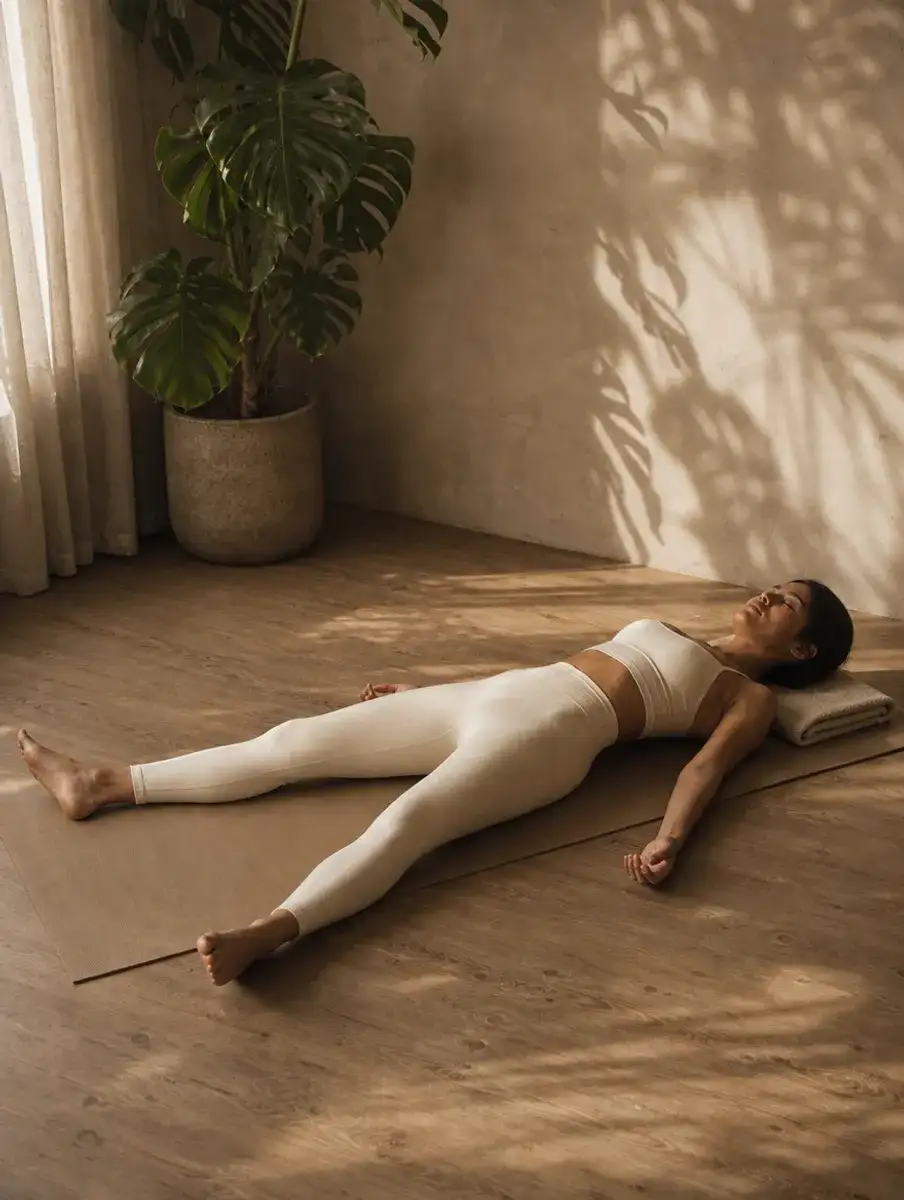
Sava means corpse and asana means posture. You lie flat on your back and stop doing anything at all, so the body can take in the practice that came before it.
Corpse Pose (Savasana) is the final resting pose of a class, lying flat on your back and doing nothing at all. Let the legs fall wider than the hips, rest the arms palms up and stay five to ten minutes. Put a bolster under the knees if the lower back aches, and roll to your side to come out.
Pronunciation and meaning
Savasana: shah-VAHS-uh-nuh. It is often written Shavasana, and the stress falls on the second syllable.
Sava means corpse and asana means posture. You lie flat on your back and stop doing anything at all, so the body can take in the practice that came before it.
How to do Corpse Pose
- Sit on the mat with your knees bent, then lower your back down one part at a time until your head rests on the floor.
- Straighten your legs one at a time and let them fall a little wider than your hips, with the feet flopping open.
- Rest your arms a hand's width away from your sides with the palms facing up, and draw the shoulder blades gently under you so the chest feels broad.
- Lengthen the back of your neck by tucking the chin down a touch. If the chin points at the ceiling, put a folded blanket under your head.
- Close your eyes and let the breath go back to its own rhythm. Stay for five to ten minutes.
- To come out, deepen the breath, move your fingers and toes, roll onto your right side and rest there for a few breaths before pressing up to sit.
Corpse Pose step by step

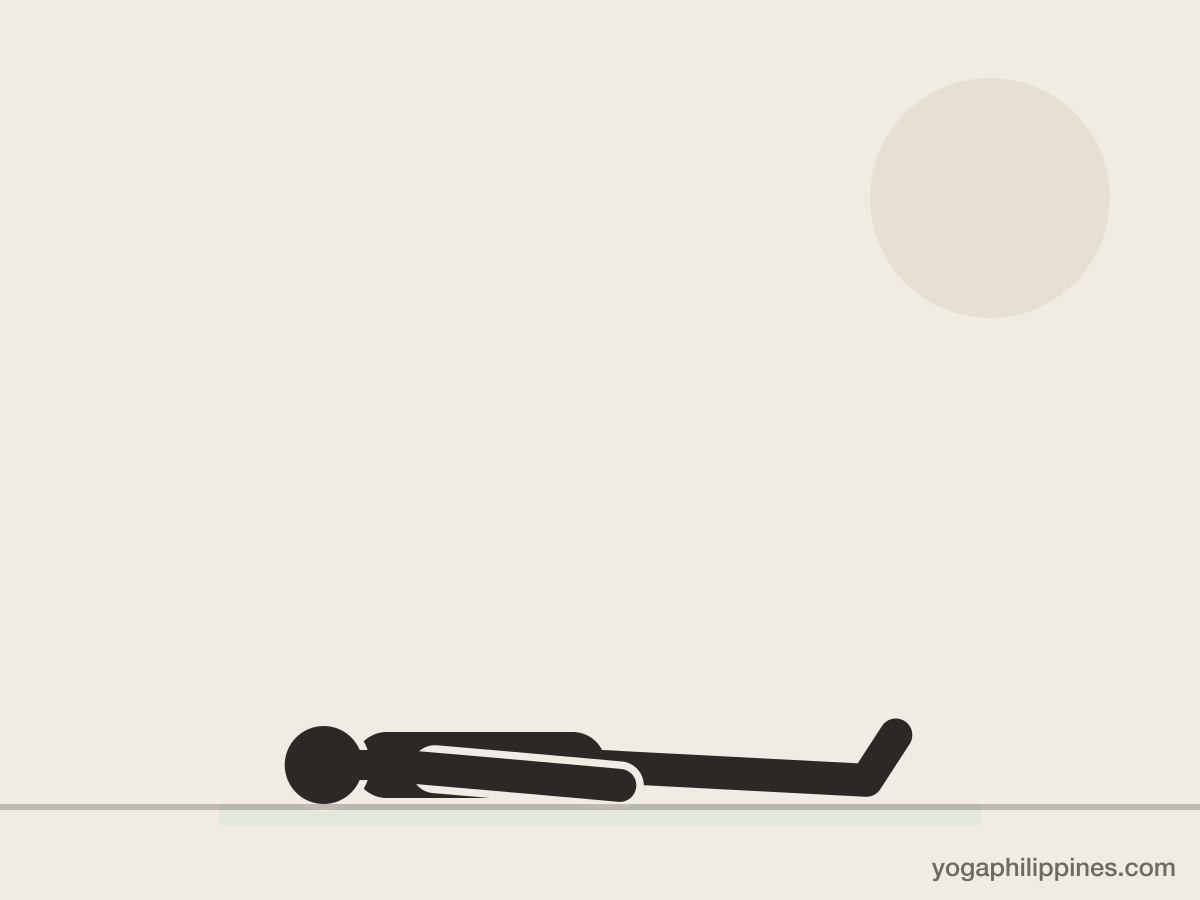
Drawings and video by YogaPhilippines.com, free to reuse under CC BY 4.0 with credit and a link: see the image licence for how to credit.
Corpse Pose appears in the 10-pose beginner yoga sequence and the Ashtanga primary series card, both printable with holds and cues.
Teacher's note from Joahnna Lee
“I ask you to let the floor hold you. Notice where you are still gripping, often the jaw, the hands or the belly, and let that one place soften.”
“There is nothing to get right here. If your mind wanders to a to-do list, come back to the feeling of the breath at the tip of the nose.”
“Stay warm. I would rather cover you with a blanket than have you lie there cold and waiting for it to end.”
Make it easier
- Place a bolster or a rolled blanket under your knees if your lower back aches when the legs are straight.
- If lying flat does not feel good, bend your knees and let them rest against each other with the feet wide on the floor.
Pregnancy and after birth
Pregnancy. Adapt. From the second trimester, many OBs and midwives advise against lying flat on your back for long, so rest on your left side with a pillow between the knees and one under the head, or recline on a bolster propped on blocks. Ask your OB or midwife what is right for you.
After birth. Adapt. Savasana is usually one of the first things you can return to, but let your doctor or midwife clear you before a full practice. A pillow under the knees takes pressure off the lower back and belly, and side-lying is fine if you are nursing or sore.
For more on practising through pregnancy, see Joahnna Lee Yoga.
Common mistakes
- Skipping it to save time. The minutes of stillness at the end are part of the practice, not a bonus.
- Sitting straight up at the end. Roll to the side first so the blood pressure and the head have time to catch up.
- Lying under a cold aircon draught with nothing over you, so the body tenses instead of resting.
Savasana looks like the easiest posture on the mat, and for many people it is the hardest to do well, because it asks you to stop. Most classes close with it, and some teachers add a little sound healing to bring the practice to a quiet end.
If rest is what you need most, restorative yoga spends much of its time in savasana and the supported shapes that lead into it. Many of those shapes are gathered in the yoga poses lying down, on the mat or in bed, and Savasana closes the gentle yoga poses for bloating too.
Why is it called Corpse Pose?
Corpse Pose is the plain English translation of Savasana, from sava, a corpse. The name can sound grim at first, but it describes the instruction exactly: lie as still as a body that has stopped doing anything at all. There is nothing to hold, lift or reach for.
The Hatha Yoga Pradipika, a hatha text from around the fifteenth century, describes lying flat on the back like a corpse, and says the posture takes away tiredness and rests the mind. Modern classes keep the idea and place it at the end, so the stillness follows the effort. In the Bikram 26 poses, a short Savasana also comes between the floor postures.
Some teachers prefer gentler names, such as final relaxation or final rest, and Shavasana is a common spelling. All of them mean the same pose. Whatever it is called in your class, the practice is the same: settle, let the breath find its own pace, and give the body a few quiet minutes before you sit up.
How do you settle into Savasana, step by step?
A five-minute version you can read through once, then do from memory:
- Lie on your back and let the feet fall open, about hip-width or a little wider.
- Rest the arms a little away from the body, palms up, and let the shoulder blades spread on the floor.
- Tuck the chin slightly so the back of the neck is long. Close the eyes or rest the gaze softly on the ceiling.
- Breathe out through the mouth once or twice, then let the breath go back to the nose and find its own pace.
- Move your attention slowly from the feet to the crown of the head, softening each area as you pass it.
- When thoughts arrive, notice them and come back to the feeling of the breath at the belly.
- To come out, deepen the breath, move the fingers and toes, roll to your right side and rest there for three breaths before pressing up to sit.
Which props make Savasana easier?
| Prop | Where it goes | Why |
|---|---|---|
| Bolster or rolled blanket | Under the knees | Lets the lower back relax |
| Folded towel | Under the head | Keeps the chin level if it tips up |
| Eye pillow or a folded cloth | Over the eyes | Blocks light in a bright room |
| Light blanket or sarong | Over the body | The body cools as it rests, even in a warm room |
What about noise and heat at home?
Few homes in Manila are silent: traffic, a neighbour’s karaoke or a barking dog will drift in. Rather than fighting the sound, let it be one more thing you notice and let pass, the same way you notice a thought. A fan on low is fine, but avoid lying directly under a strong aircon draught, which can leave the body tense from the cold within a few minutes. A sheet over the legs usually solves both.
How long until Savasana feels restful?
For many people, the first few weeks of Savasana feel restless, with the mind busy and the body fidgety. That usually eases with regular practice, and many students find that within a month or two the stillness at the end becomes the part of class they look forward to most.
Props that help in Corpse Pose
- Blanket: supports the head or the back so the neck stays relaxed.
- Bolster: supports the body so you can stay longer with less effort.
Programs and sessions that use Corpse Pose
- The 30-day yoga challenge 13 of its 30 sessions
- The 4-week beginner program 10 of its 12 sessions
- The 14-day flexibility plan 3 of its 14 sessions
- The 7-day desk reset 1 of its 7 sessions
- Sequences: quick 10-minute session, 30-minute home flow, 45-minute slow yoga, Ashtanga first series, gentle back routine, evening wind-down, beginner yoga sequence, Bikram series, recovery sequence for runners and flow that spares the wrists
- Practice app sessions: 10-minute reset, 20-minute flow, 30-minute practice, morning wake-up, evening wind-down, hip opener, back-friendly and balance
- Generated example flows: 10-minute beginner flow, 20-minute hip flow, 30-minute back-friendly session, no weight on the wrists and 45-minute yin-style wind-down
Put it into practice with the flow builder, the pose of the day, the random flow generator and the app's ambience and timer, built on pages like this one.
Sources: Mayo Clinic, Fitness program: 5 steps to get started; NCCIH (US National Institutes of Health), Yoga: Effectiveness and Safety; NHS, Exercise in pregnancy; CDC, Pregnant & Postpartum Activity: An Overview; Canadian Family Physician (Chan et al., 2014), via PubMed Central, Hot yoga and pregnancy: Fitness and hyperthermia. Last reviewed 2 October 2026.
Corpse Pose questions
How long should Savasana be?
Five minutes is a good minimum after a short practice, and ten or more after a longer one.
Is it OK to fall asleep in Savasana?
It happens, especially if you are tired, and it is nothing to feel bad about. The aim, though, is to stay awake and resting at the same time, so if you drift off often, try a little more support under the head and knees and keep the eyes lightly open.
Why is Savasana done at the end of class?
It gives the body and breath time to settle after the effort of the practice, and many people find it the easiest moment to feel the effect of the class. It also works as a pause between the practice and the rest of the day, so you leave the mat calmer rather than rushing straight out.
What can you do if Savasana feels uncomfortable?
Change the setup. A rolled blanket or bolster under the knees often eases the lower back, a folded blanket under the head helps the neck, and a light cover keeps you warm. You can also keep your eyes open, bend the knees with the feet flat, or lie on your side.
Can you practise Savasana on its own?
Yes. You can lie down in Savasana for five to ten minutes any time you want a rest, such as in the afternoon or before sleep. Lie on a mat or firm surface, use whatever props make you comfortable, and let your breath slow down without forcing it.
Why do some people cry during Savasana?
It happens more often than people expect, and it is nothing to worry about. Savasana is often the first time in the day that you stop doing anything, and when the body goes still after effort, feelings that were kept busy can surface. Let the tears come and go, open your eyes or sit up if you need to.
Pairs well with
Updated