Guides · reviewed by a teacher
Yoga for stress relief
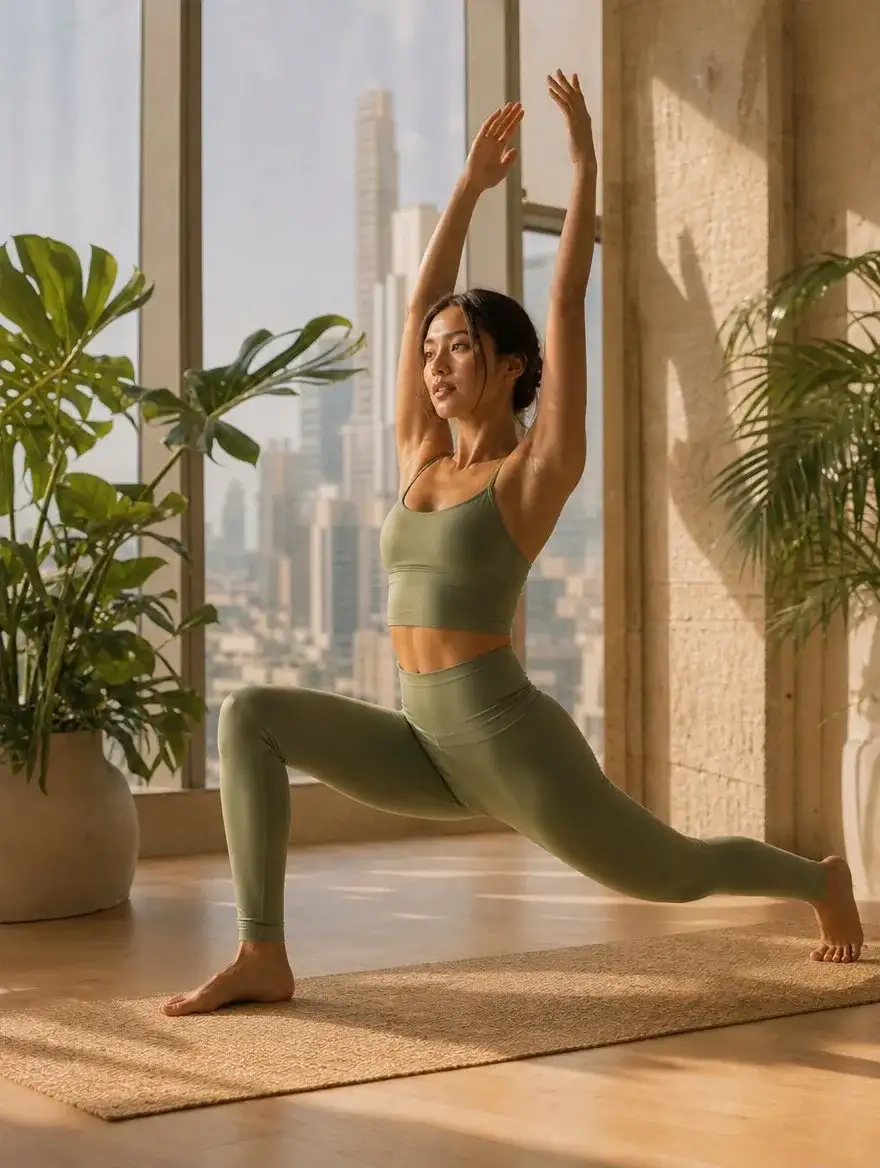
Yoga for stress relief means choosing slow movement, a longer out-breath and properly supported rest, so you have a clear, physical way to mark the end of the working day. It is a practice many people keep alongside their other care, not a treatment, and it works best when it is short, regular and easy to start.
Teacher's note from Joahnna Lee
“I cannot promise what your body will do with those conditions. What I can say is that many people find them restful, and that they are easy to repeat.”
Stress is not only in your head. It shows up in the jaw, the shoulders, the breath and the way you sit at a desk for ten hours.
A yoga practice for stress works with those places directly. It does not ask you to think your way calm. It gives your body a slower thing to do for a while.
Effort mode and rest mode, in plain words
Your nervous system has a setting for getting things done and a setting for winding down. Both are normal. Deadlines, traffic, notifications and late emails keep nudging you towards the first one, and some days it never quite switches back.
A calming practice is simply a set of conditions that make the second setting easier to find: moving slowly, breathing out for longer than you breathe in, lying down with your weight fully supported, and not being interrupted.
Nobody can promise what your body will do with those conditions. Many people find them restful, though, and they are easy to repeat. Yoga’s own word for that settled state is shanti, and why om shanti is said three times has a page of its own.
A short practice to try at home
You need a mat or a rug, a firm cushion or two, and a blanket. Put your phone in another room.
- Arrive. Sit or lie down and notice how you are breathing, without changing it. Give it a minute.
- Loosen the desk places. On hands and knees, move slowly between rounding and arching the back, as in the cat-cow stretch. Then roll the shoulders and let the head hang heavy for a few breaths.
- Fold forward and rest. Come into child’s pose with the knees wide, with a cushion under your chest if the floor feels far away. Stay for a minute or two.
- Lengthen the out-breath. Lying on your back with knees bent, breathe in for a count of four and out for a count of six. Keep it comfortable. If counting makes you tense, drop the numbers and just let the exhale be slow.
- Legs up. Rest your legs up a wall, as in the legs-up-the-wall pose, with a folded blanket under your hips if you like. Stay three to five minutes.
- Lie still. Finish in the final resting pose, savasana, with a blanket over you. Let the floor take your weight for five minutes before you get up.
This whole sequence takes about fifteen to twenty minutes. On a busy night, steps 4 to 6 on their own are enough. For setting up a regular practice space, see yoga at home for beginners.
Choosing the right style
When you are stressed, the instinct is sometimes to go hard. A strong class can feel good, but if you are already running on adrenaline and little sleep, slower styles are often a better match.
Yin yoga holds a few floor shapes for several minutes with the muscles let go. In a restorative yoga practice, bolsters and blankets hold the body completely. Both give you stillness with support, which is often the thing stress takes away. If you would rather keep moving, a slow moon salutation, Chandra Namaskar is a calm standing sequence for the evening. For a guided rest lying still, see how yoga nidra works.
Which poses suit which kind of stress?
Stress does not always feel the same. Matching the practice to how you feel tends to work better than one fixed routine.
| How you feel | Try | Why |
|---|---|---|
| Wired, restless, mind racing | A few slow Sun Salutations, then Child’s Pose | Moving first can make stillness easier afterwards |
| Tired but tense | Legs Up the Wall, supported Child’s Pose | Rest with support, no effort needed |
| Stiff after a long day of screens | Cat-Cow, a supine twist, a gentle forward fold | Moves the places that held still all day |
| Unable to switch off at night | Reclined Butterfly, then Savasana with a longer exhale | Quiet floor shapes close to bed |
| Short on time | Three minutes of the longer exhale lying down | Breath alone can be enough |
How long before you notice a difference?
Many people feel calmer straight after a gentle session, and that short-term effect is often the main reason to practise. A steadier baseline, such as sleeping a little better or feeling less on edge through the week, tends to build over a few weeks of practising most days. If nothing has changed after a month, try a different time of day or a slower style before giving up on it. And if stress is affecting your sleep, appetite or work for weeks at a time, that is a reason to talk to a doctor as well.
Practising in a hot, small home
A calm practice is hard in a stuffy room. Choose the coolest time, often early morning or late evening, switch on a fan or the air conditioner for a few minutes beforehand, and practise on a mat or a folded blanket rather than cold tile for the lying poses. Silence the phone and leave it in another room. Keep a light blanket nearby for Savasana, because the body cools quickly once you lie still under a fan.
Habits that help the practice work
- Keep it small. Ten minutes most days beats an hour once a month.
- Pick a trigger. Straight after you change out of work clothes, or before you brush your teeth.
- Leave the screen out. A practice done with one eye on messages is not much of a break.
- Stop anything that hurts. Sharp pain, pins and needles or dizziness mean come out and rest.
- Unwind the desk places first. If stress settles in your neck and shoulders, five minutes of slow neck stretches in a chair or shoulder stretches for long laptop days can come before the practice above.
For more ways to use the breath on its own, see three breathing exercises to try. If you would rather be loud than still, laughter yoga mixes deep breathing with laughing in a group.
When to see a professional
Yoga is not a treatment for stress-related illness, and it is not a replacement for medical or psychological care. Please see a doctor or a mental health professional if:
- stress is affecting your sleep, appetite, work or relationships for weeks at a time;
- you feel low, hopeless or numb most days;
- you have chest pain, a racing heart or breathlessness that worries you;
- you are using alcohol or other substances to get through the day.
If you ever feel unsafe or think you might harm yourself, contact a local crisis line or emergency services straight away. If you have a heart condition, high blood pressure, a recent injury, or you are pregnant, check with your doctor before starting a new practice.
Practising with a teacher
If you would rather not do this alone, a slow evening class can give you the same shape with someone else keeping time. Look for timetable names like Yin, restorative or gentle, and a class that ends with a long savasana. The free group sessions held around International Yoga Day on June 21 are another way to practise in company. To find one near you, browse yoga studios in the Philippines.
This page is one of the sources behind the breath pacer and the breathwork studio.
Browse all our yoga guides.
Sources: Mayo Clinic, Fitness program: 5 steps to get started; NCCIH (US National Institutes of Health), Yoga: Effectiveness and Safety; NHS, Exercise in pregnancy; CDC, Pregnant & Postpartum Activity: An Overview; Canadian Family Physician (Chan et al., 2014), via PubMed Central, Hot yoga and pregnancy: Fitness and hyperthermia. Last reviewed 2 October 2026.
Questions
What kind of yoga is best when I am stressed?
Usually the slower kinds. Yin, restorative and gentle floor sequences give you somewhere to put your attention without asking for more effort. If you feel restless rather than flat, a little steady movement first and rest afterwards often suits better.
What if I only have five minutes?
Use them. Sit or lie down, let the out-breath grow a little longer than the in-breath, and let the shoulders drop. Five quiet minutes most evenings is more useful than a long practice you keep postponing, and on a better day you can add a few gentle shapes.
Can yoga replace seeing a doctor or therapist?
No. If stress is affecting your sleep, your work or your relationships, or you feel low most days, please speak to a doctor or a mental health professional. Yoga can sit alongside that support, never in place of it.
What is the best time of day to do yoga for stress?
The best time is whenever you can practise without rushing. Many people like an evening session to mark the end of the working day, while others prefer a few calm minutes before the commute. Keeping the same time each day helps the habit stick more than any particular hour.
How often should you do yoga for stress relief?
Short and regular tends to work better than long and occasional. Ten to fifteen minutes on most days, or at least three times a week, is a realistic target. Add a longer class at a studio when you can, but do not wait for a free hour to start.
Which yoga poses feel most calming?
Many people find slow, supported shapes close to the floor the most calming: Child's Pose, a lying twist, Legs Up the Wall, a supported forward fold and Savasana. Hold each for several slow breaths with a longer exhale, and use cushions or blankets so nothing strains.
Your yoga calendar
We track every yoga event, workshop and pop-up class so you don't have to.
Updated