Pose library · Marjaryasana Bitilasana · reviewed by a teacher
Cat-Cow (Marjaryasana Bitilasana)
Marjari means cat, bitila means cow and asana means posture. The two shapes are practised as a pair: the cat arches its back up, and the cow lets its belly drop while its head lifts.
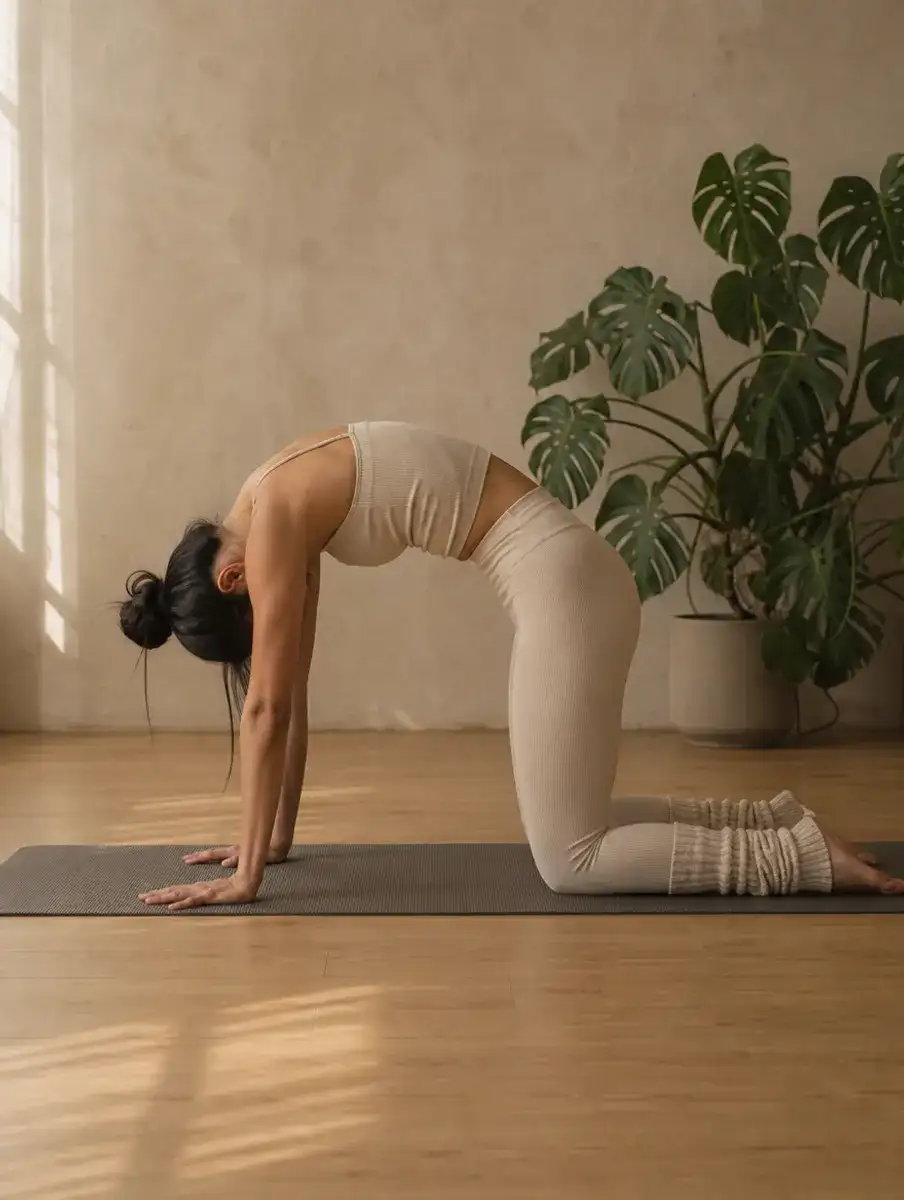
Cat-Cow (Marjaryasana Bitilasana) is a pair of shapes on hands and knees that arch and round the spine with the breath. Inhale into Cow, belly softening and chest lifting, then exhale into Cat, rounding toward the ceiling, for five to ten rounds. Keep the range small if the lower back is sensitive, and pad sore knees.
Pronunciation and meaning
Marjaryasana Bitilasana: mar-jar-YAHS-uh-nuh bit-ee-LAHS-uh-nuh. Two names said together, each stressed on the long a just before sana.
Marjari means cat, bitila means cow and asana means posture. The two shapes are practised as a pair: the cat arches its back up, and the cow lets its belly drop while its head lifts.
How to do Cat-Cow
- Come onto hands and knees with the wrists under the shoulders, the knees under the hips and the tops of the feet on the mat.
- Spread the fingers and press the floor away so the shoulders do not sag. Begin with a neutral, flat back.
- Inhale into Cow: tip the tailbone up, let the belly soften toward the floor, and lift the chest and gaze forward without throwing the head back.
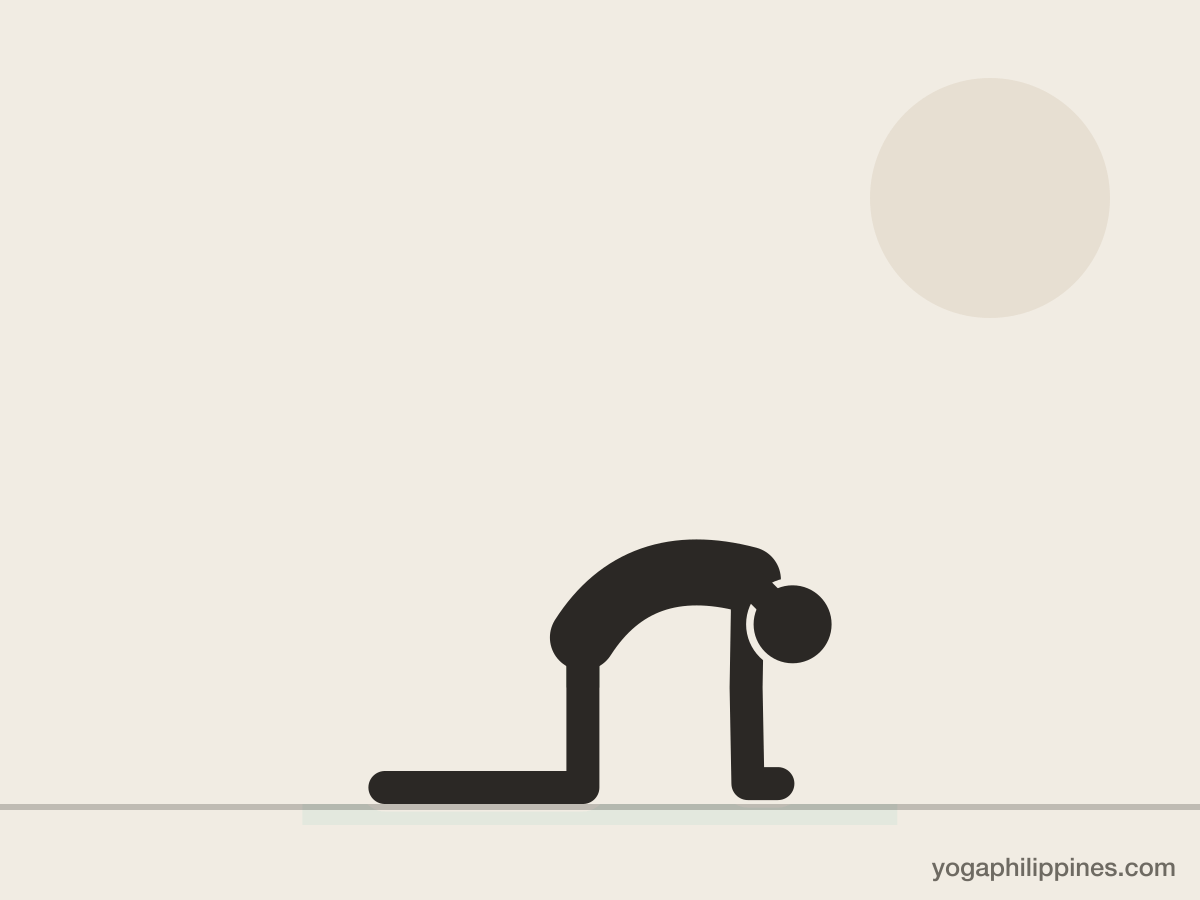
- Exhale into Cat: tuck the tailbone, press the hands into the floor and round the spine toward the ceiling, letting the head drop.
- Move between the two with your breath, one shape per inhale and one per exhale, for five to ten rounds.
- Finish in a neutral spine, then sit back into Child's Pose or come to standing.
Cat-Cow step by step
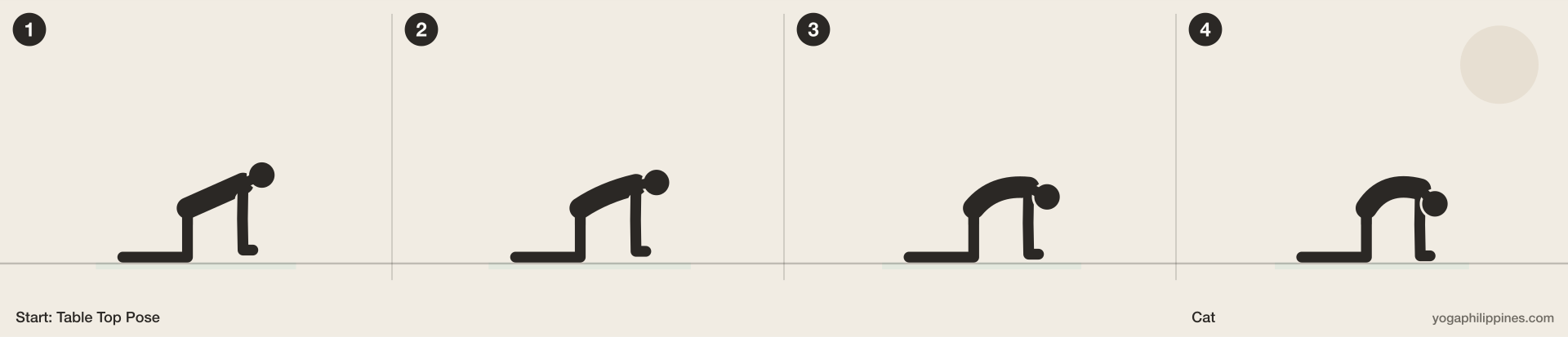
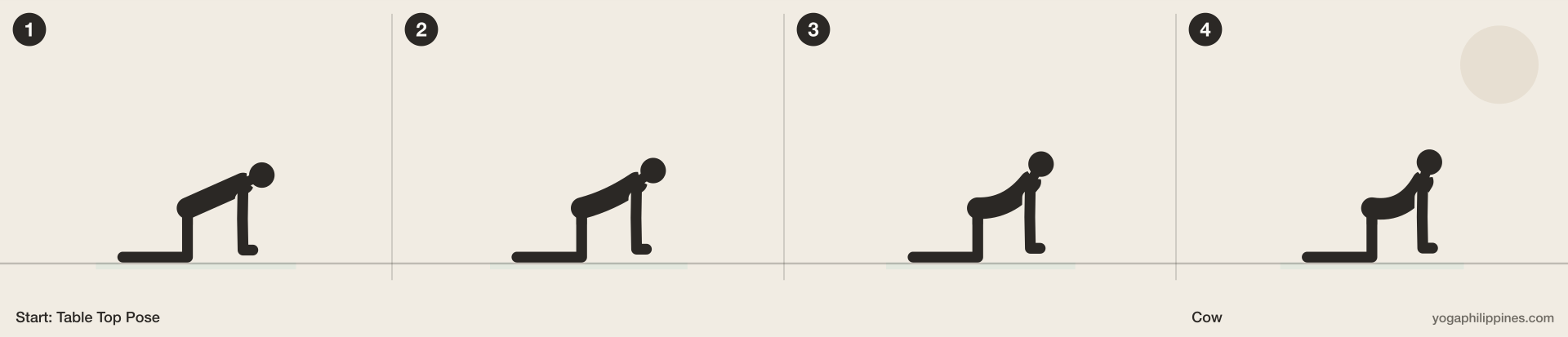
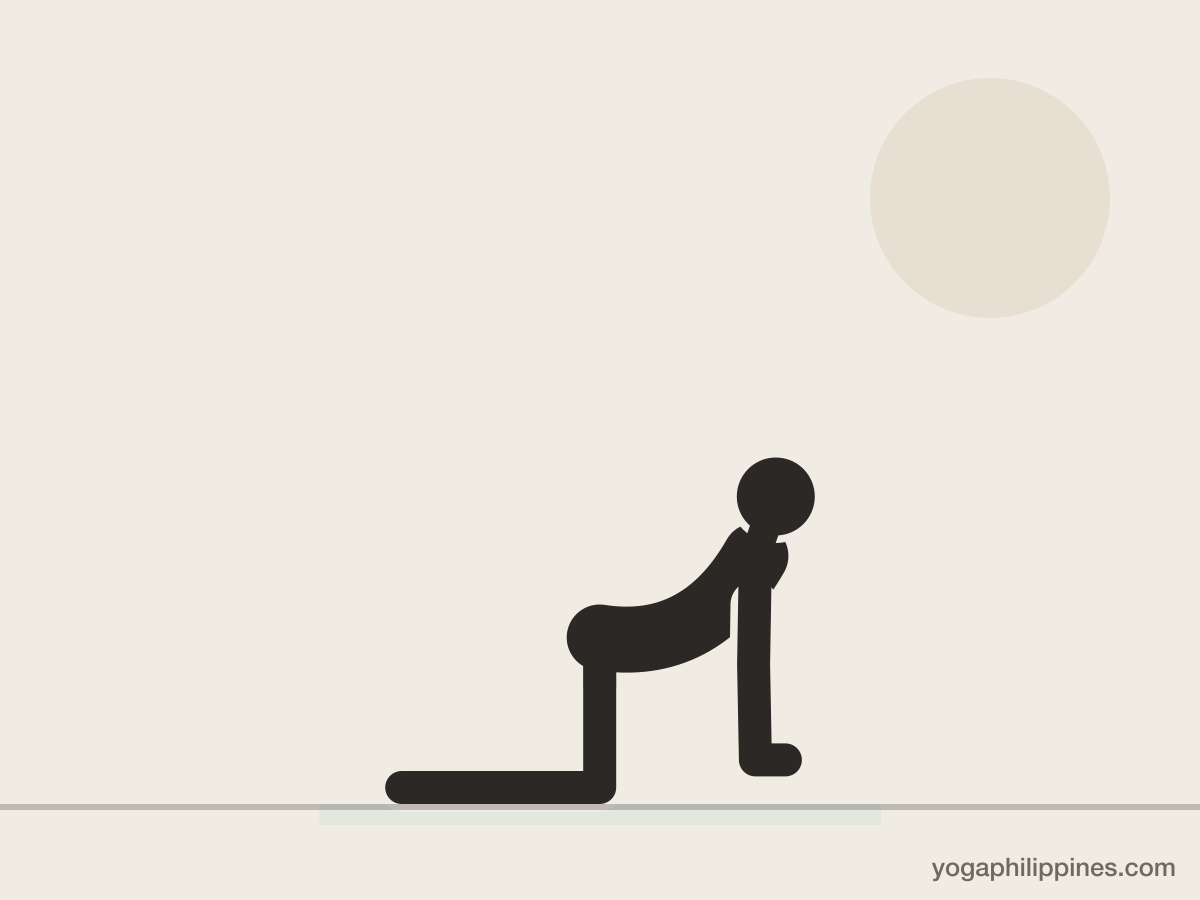
Drawings and video by YogaPhilippines.com, free to reuse under CC BY 4.0 with credit and a link: see the image licence for how to credit.
Cat-Cow appears in the beginner yoga sequence card and the 10-minute morning yoga sequence, both printable with holds and cues. For other poses that work the lower back, open the pose finder set to the lower back.
Teacher's note from Joahnna Lee
“Start the movement from your tailbone and let it ripple up the spine, one vertebra after another, so the head moves last.”
“Let the breath set the pace. If the movement finishes before the breath does, slow the movement down.”
“In Cow, think of lengthening the front of the body rather than dropping the belly. The lower back should feel spacious, not squeezed.”
Make it easier
- Fold the mat or add a blanket under the knees if kneeling is sore.
- Make fists or use blocks under the hands if bending the wrists is uncomfortable.
- Do it seated on a chair: hands on the knees, rounding and arching the spine with the breath.
- Keep the range small if the lower back is sensitive.
Pregnancy and after birth
Pregnancy. Adapt. Cat-Cow is commonly offered during pregnancy. Keep the Cow part gentle, letting the belly move only slightly toward the floor, and give more time to the rounding. Widen the knees for room. Check with your OB or midwife before you start.
After birth. Adapt. Once your doctor or midwife has cleared you to exercise, begin with a small range and slow breathing. After a caesarean birth, or if the belly still feels weak, keep the Cow shape shallow and stop if anything pulls across the abdomen.
For more on practising through pregnancy, see Joahnna Lee Yoga.
Common mistakes
- Moving only the neck, nodding the head up and down while the spine stays still.
- Collapsing between the shoulder blades in Cat instead of pressing the floor away.
- Rushing, so the breath and the movement fall out of step.
- Crunching the lower back in Cow by pushing the belly down too far.
Cat-Cow is two poses done as one movement, and it often opens a practice because it wakes the spine up without asking much of anyone. It is also a simple way to learn to move with the breath.
It is a natural place to begin yoga for complete beginners, because it asks for no flexibility at all, only attention to the breath. It also makes a good warm-up before the floor routine for lower back stiffness.
From hands and knees, walking the hands forward with the hips high turns it into Puppy Pose, a shoulder stretch on all fours.
Cat-Cow begins and ends in Table Top Pose, the flat-backed hands and knees position.
Can you practise Cat Pose and Cow Pose on their own?
Yes. Cat Pose (Marjaryasana) and Cow Pose (Bitilasana) are taught as a pair, but each is a pose in its own right, and some classes hold one for a few breaths before moving on.
Cat Pose on its own is the rounded shape: hands and knees, the tailbone tucking, the spine lifting toward the ceiling and the head hanging. Held for three to five breaths, many people feel it as a stretch across the upper back and between the shoulder blades. Keep pressing the floor away so the chest does not sink.
Cow Pose on its own is the gentle arch: the tailbone lifts, the belly softens and the chest moves forward and up, with the gaze slightly ahead rather than thrown back. Held still, it asks you to keep the lower back long and the shoulders away from the ears, which is harder than it sounds.
Practised separately, the two shapes are also useful checks. If Cat feels easy and Cow pinches, keep Cow small. If either is uncomfortable for the wrists or knees, the same modifications apply to both.
What variations of Cat-Cow can you try?
| Variation | How it differs | Good for |
|---|---|---|
| Standing Cat-Cow | Hands on the thighs, knees bent, rounding and arching | Office breaks and anyone who cannot kneel |
| Seated Cat-Cow | On a chair, hands on the knees | Long meetings and travel |
| Table top circles | Move the hips in slow circles over the knees instead of straight up and down | Finding stiff spots between the two shapes |
| Side-to-side wag | Look towards the right hip as it swings towards the head, then the left | A side bend for the waist |
| Knee to nose | In Cat, draw one knee towards the forehead; in Cow, reach the leg back | More core work, and a bridge to Plank |
Which muscles move in Cat-Cow?
Rounding into Cat asks the abdominal muscles to draw in while the long muscles along the back lengthen. Arching into Cow reverses that: the back muscles shorten and the front of the trunk opens. The hands and knees press steadily throughout, so the shoulders and hips work to hold you, too.
A two-minute morning routine
On a weekday when there is no time for a full practice, try this on the mat or a rug before getting ready for work:
- Table top, three slow breaths to settle.
- Cat-Cow, eight rounds with the breath.
- Table top circles, four each direction.
- Thread the needle, three breaths each side.
- Child’s Pose, five breaths.
The two-minute version of Child’s Pose is a good way to end it.
How long until Cat-Cow makes a difference?
The spine usually feels warmer and easier to move within a minute or two of rounds, which is why classes start with it. A more lasting change, such as getting out of bed feeling less stiff, tends to come from moving the spine most days over several weeks, often with Cat-Cow as one part of a wider routine.
Props that help in Cat-Cow
- Blanket: pads the knees on a hard floor.
- Block: brings the floor closer under the hands.
- Chair: brings the floor closer, or gives a seat or a hand rest for a gentler version.
Programs and sessions that use Cat-Cow
- The 30-day challenge 4 of its 30 sessions
- The 4-week beginner program 4 of its 12 sessions
- The 14-day flexibility plan 2 of its 14 sessions
- The 7-day desk reset 2 of its 7 sessions
- Sequences: 10-minute routine, half-hour flow, back-friendly yoga sequence, sequence for beginners and morning routine
- Practice app sessions: 10-minute reset, 20-minute flow, 30-minute practice, morning wake-up, evening wind-down, hip opener and back-friendly
This page feeds the sequence builder and the random flow generator.
Sources: Mayo Clinic, Fitness program: 5 steps to get started; NCCIH (US National Institutes of Health), Yoga: Effectiveness and Safety; NHS, Exercise in pregnancy; CDC, Pregnant & Postpartum Activity: An Overview; Canadian Family Physician (Chan et al., 2014), via PubMed Central, Hot yoga and pregnancy: Fitness and hyperthermia. Last reviewed 2 October 2026.
Cat-Cow questions
Is cat cow good for beginners?
Yes. It needs no particular flexibility, the range is up to you, and it is easy to adjust for wrists and knees. It is often used near the start of a practice to warm the spine up gently.
Do you inhale on cat or cow?
Inhale into Cow, as the chest opens and the belly softens, and exhale into Cat, as the spine rounds. The breath and the shape move together.
How many times should you do Cat-Cow?
Five to ten slow rounds is typical, matching each shape to a full breath. As a warm-up or a break from sitting, a minute or so is enough. Move at the speed of your breath rather than counting fast.
Can you do Cat-Cow sitting in a chair?
Yes. Sit near the front of the chair with your feet flat and hands on your knees. As you breathe in, lift the chest and let the back arch gently; as you breathe out, round the spine and drop the chin. It suits office breaks or anyone who finds kneeling uncomfortable.
Is Cat-Cow good for a stiff back?
Many people find it a gentle way to move a stiff back, because it takes the spine through small arching and rounding movements without load. Keep the range comfortable and go slowly. If the stiffness comes with pain that spreads, lasts or keeps returning, see a doctor or physio.
Who should not do Cat-Cow?
Most people can do some version, but adapt it if you need to. With sore wrists, make fists or use blocks. With sore knees, pad them or do it seated on a chair. With a sensitive lower back, keep the range small. After a recent back, neck, wrist or knee injury or surgery, check with your doctor or physio first.
Updated