Pose library · Phalakasana · reviewed by a teacher
Plank exercise: Plank Pose (Phalakasana)
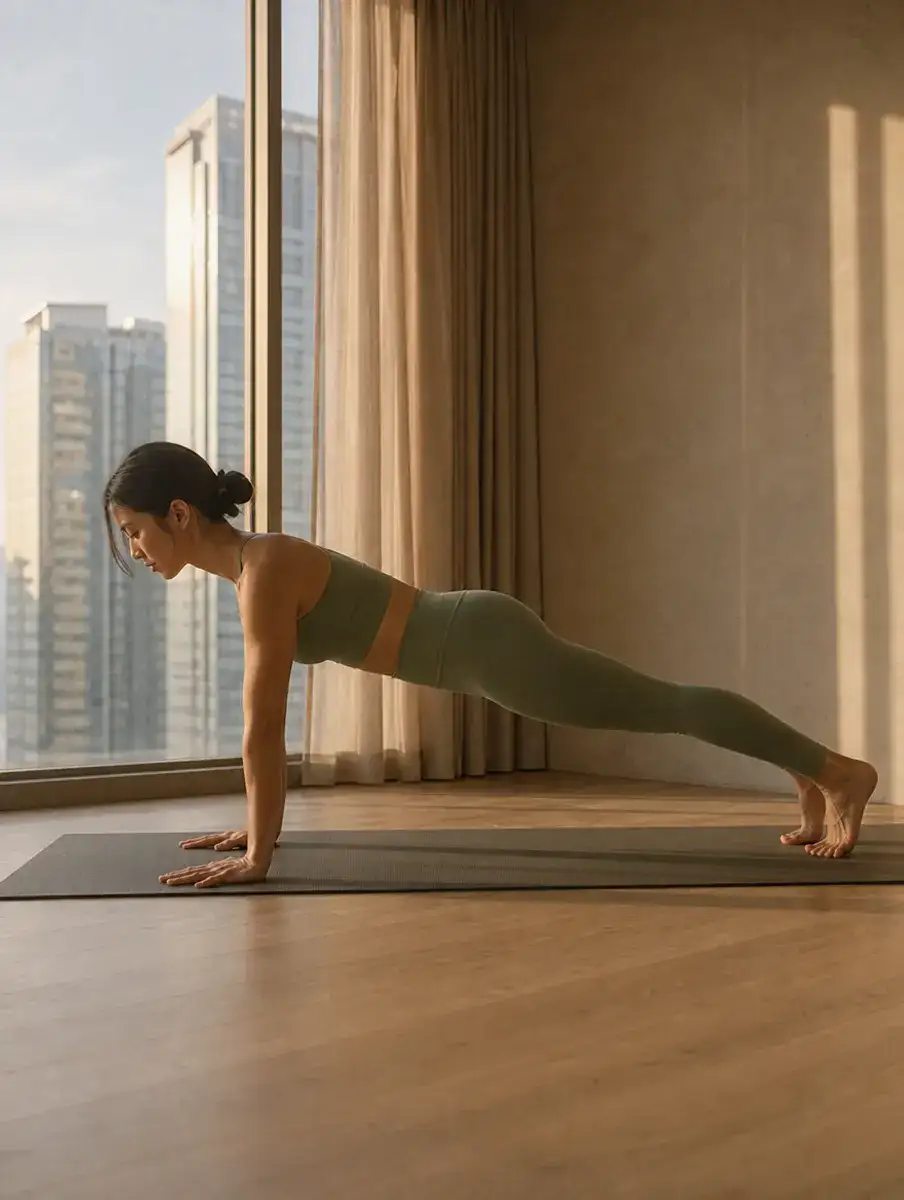
The plank exercise holds the body in one long, firm line from the crown of the head to the heels, supported on the hands or forearms and the toes, like a board resting on two supports. In yoga it is Phalakasana, from phalaka, plank or board, and asana, posture.
Plank Pose (Phalakasana) holds the body in one firm line from the crown to the heels, working the arms, shoulders and middle of the body. Stack the wrists under the shoulders, step back onto the balls of the feet and lift the thighs and lower belly for three to five breaths. Lower the knees if the hips sag.
Pronunciation and meaning
Phalakasana: pah-luh-KAHS-uh-nuh. Four syllables before the asana, with the stress on the third.
The plank exercise holds the body in one long, firm line from the crown of the head to the heels, supported on the hands or forearms and the toes, like a board resting on two supports. In yoga it is Phalakasana, from phalaka, plank or board, and asana, posture.
How to do Plank Pose
- Come to hands and knees with your wrists under your shoulders and your fingers spread wide, the middle fingers pointing forward.
- Press the whole palm down, especially the base of the index finger, and gently draw the shoulder blades away from your ears.
- Step one foot back and then the other, resting on the balls of the feet with the legs straight and about hip-width apart.
- Lift the front of the thighs, press back through the heels and draw the lower belly lightly in, so the hips sit level with the shoulders.
- Keep the back of the neck long and look at the floor slightly ahead of your hands. Hold for three to five steady breaths.
- Lower the knees to the mat to come out, then sit back into Child's Pose and shake out the wrists.
Plank Pose step by step

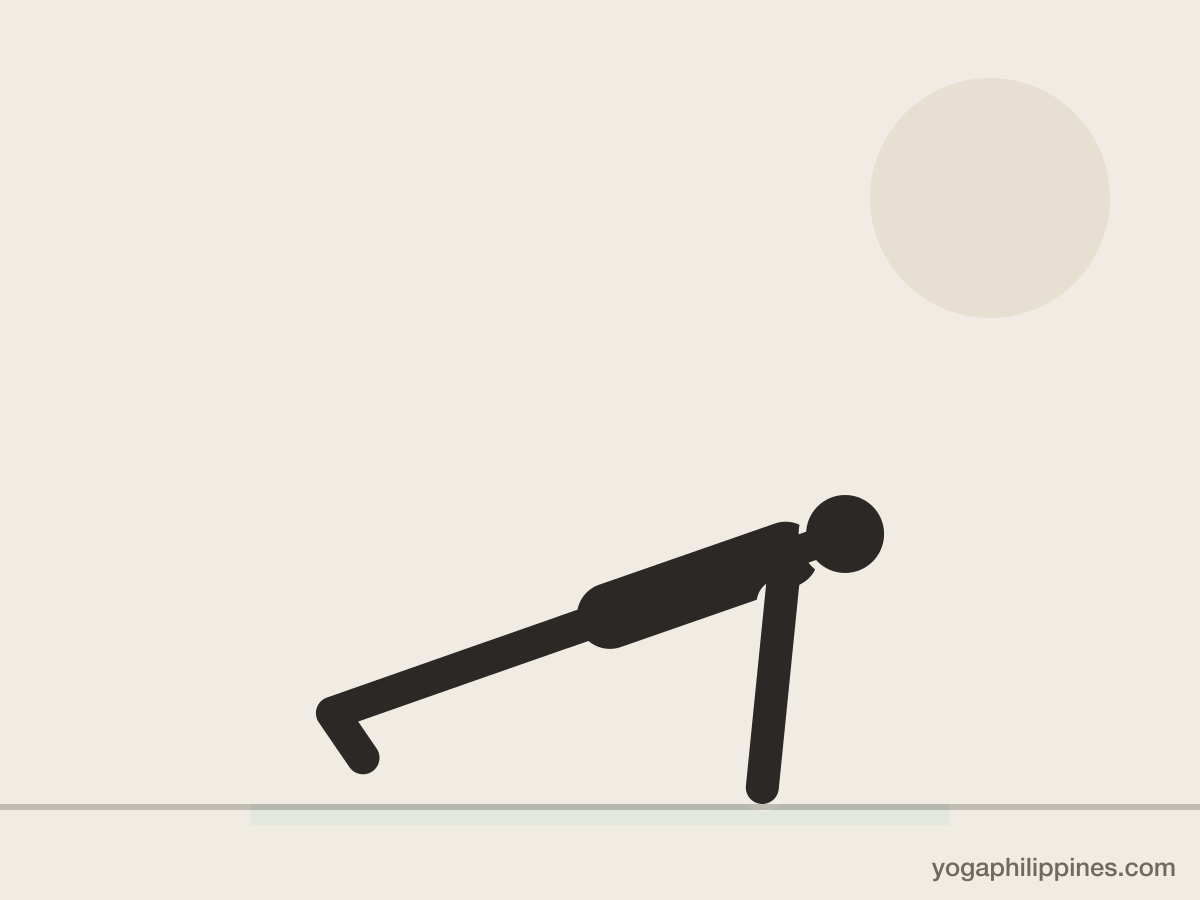
Drawings and video by YogaPhilippines.com, free to reuse under CC BY 4.0 with credit and a link: see the image licence for how to credit.
Plank Pose appears in the core strength sequence card, which is printable with holds and cues. For other poses that work the core, open the pose finder set to the core.
Teacher's note from Joahnna Lee
“Push the floor away with your hands. When the upper back broadens between the shoulder blades, the chest stops sinking toward the mat.”
“I want your heels reaching back while the crown reaches forward, as though someone were gently pulling you longer from both ends.”
“Breathe into the back of the ribs. If the breath turns short and gasping, drop the knees and keep the same shape from there.”
Make it easier
- Lower both knees to the mat and keep a straight line from the knees to the head. The shape is the same, with less weight to carry.
- If your wrists complain, come down onto the forearms with the elbows under the shoulders, or roll the front edge of the mat under the heels of your hands.
Pregnancy and after birth
Pregnancy. Adapt. Keep the knees down or put your hands on a wall or a chair, and stop if you see the centre of the belly dome or cone as you hold. Hold for fewer breaths than you used to, and check with your OB or midwife that this kind of core work suits your pregnancy.
After birth. Adapt. Wait until your doctor or midwife clears you for core work, then start with an incline plank against a wall or a counter. Watch the midline of the belly and choose an easier angle if it bulges or pushes out.
For more on practising through pregnancy, see Joahnna Lee Yoga.
Common mistakes
- Letting the hips sag toward the floor so the lower back takes the weight. Lift the thighs and the lower belly to bring the line back.
- Piking the hips up high. That turns the pose into a half Downward Dog and switches off the work in the middle of the body.
- Placing the hands too far forward. Stack wrists under shoulders, or the shoulders end up doing all the work.
- Lifting the head to look forward. The neck takes strain and the chest drops. Keep the gaze on the floor just ahead of the hands.
The plank exercise is one of the most familiar strength holds in any gym or home workout, and in yoga it is Plank Pose. Plank is the doorway between standing and lying down in most Vinyasa sequences, and it shows up in every Sun Salutation. It is a strength posture more than a flexible one, and the work is spread across the arms, the shoulders, the belly and the legs at once.
In a Vinyasa practice it is worth starting with the knees down, so the line is right before the shape gets longer. To practise it inside a flow, the timed Sun Salutation tool paces each round.
How is a yoga plank different from a gym plank exercise?
The shape is the same. The difference is mostly in the timing and the focus. A gym plank is often timed in seconds or minutes, usually on the forearms. A yoga plank is usually held on straight arms for a few breaths, then flows on into the next pose. Counting breaths rather than seconds gives you a built-in check: if the breath turns short, the hold is over.
Once Plank feels steady, turning onto one hand for Side Plank asks the same muscles to hold you on your edge, and turning face up gives you Reverse Plank, Purvottanasana, which works the back of the body instead.
Lowering halfway from here, elbows hugging the ribs, is Chaturanga, the low plank of a flowing class.
Which plank should you start with?
Start with the knees down if the full line sags within a few breaths, keeping one straight line from the knees to the head. Move to the high plank on the hands and toes once your wrists feel fine and the line stays straight. If you are new to strength work or returning after a break, hands on a wall or a counter is a kinder start, and the forearms take the load off sore wrists. Once a steady plank feels easy, move up through these ten plank variations.
A four-week plank plan
Practise three or four days a week, with a rest day between. Each session is three rounds with a few breaths of rest in Child’s Pose between them.
- Week 1: three rounds of three breaths, knees down, with a straight line from knees to head.
- Week 2: three rounds of five breaths, knees down for the first two rounds and the full plank for the last.
- Week 3: three rounds of five breaths in the full plank, on the hands or the forearms.
- Week 4: three rounds of eight breaths in the full plank, then one round of Side Plank with the bottom knee down on each side.
If the last round no longer looks like the first, stay at that week until it does.
How long until plank feels easier?
Many people notice a short, steady plank feels more comfortable after two or three weeks of regular practice, and that the shoulders and wrists settle into it over a month or two. The clearest sign of progress is not a longer time on the clock but a calmer breath at the same number of breaths.
Planking on a hot day
In a humid room the hands sweat quickly and can slide forward, which pulls the wrists out from under the shoulders. Wipe the palms between rounds, keep a small towel at the front of the mat, or move to the forearms, where grip matters less.
If weight on the hands bothers your wrists, try the forearm version above or practise the wrist-free yoga flow, which leaves Plank out entirely.
Plank Pose or Four-Limbed Staff Pose?
Plank is the top of the push-up; Chaturanga is the halfway point on the way down. Holding Plank steadily comes first.
| Compare | Plank Pose | Four-Limbed Staff Pose |
|---|---|---|
| Position | Hands and knees or hands and feet | Hands and knees or hands and feet |
| What it works | core, arms and shoulders | arms, shoulders and core |
| Level | Beginner plus | Intermediate |
| Key difference | Arms stay straight, wrists under the shoulders, hips level with the shoulders. | Elbows bend straight back beside the ribs and stop at shoulder height, the body lowering as one line. |
Prep poses for Plank Pose
Poses that warm up the same body areas at a lower intensity, so Plank Pose feels steadier when you get there.
- Table Top Pose (Bharmanasana) a direct preparation, beginner
- Cat-Cow (Marjaryasana Bitilasana) gentler work for the same area, beginner
Counter-poses for Plank Pose
Shapes that move the body the other way or let it rest straight after Plank Pose.
- Balasana (Child's Pose) beginner
Where to go next after Plank Pose
These poses list Plank Pose as a preparation, so they are a natural next step once it feels comfortable.
- Upward-Facing Dog (Urdhva Mukha Svanasana) intermediate
- Four-Limbed Staff Pose (Chaturanga Dandasana) intermediate
- Side Plank (Vasisthasana) intermediate
- Crow Pose (Bakasana) advanced
Easier and harder variations of Plank Pose
Related poses from the same family that start from the same position and do a similar kind of work; Plank Pose itself is beginner plus.
- Harder: Firefly Pose (Tittibhasana) advanced plus
Props that help in Plank Pose
- Blanket: pads the knees on a hard floor.
Programs and sessions that use Plank Pose
- The one-month challenge 1 of its 30 sessions
- The 4-week beginner program 1 of its 12 sessions
- Sequences: 45-minute slow practice and core-strength session
Put it into practice with the Sun Salutation round timer, the pose of the day, the random flow generator and the form check, built on pages like this one.
Sources: Mayo Clinic, Fitness program: 5 steps to get started; NCCIH (US National Institutes of Health), Yoga: Effectiveness and Safety; NHS, Exercise in pregnancy; CDC, Pregnant & Postpartum Activity: An Overview; Canadian Family Physician (Chan et al., 2014), via PubMed Central, Hot yoga and pregnancy: Fitness and hyperthermia. Last reviewed 2 October 2026.
Plank Pose questions
What muscles does the plank exercise work?
Mostly the muscles around the trunk, at the front, the sides and the back, along with the shoulders, the arms and the fronts of the thighs. That is why it feels like whole-body work rather than an arm exercise.
Is a forearm plank easier than a high plank?
Not always. A forearm plank takes the wrists out of it, which many people prefer, but the body sits closer to the floor and the middle often has to work harder. Try both and choose the one you can hold in a straight line.
How long should I hold Plank Pose?
Three to five slow breaths is a good start. Holding the line well for a short time teaches you more than holding it badly for a long time, so come down as soon as the hips begin to drop.
Is Plank Pose hard on the wrists?
It can be, because the wrists bend back and carry weight. Spread the fingers, press through the knuckles rather than the heel of the hand, and use forearms or a wall if they still ache.
Is it better to do several short planks or one long one?
For most people, several short holds with good form beat one long hold that sags. Try three rounds of 10 to 30 seconds with a rest between, keeping one straight line from head to heels, and add time only when the last round still looks like the first.
Why does the lower back sag in plank?
Usually because the stomach, thighs and buttocks have tired and stopped holding the line, so the hips drop. Firm the legs, draw the lower ribs in, and shorten the hold. If it still sags, lower the knees to the floor and keep the line from head to knees until the full version feels steady.
Can you do the plank exercise every day?
Most people can do short plank holds daily, since the effort is moderate and quick to recover from. Keep the holds brief, rest a day if your wrists, shoulders or lower back start to ache, and mix in forearm and knees-down versions to spread the load.
Updated