Pose library · Surya Namaskar · reviewed by a teacher
Sun Salutation (Surya Namaskar)
Surya means sun and namaskar means greeting or bow. It is not one posture but a short sequence of postures linked to the breath, often repeated several times to warm the body.
Sun Salutation (Surya Namaskar) is a short sequence of postures linked to the breath, often repeated to warm the body. One round moves from standing to a forward fold, half lift, Plank, a controlled lowering, Cobra and Downward Dog, then back up. Keep the knees down in Plank to make it gentler, and never rush the breath.
Pronunciation and meaning
Surya Namaskar: SOOR-yah nuh-muh-SKAR. Surya has two syllables, and namaskar rhymes loosely with car.
Surya means sun and namaskar means greeting or bow. It is not one posture but a short sequence of postures linked to the breath, often repeated several times to warm the body.
How to do Sun Salutation
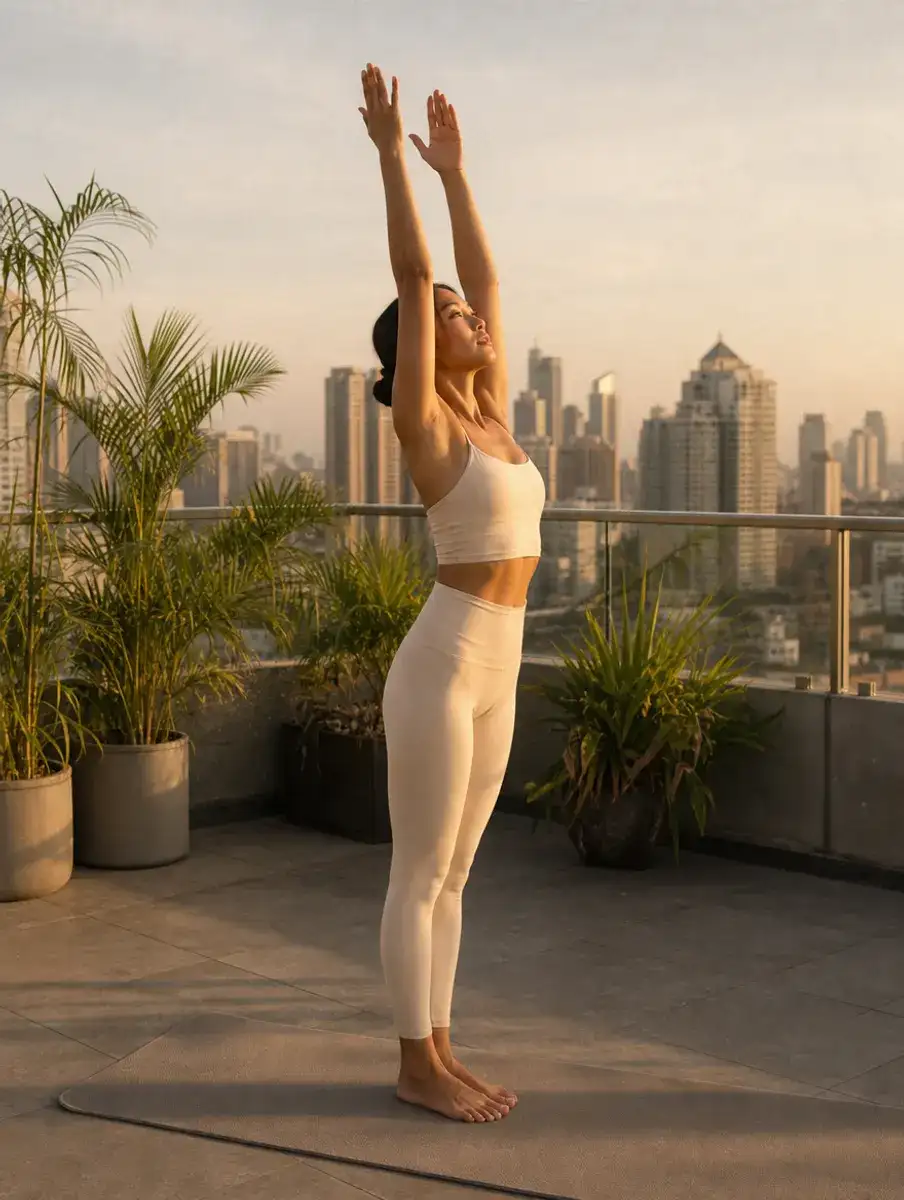
- Stand in Mountain Pose with your feet together or hip-width apart. Breathe in and sweep your arms up overhead.
- Breathe out and fold forward from the hips, bending your knees as much as you need to bring the hands to the floor or to blocks. Breathe in and lift halfway, hands on the shins, with a long flat back.
- Breathe out and step back to Plank, then lower with control: either straight down with elbows hugging in, or knees, chest and chin to the floor.
- Breathe in and lift the chest into Cobra, with the elbows bent and the legs resting on the mat.
- Breathe out, lift the hips and press back into Downward Dog. Stay for three to five breaths.
- Step your feet to your hands, breathe in to a half lift, breathe out to fold, then breathe in and rise all the way up with the arms overhead. Breathe out and bring the hands to the chest. That is one round.
Sun Salutation appears in the Ashtanga primary series card, which is printable with holds and cues. For other poses that work the hamstrings, open the pose finder set to the hamstrings.
Teacher's note from Joahnna Lee
“Let the breath set the pace. One movement per breath, and if you need an extra breath somewhere, take it.”
“Step back one foot at a time until your wrists and shoulders feel ready. Jumping back is optional, not a sign of progress.”
“In the half lift I want you to lengthen from tailbone to crown, even if that means the hands come off the floor and onto the shins.”
Make it easier
- Keep the knees down in Plank and lower knees, chest and chin, a gentle version that builds strength over time.
- Put blocks under your hands in the forward fold if the floor feels far away.
- Swap Cobra for a small Cat-Cow on hands and knees if lying on your belly or bending back does not suit you.
Pregnancy and after birth
Pregnancy. Adapt. Take a wider stance, step instead of jumping, keep the knees down, and skip lying on your belly in Cobra; use Cat-Cow on hands and knees instead. Slow the pace so you never feel breathless, and check with your OB or midwife before you start.
After birth. Adapt. When your doctor or midwife has cleared you, start with one or two slow rounds with the knees down and no jumping. Watch for doming along the middle of the belly in Plank, and ease off if you see it.
See prenatal yoga notes by trimester before you adapt a pose.
Common mistakes
- Rushing so the breath and the movement fall out of step. Slow down until they match.
- Dropping from Plank to the floor with the elbows flaring wide and the lower back sagging.
- Straining the lower back in Cobra by pushing up with straight arms. Keep the elbows bent and lift with the upper back.
Sun Salutations are often the first thing you move through in a Vinyasa class, because they warm the whole body in a few minutes. Learn the order slowly, one breath per movement, and the sequence soon runs by itself.
Many Vinyasa classes begin with them, so learning the order well pays off every time you practise. To pace your rounds at home, try the timer with a step card for each pose. On slow mornings, start with the wake-up stretches you can do in bed and add a round or two of this once you are warm.
The fold after the arms sweep up is the standing forward bend, knees as bent as you like, and it is worth learning on its own first. Most of the shapes in a round appear on the yoga poses chart with English and Sanskrit names, and a slower hatha class holds the same hatha yoga poses for several breaths instead of flowing through them.
The lowering between Plank and Upward-Facing Dog is Chaturanga, which is worth learning slowly. Lifting the back knee in the lunge of a Sun Salutation B variation gives you Crescent Lunge, the high lunge. Five rounds each of A and B open the Ashtanga primary series.
Sun Salutation A, B and the twelve-step version
| Version | What it adds | Where you meet it |
|---|---|---|
| Sun Salutation A | The round described on this page: fold, step back, lower, Cobra or Upward Dog, Downward Dog | Most Vinyasa and Ashtanga classes |
| Sun Salutation B | Chair Pose at the start and end, and Warrior I on each side | Stronger flow classes and the Ashtanga opening |
| Twelve-step Surya Namaskar | A low lunge on each side, knees-chest-chin instead of Plank, each step often paired with a mantra | Sivananda, hatha and many classes in India |
All three link one movement to one breath. If a teacher calls out a version you do not know, follow the breath and copy the shapes, and you will usually catch up within a round. To keep A and B beside your mat, print the Sun Salutation A and B cards: every position as a numbered figure with its breath.
Where does the Sun Salutation come from?
Bowing to the sun is an old devotional practice in India, but the sequence as most classes teach it took shape in the early twentieth century. Bhawanrao Pant Pratinidhi, ruler of the small state of Aundh, promoted a daily routine of sun salutations as exercise in the 1920s and 1930s, and T. Krishnamacharya built similar sequences into the teaching that later spread through his students.
A ten-minute morning practice before work
In the Philippines the morning is the coolest part of the day, and ten minutes before the commute is easier to keep than an evening plan that traffic can wipe out.
- Stand in Mountain Pose for five breaths.
- Two slow rounds of Sun Salutation A, knees down in Plank.
- Two rounds of A at your normal pace.
- One round of B, or a third round of A.
- Downward Dog for five breaths.
- Sit or lie down for one minute and let the breath settle.
If the room is already warm, open a window or switch on a fan and keep a towel nearby for your hands. The Surya Namaskar timer can pace the rounds for you.
Prep poses for Sun Salutation
Poses that warm up the same body areas at a lower intensity, so Sun Salutation feels steadier when you get there.
- Mountain Pose (Tadasana) a direct preparation, beginner
- Standing Forward Bend (Uttanasana) a direct preparation, beginner
- Downward-Facing Dog (Adho Mukha Svanasana) a direct preparation, beginner plus
- Wide Legged Forward Bend (Prasarita Padottanasana) gentler work for the same area, beginner plus
Counter-poses for Sun Salutation
Shapes that move the body the other way or let it rest straight after Sun Salutation.
- Balasana (Child's Pose) beginner
- Knees to Chest beginner
Props that help in Sun Salutation
- Block: brings the floor closer under the lower hand, so the legs and spine can stay long.
Programs and sessions that use Sun Salutation
- The 30-day yoga challenge 4 of its 30 sessions
- The 4-week beginner program 2 of its 12 sessions
- Sequences: 30-minute home flow, 45-minute slow yoga and Ashtanga first series
- Practice app sessions: 20-minute flow, 30-minute practice, morning wake-up and balance
This page is one of the sources behind the sequence builder, the Surya Namaskar timer and the calorie estimator.
Sources: Mayo Clinic, Fitness program: 5 steps to get started; NCCIH (US National Institutes of Health), Yoga: Effectiveness and Safety; NHS, Exercise in pregnancy; CDC, Pregnant & Postpartum Activity: An Overview; Canadian Family Physician (Chan et al., 2014), via PubMed Central, Hot yoga and pregnancy: Fitness and hyperthermia. Last reviewed 2 October 2026.
Sun Salutation questions
How many Sun Salutations should I do?
Three to five slow rounds make a good warm-up. Some people build to more, but it is better to do fewer rounds well, with steady breath, than many in a rush.
Are there different versions of Surya Namaskar?
Yes. The version here is the one most often taught in Vinyasa classes. Another common version has twelve positions and includes a low lunge on each side. Both link the breath to movement in the same way.
What is the best time of day for Sun Salutations?
Any time you can practise on a fairly empty stomach. Many people like them in the morning, when the air is cooler and a few rounds wake the body up. In the evening, slow the pace and finish with a few quiet minutes lying down.
What are the 12 steps of Surya Namaskar?
A common twelve-step version runs: prayer position, raised arms, standing forward bend, a low lunge stepping the right leg back, Downward Dog, knees-chest-chin, Cobra, Downward Dog, a low lunge stepping the right foot forward, forward bend, raised arms, then standing with the hands at the chest. Schools differ slightly, and some add Plank.
What happens if you do Sun Salutations every day?
A few daily rounds become a quick routine that warms the whole body, working the legs, arms, shoulders and trunk and moving the spine forward and back. The order soon runs by itself, so the breath can set the pace. Keep some days gentle, with the knees down, and rest if the wrists, shoulders or back feel tired.
How long do Sun Salutations take?
At one movement per breath, with three to five breaths in Downward Dog, one slow round takes about a minute or two. Three to five rounds make a warm-up of five to ten minutes, which is why a ten-minute morning practice fits easily before work. Slow down rather than speed up, so the breath and movement stay in step.
Updated