Pose library · Trikonasana · reviewed by a teacher
Triangle Pose (Trikonasana)
Tri means three, kona means angle and asana means posture. The legs and the floor make one triangle, and the arms and the side of the body make others.
Triangle Pose (Trikonasana) is a straight-legged standing pose that stretches the side of the body and the legs. Turn the front foot out, reach the torso forward over the front leg, then rest the hand on the shin or a block with the top arm up for five breaths. Use a block, and never lock the front knee.
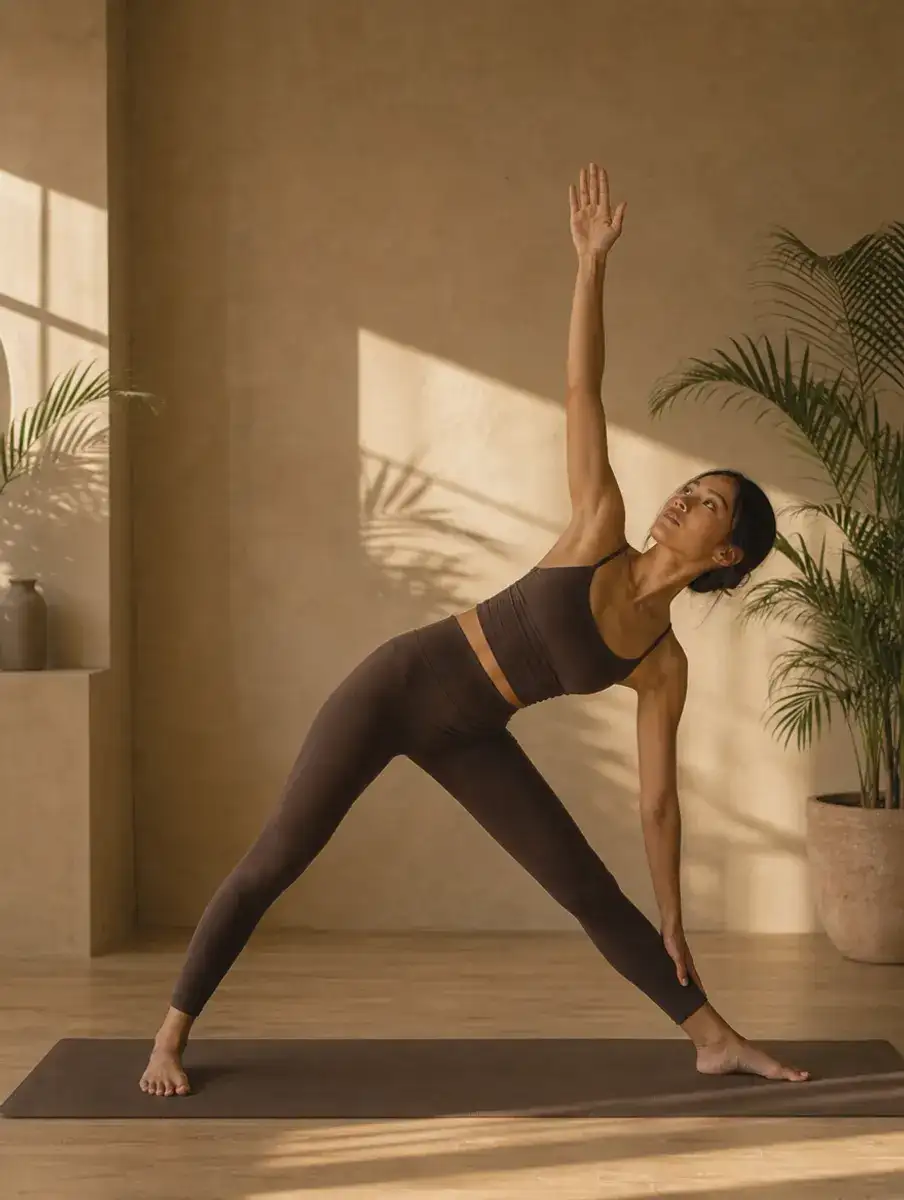
Pronunciation and meaning
Trikonasana: trik-oh-NAHS-uh-nuh. The full name of the standing version is Utthita Trikonasana, extended triangle.
Tri means three, kona means angle and asana means posture. The legs and the floor make one triangle, and the arms and the side of the body make others.
How to do Triangle Pose
- Stand with your feet about one leg's length apart, parallel, and reach your arms out to shoulder height.
- Turn your right foot out ninety degrees and the left foot in slightly, so the right heel lines up roughly with the arch of the left foot.
- Keep both legs straight without locking the knees. Reach your right arm out over the right leg, as if the torso were sliding along a shelf.
- When you cannot reach any further, hinge at the right hip and bring the right hand to the shin, the ankle or a block outside the right foot.
- Stretch the left arm up toward the ceiling so both arms make one line, and turn your gaze up to the left hand, to the side, or down at the floor.
- Stay for five breaths, press firmly into both feet to rise back up to standing, then turn the feet and repeat on the left side.
Triangle Pose step by step
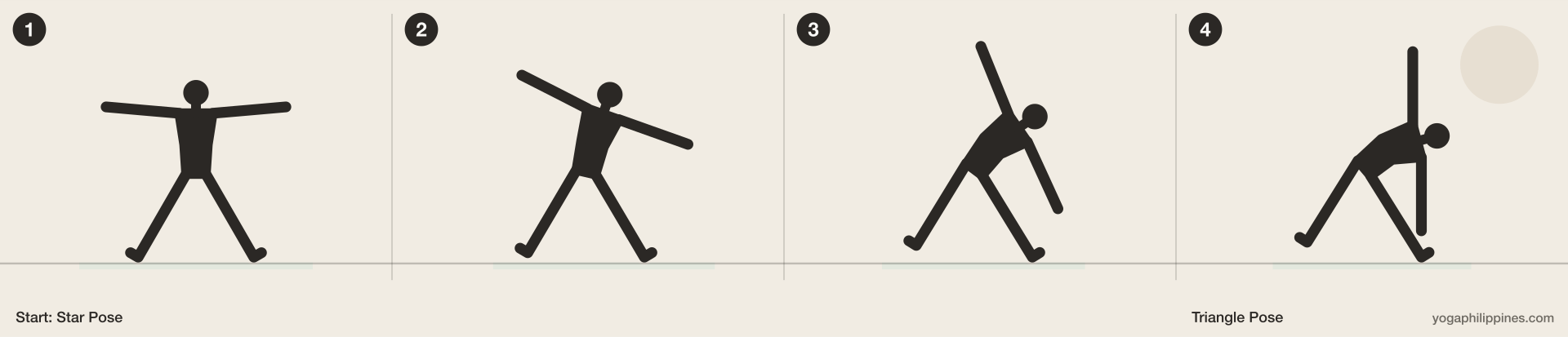
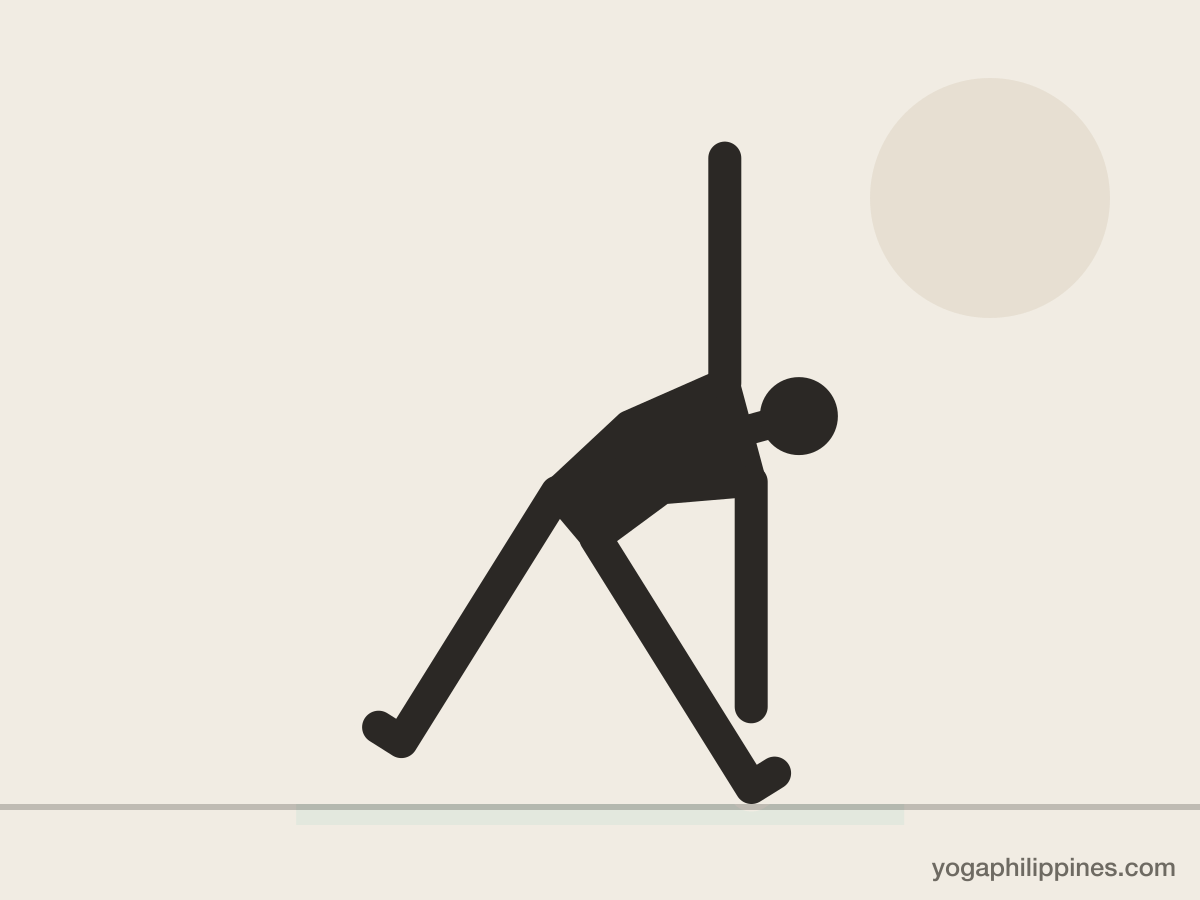
Drawings and video by YogaPhilippines.com, free to reuse under CC BY 4.0 with credit and a link: see the image licence for how to credit.
Triangle Pose appears in the beginner yoga sequence card and the Bikram 26 poses, both printable with holds and cues. For other poses that work the hamstrings, open the pose finder set to the hamstrings.
Teacher's note from Joahnna Lee
“Think long before you think low. I would rather your hand rested high on the shin with both sides of the waist long than touched the floor with the bottom side crushed.”
“Press the outer edge of the back foot down. It anchors the whole shape and stops you tipping forward.”
“Imagine your back is sliding along a wall behind you, so the top shoulder and the top hip stack rather than roll toward the floor.”
Make it easier
- Rest the lower hand on a block, set at whatever height lets the spine stay long.
- Keep the top hand on the hip and look down if the neck feels strained or your balance is shaky.
- Practise with the outer edge of the back foot pressed against a wall to steady the back leg.
Pregnancy and after birth
Pregnancy. Adapt. Take a slightly shorter stance, use a block or a chair under the lower hand, and practise with your back to a wall for balance. Avoid overstretching the inner thighs, since ligaments are looser in pregnancy, and check with your OB or midwife first.
After birth. Adapt. Once your doctor or midwife has cleared you for exercise, begin with a short stance and a high block. Your joints and your balance may take a while to feel steady again, so go by what feels stable, not by how far you can reach.
Wondering about yoga safety in pregnancy? Joahnna Lee covers it trimester by trimester.
Common mistakes
- Reaching for the floor at the cost of the spine, so the bottom side of the waist folds and the chest faces the floor.
- Locking the front knee hard backward. Keep a micro-bend, or lift the kneecap with the thigh muscles, so the joint is not pushed past straight.
- Letting the back foot turn out or the back heel lift, which takes the stability away from the whole pose.
Triangle is a standing posture that asks for length more than depth. It stretches along the back of the front leg and the side of the body, and it teaches you to keep a clear line while you tilt, which is useful in almost every other standing shape.
In a Vinyasa flow a block under the lower hand is common, so the side body stays long instead of collapsing toward the floor. The guide to yoga blocks and straps helps if you need one. The wide stance runs along the length of the mat, so taller students may find a long mat easier; yoga mat size and thickness explains the options.
Bend the front knee, place a block ahead of the foot and lift the back leg, and Triangle becomes Half Moon Pose, a standing balance.
Turning the hips to face forward and folding over the front leg gives you Pyramid Pose, Parsvottanasana. From the same wide stance, turn both feet forward and fold into the wide legged forward bend.
What variations of Triangle Pose are there?
| Variation | How it changes | Who it suits |
|---|---|---|
| Hand on a chair seat | Lower hand rests high on a chair | Tight hamstrings, or balance that wobbles |
| Back heel to the wall | The outer edge of the back foot presses into a wall | Learning to ground the back leg |
| Back against the wall | Shoulders and hips brush a wall behind you | Feeling whether the chest turns down |
| Top arm overhead | The top arm reaches past the ear | More stretch along the side of the body |
| Revolved Triangle | Hips square, opposite hand to the outside of the front foot | Experienced students; a strong twist and balance |
Which poses prepare you for Triangle?
A short warm-up helps the hamstrings and the side body:
- Mountain Pose, five breaths, feeling both feet.
- Standing side bend, three breaths each side.
- Warrior II, five breaths each side, to set the wide stance and the turned-out front leg.
- Wide-legged forward bend, five breaths, hands on blocks.
- Triangle with the hand on a block, five breaths each side.
Who should take care in Triangle?
If you have a neck problem, keep the gaze down or straight ahead rather than up at the top hand. If you have low blood pressure or feel light-headed, come up slowly and keep the top hand on the hip. Anyone with a recent hamstring strain should shorten the stance and use a high block, so the back of the front leg is not pulled hard.
Practising in a small room
The stance runs along the length of the mat, so in a narrow condo room, lay the mat beside a wall and use it: press the back heel into the skirting or let the back of the body brush the wall. It gives you the same feedback a teacher might.
How long until the lower hand reaches lower?
It depends mostly on the hamstrings and the hips. With practice two or three times a week, many people find they can lower the block by one height within a couple of months. A long spine with the hand on a high block is a complete pose at any stage. To check the shape at home, the on-device yoga form check tells you from your phone camera whether the front leg is long and the top arm reaches straight up.
Triangle Pose or Half Moon Pose?
Half Moon grows out of Triangle by lifting the back leg. Triangle keeps both feet down, so it is the steadier place to learn the long side waist first.
| Compare | Triangle Pose | Half Moon Pose |
|---|---|---|
| Position | Standing | Standing |
| What it works | hamstrings, hips and spine | hamstrings, hips and glutes |
| Level | Beginner plus | Intermediate |
| Key difference | Both feet stay down and the legs stay straight and firm while the torso reaches over the front leg. | The back leg lifts level with the hip and the hips stack, so you balance on one foot and one hand. |
Prep poses for Triangle Pose
Poses that warm up the same body areas at a lower intensity, so Triangle Pose feels steadier when you get there.
- Wide Legged Forward Bend (Prasarita Padottanasana) gentler work for the same area, beginner plus
- Standing Forward Bend (Uttanasana) gentler work for the same area, beginner
Where to go next after Triangle Pose
These poses list Triangle Pose as a preparation, so they are a natural next step once it feels comfortable.
- Half Moon Pose (Ardha Chandrasana) intermediate
Props that help in Triangle Pose
- Block: brings the floor closer under the lower hand, so the legs and spine can stay long.
- Wall: gives a steady point to lean on or press into for balance and alignment.
Programs and sessions that use Triangle Pose
- The 30-day challenge 4 of its 30 sessions
- The 14-day flexibility plan 1 of its 14 sessions
- The 4-week beginner program 1 of its 12 sessions
- Sequences: half-hour flow, Ashtanga primary series, sequence for beginners, Bikram 26 poses, Moon salutation and wrist-free yoga flow
- Practice app sessions: 20-minute flow, 30-minute practice and morning wake-up
- Generated example flows: 30-minute back-friendly session, no weight on the wrists
Put it into practice with the tool for building your own sequence, the pose of the day, the quiz on pose names, the random yoga flow and the camera form check, built on pages like this one.
Sources: Mayo Clinic, Fitness program: 5 steps to get started; NCCIH (US National Institutes of Health), Yoga: Effectiveness and Safety; NHS, Exercise in pregnancy; CDC, Pregnant & Postpartum Activity: An Overview; Canadian Family Physician (Chan et al., 2014), via PubMed Central, Hot yoga and pregnancy: Fitness and hyperthermia. Last reviewed 2 October 2026.
Triangle Pose questions
Should my hand touch the floor in Triangle Pose?
Only if it can without the spine bending sideways or the chest turning down. For most people the shin or a block gives a better shape.
What is the difference between Triangle and Extended Side Angle?
In Triangle both legs stay straight. In Extended Side Angle the front knee bends over the ankle and the forearm or hand rests near the front foot, so it asks more of the front thigh.
Should your front knee be straight in Triangle Pose?
Straight, but not locked. Lift the kneecap by firming the front thigh, and if your knee tends to bend backwards, keep a tiny bend so the joint is not pressing back. A straight, steady leg with a long spine matters more than how low your hand goes.
Which way should your back foot point in Triangle Pose?
Turn the back foot in a little, so the toes angle towards the front of the mat and the outer edge presses down. Many teachers line the front heel up with the back heel or the arch. A slightly shorter or wider stance can help if your hips feel strained.
Where should you look in Triangle Pose?
The classic gaze is up towards the top hand. If that strains your neck, look straight ahead or down at the floor instead, keeping the neck in line with the spine. Turn the head slowly and only as far as stays comfortable.
What is Triangle Pose good for?
Triangle Pose stretches the back of the front leg, the inner thighs and the side of the body, while the legs work to hold the wide stance. It also teaches you to keep a clear line as you tilt, which helps in many other standing poses. A block under the lower hand keeps the side body long.
Pairs well with
Updated