Stretches · reviewed by a teacher
Seven hamstring stretches, from standing to lying down
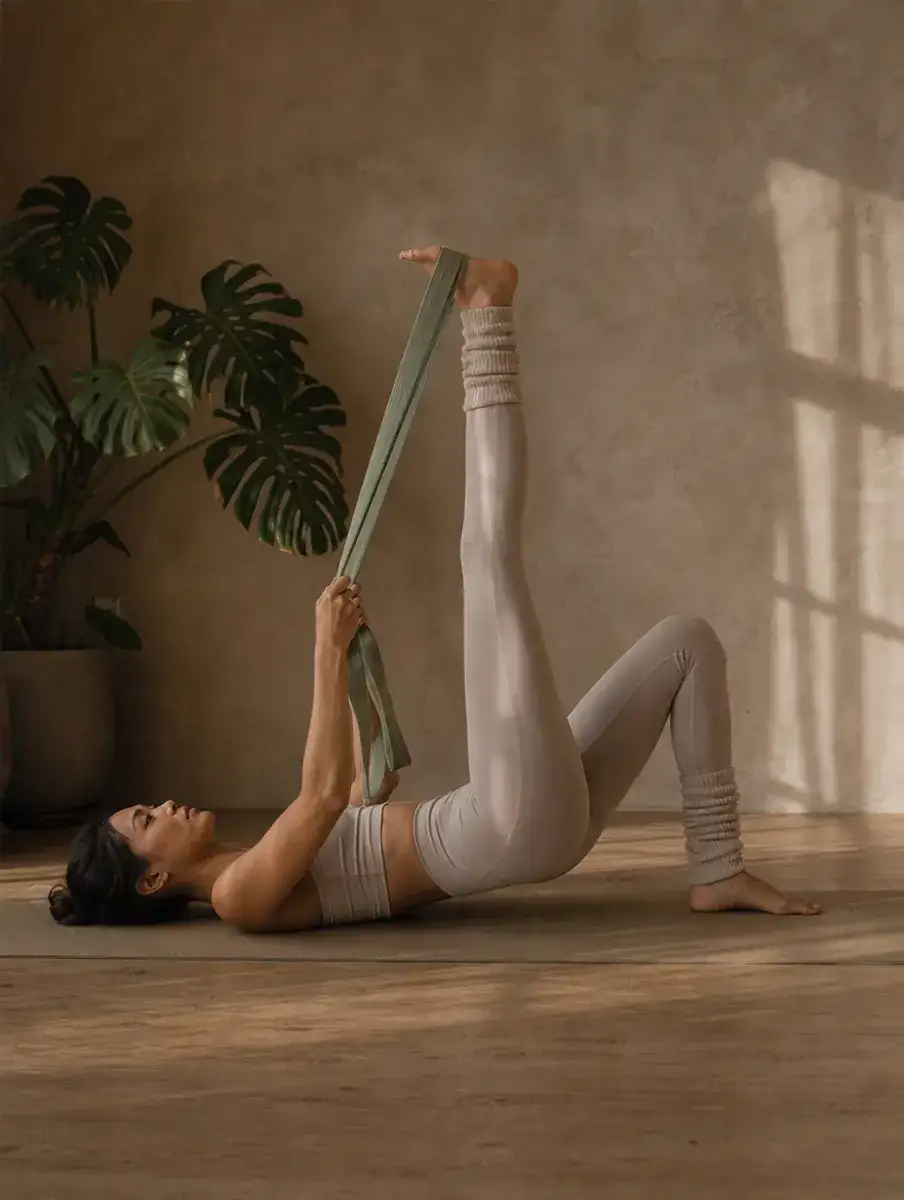
A good hamstring stretch keeps the spine long and the knee soft, folds from the hips rather than the waist, and is held for five to eight slow breaths, about 30 seconds, two or three times. The seven below run from a gentle standing fold to a strapped stretch lying down, with a chair version for the office.
Teacher's note from Joahnna Lee
“Many students tell me they cannot touch their toes, as if that were a test. It is not.”
“These seven stretches are the ones I lean on most when a student's hamstrings are tight.”
The hamstrings run down the back of each thigh, from the sit bones to just below the knee. They bend the knee and help the hip extend, and after a day in a chair they spend hours in a short, folded position. Touching your toes is not a test. What matters is folding comfortably and bending down without a pull in the lower back.
These seven stretches are common choices when the hamstrings are tight. A teacher would usually warm the body first and then choose three or four. In long, quiet holds in a Yin practice, the floor versions can be held for a few minutes, propped and relaxed.
Read the safety section before you start, then pick two or three to try today.
Is it safe to stretch tight hamstrings?
For most people, yes, if you go gently. Stop and see a doctor or a physiotherapist first if:
- you felt a sudden pop or sharp pain at the back of the thigh, with bruising or swelling (a possible tear);
- pain, tingling or numbness travels down the back of the leg, or the leg feels weak;
- stretching makes your lower back pain worse;
- you have had recent surgery on the knee, hip or spine.
A stretch should feel like a broad, dull pull in the muscle. Pain behind the knee, pins and needles, or a sharp feeling anywhere means come out.
How long should you hold a hamstring stretch?
Five to eight slow breaths, which is roughly 30 seconds, then rest and repeat two or three times. That is close to what the American College of Sports Medicine suggests for most adults. On a rest day, the supported floor versions can be held for two or three minutes with the muscles soft. Never bounce at the end of the stretch.
The routine: seven hamstring stretches
- Standing forward fold with bent knees. Stand with feet hip-width apart, bend the knees generously and fold from the hips, letting the arms hang or holding opposite elbows. Rest the belly on the thighs. Straighten the legs only as far as the back stays easy. Five breaths, then roll up slowly.
- Half forward fold at a wall or counter. Place your hands on a kitchen counter and walk back until your body makes an L shape, hips over heels. Lift the sit bones away from the counter and keep the back long. This one teaches the hip fold better than any other.
- Pyramid with blocks. Step one foot back about a leg’s length, both feet pointing forward, hips facing the front. Put your hands on blocks or a stack of books either side of the front foot and fold over the front leg with the knee slightly bent. Five breaths each side.
- Downward Dog, knees bent. From hands and knees, lift the hips up and back. Keep the knees bent and the heels high, then pedal one heel down and then the other. The Downward Dog steps for stiff legs show how to set the hands.
- Seated forward bend on a blanket. Sit on a folded blanket with the legs straight ahead and the knees softly bent. Lengthen up, then tip forward from the hips. A seated forward bend with a rolled blanket under the knees keeps the lower back out of it.
- Lying down with a strap. Lie on your back, both knees bent. Loop a strap, belt or scarf around one foot and straighten that leg towards the ceiling, keeping the knee soft. Let the head and shoulders rest. This is the kindest version for a sensitive back. Eight breaths each side.
- Legs up the wall to finish. Rest with the legs up a wall, the hips a little away from it so the backs of the legs are not pulled. Three to five minutes of quiet. Legs Up the Wall with the hips moved back has the set-up.
The triangle pose with a block under the hand is a good standing alternative if you want one more. If you need a strap or blocks, the guide to yoga blocks and straps covers what to look for.
Can you stretch your hamstrings at a desk?
Yes. Sit on the front edge of a chair, straighten one leg with the heel on the floor and the toes up, keep the other foot flat. Sit tall, then lean forward from the hips with a long back until you feel the back of the straight leg. Five breaths, then switch. It fits between calls.
Should you stretch your hamstrings before or after exercise?
Both can work, but in different ways. Before a run, a game of basketball or a class, moving stretches suit the hamstrings better than long holds: easy leg swings, walking with a gentle hip hinge, or a few slow Downward Dogs pedalling the heels. Save the held stretches in the routine above for after exercise or for a separate quiet session, when the muscles are already warm.
| When | What to do | How long |
|---|---|---|
| Before exercise | Leg swings, walking hinges, Downward Dog pedalling | 3 to 5 minutes, no long holds |
| After exercise | Stretches 3, 5 and 6 from the routine | About 30 seconds each, 2 or 3 rounds |
| A rest day or evening | Stretches 6 and 7, propped and relaxed | 2 to 3 minutes each |
What are the most common hamstring stretch mistakes?
- Reaching for the toes with a rounded back. The pull moves into the lower back and the hamstrings barely change. Fold from the hip crease with a long spine and let the hands land wherever they land.
- Locking the knee hard. A knee pressed straight can send a pull into the back of the knee instead of the belly of the muscle. Keep a micro-bend.
- Pulling the foot with the hands or strap. Let the strap hold the leg; do not yank it closer on each breath.
- Holding the breath. If the breath stops, back off until it flows again.
How long before your hamstrings feel looser?
Many people notice that folding feels easier within a couple of weeks of stretching most days, and that a bigger change in range builds over a couple of months. Consistency matters more than intensity: five easy minutes on most evenings tends to do more than one long, hard session a week. Measure progress by how the fold feels, or how far down the shin your hands rest with a long back.
A desk-to-evening plan for long commutes
If your day in Manila includes two long rides and eight hours in a chair, split the work: the desk stretch above twice during the day, then stretches 6 and 7 at home in the evening, when the body is warm from the heat of the day. A mat with good grip matters for the standing versions on a humid night.
How do hamstrings fit with the rest of the body?
Tight hamstrings rarely travel alone. The hip flexors on the front of the hips often feel short after a long day too, and the low lunge stretches for the front of the hip balance this routine well. If the lower back is the part that complains, the gentle stretches for a stiff lower back start lying down. And if you would like a longer goal, the patient progression towards the splits builds on stretches 3 and 6. Below the knee, the calf stretch at a wall or on a step finishes the back of the leg, and the leg stretch routine for the whole lower body puts all of it in one sequence. For the rest of the spine, the back stretches from neck to tailbone start with Cat-Cow. If you would rather work through a full yoga practice, follow this yoga for tight hamstrings sequence.
How a teacher adapts this
A careful teacher will ask about your back, your knees and any old injuries before starting, then watch how you fold. Some people need the knees bent for weeks; some need the strap far longer than they expect. Keep it slow, set up props so you can relax into each shape, and come out of anything at any moment.
To track progress over a few weeks, try the online sit-and-reach check before you start and again later.
Best time to do it
Of the 7 moves, 3 work as warm-up moves and 4 as slower cool-down holds, so it fits most times of day after a few minutes of walking or easy movement. You can also split it: the gentler moving parts before exercise, the longer holds after.
How long to hold each move
Holds below are for a medium pace; at a slower pace, stay up to the longer time. Moves marked each side are done on both sides.
| Move | Hold | Slower pace |
|---|---|---|
| Standing Forward Bend | 30 s | 45 s |
| Half Forward Fold at a Wall | 30 s | 45 s |
| Pyramid Pose | 30 s each side | 45 s |
| Downward-Facing Dog | 30 s | 45 s |
| Seated Forward Bend | 45 s | 1 min 10 s |
| Reclined Hand to Big Toe Pose | 45 s each side | 1 min 10 s |
| Legs Up the Wall | 5 min | 7 min 30 s |
Pair it with
Other stretching routines that work the same areas, for a longer session or the next day:
- Flexibility routine also works the hamstrings and calves
- Full body stretch routine also works the hamstrings and calves
- Cool down exercise routine for after a workout also works the hamstrings and calves
This page feeds the sit-and-reach scorer, the body map pose finder, the at-home flexibility check and the mobility check in the app.
Browse all stretching routines.
Sources: Mayo Clinic, Fitness program: 5 steps to get started; NCCIH (US National Institutes of Health), Yoga: Effectiveness and Safety; NHS, Exercise in pregnancy; CDC, Pregnant & Postpartum Activity: An Overview; Canadian Family Physician (Chan et al., 2014), via PubMed Central, Hot yoga and pregnancy: Fitness and hyperthermia. Last reviewed 2 October 2026.
Questions
Why do my hamstrings feel tight even though I stretch?
Often because the stretch is done cold, rushed, or pulled from the lower back instead of the hips. Long hours of sitting also leave the backs of the legs in one position all day. Try stretching after a walk or a warm shower, fold from the hips with bent knees, and stretch a little most days instead of hard once a week.
Should I straighten my knee in a hamstring stretch?
Not fully, at first. A soft bend in the knee lets the stretch land in the belly of the muscle instead of pulling behind the knee. As the back of the leg eases over weeks, you can straighten a little more, as long as the sensation stays in the muscle and nothing pulls behind the knee joint.
How often should you stretch your hamstrings?
A few minutes on most days tends to work better than one long session a week. Aim for at least three short sessions a week, ideally after a walk or a workout when the legs are warm. Two or three rounds of five to eight slow breaths on each leg is plenty.
What should a hamstring stretch feel like?
A mild, even pull in the belly of the muscle along the back of the thigh, which eases a little as you breathe. It should not pull sharply behind the knee, and it should never tingle, burn or run down the leg. If you feel any of those, back off; if they keep coming back, see a doctor or physio.
Can tight hamstrings affect the lower back?
They can change how you bend. When the hamstrings are tight, forward bends often pull the pelvis under, so the lower back rounds more to make up the difference. Folding from the hips with soft knees takes much of that load away. Back pain that lasts or travels down the leg needs a doctor or physio, not just more stretching.
What is the best hamstring stretch?
There is no single best one, but two stand out. The half forward fold at a wall or counter teaches folding from the hips better than any other, and the lying stretch with a strap around one foot is the kindest for a sensitive back. Hold either for five to eight slow breaths with the knee soft, twice or more.
Pairs well with
Your yoga calendar
We track every yoga event, workshop and pop-up class so you don't have to.
Updated