Stretches
Flexibility exercises and a weekly plan to build range
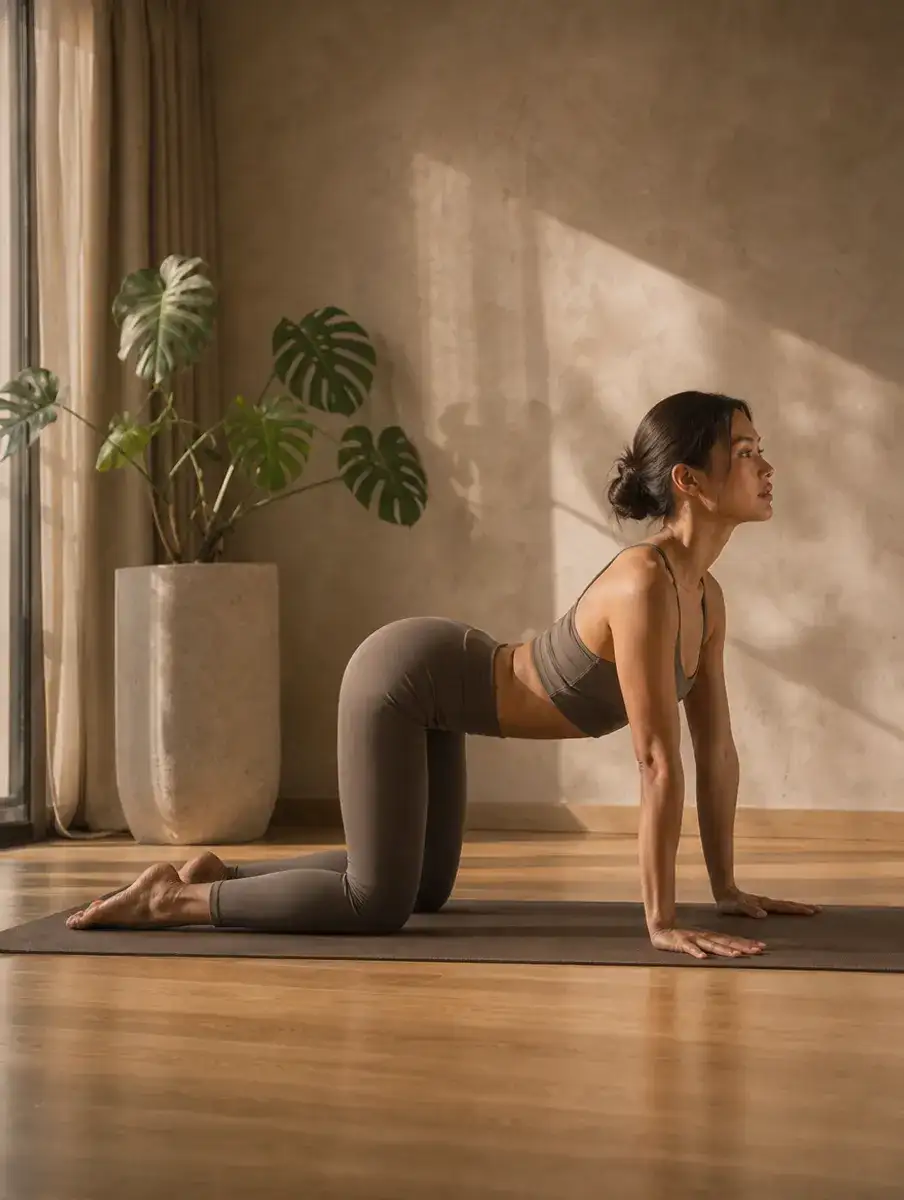
Flexibility exercises are moves that take a joint gently towards the end of its range, either by moving through it or by holding a mild stretch. The routine below warms up with three moving exercises, then holds seven stretches for five to eight breaths each. Done three or four times a week, it takes about 15 minutes.
Flexibility exercises are what most people mean when they say they want to be less stiff: moves that ask a joint, gently, for a little more range. This page is a practical routine you can follow at home on a mat or a strip of floor. It covers the hips, legs, spine and shoulders, and takes about 15 minutes.
For the bigger picture, what flexibility is, why progress is slow and how yoga approaches it, read yoga for flexibility. This page is the workout.
Before you start: who should check with a doctor?
See a doctor or physiotherapist before starting if you have a joint condition, a recent injury or surgery, a condition that makes your joints unusually loose, or pain that is there even when you are not stretching. Stop any exercise that gives you sharp, pinching or electric sensations, or numbness or tingling.
How should the routine feel?
Steady and mild. The warm-up exercises should feel easy and slightly warming. The held stretches should feel like a broad pull in the muscle at about half to two-thirds of your strongest stretch, never pain in a joint. Breathe slowly through the nose and let each out-breath soften you a little.
The routine: ten flexibility exercises
Warm-up (3 minutes)
- Cat-Cow, 1 minute. On hands and knees, breathe in and let the belly drop as you look forward; breathe out and round the back. Eight slow rounds. Cat-Cow for the whole spine has the full cues.
- Leg swings, 1 minute. Holding a wall, swing one leg forward and back ten times, starting small. Switch legs.
- Arm circles, 1 minute. Big, slow circles forward and back, ten each way.
Held stretches (about 12 minutes)
- Standing forward fold, bent knees, 6 breaths. Feet hip-width apart, fold from the hips and let the arms hang. Roll up slowly.
- Low lunge, 6 breaths each side. Back knee on a folded towel, ease the hips forward to feel the front of the back hip.
- Half splits, 6 breaths each side. From the lunge, shift the hips back over the back knee and straighten the front leg a little, toes flexed, knee soft.
- Butterfly, 8 breaths. Sit on a folded blanket, soles together, knees falling out, spine tall. For more options, see the inner thigh stretches from seated to lying down.
- Seated twist, 5 breaths each side. Sit tall with the legs crossed, place the right hand behind you and the left hand on the right knee, and turn gently from the ribs. Switch sides.
- Thread the needle, 5 breaths each side. On hands and knees, slide the right arm under the left and rest the right shoulder and head down. Switch sides.
- Strapped hamstring stretch, 8 breaths each side. Lie on your back, loop a strap around one foot and raise the leg, knee soft, until you feel a mild stretch. Finish lying still for a minute.
A simple weekly plan
- Three or four days a week: the full routine.
- Other days: the three warm-up exercises and a walk.
- Once a week, if you like: a longer, slower practice, holding the floor stretches for two or three minutes with props.
If you would like a daily plan that works one area at a time, the 14-day flexibility plan rotates through the body with a printable checklist. Repeat the same routine for a few weeks rather than changing it daily. It is easier to notice small changes in shapes you know. To track your reach, repeat the sit and reach test every month or two.
Which exercise works which area?
If you only have time for part of the routine, pick by where you feel stiff.
| Stiff area | Exercises from the routine | Go deeper with |
|---|---|---|
| Backs of the legs | 4, 6 and 10 | hamstring stretches |
| Front of the hips | 5 | hip flexor stretches |
| Inner thighs and hips | 7 | inner thigh stretches |
| Spine | 1 and 8 | back stretches |
| Shoulders and upper back | 3 and 9 | shoulder stretches |
How long before you feel more flexible?
Many people feel looser within the first week, mostly because the body gets used to the stretch and relaxes into it sooner. Changes you can see, such as hands landing lower on the shins in a forward fold, usually take several weeks of practising three or four times a week. Progress is rarely a straight line: a busy week, poor sleep or a cold morning can make you feel stiffer for a day or two. Look at the trend over a month, not a single session. To see that trend in numbers, the free mobility assessment with your phone camera measures your hip hinge, squat, shoulders, hip flexors and side bend in degrees, keeps the dates in your browser and builds a 4-week plan for the tightest areas.
A five-minute version for a work morning
On days when the commute starts early, this keeps the habit going.
- Cat-Cow, eight rounds.
- Standing forward fold with bent knees, five breaths.
- Low lunge, five breaths each side.
- Seated twist on a chair, five breaths each side.
- Thread the needle, five breaths each side.
Does the heat make you more flexible?
Warm muscles often feel easier to stretch, and on a humid Manila afternoon you may notice you fold further than you do at dawn. That extra give is real but temporary, so use it to settle into the stretch, not to push past where it feels mild. Drink water before you start and keep a towel nearby so damp hands and feet do not slip in the lunges.
Common mistakes
- Skipping the warm-up. Cold muscles resist. Three minutes is enough.
- Bouncing or pulling. Let the breath, not the hands, take you deeper.
- Rounding the back to reach further. Fold from the hips, with the knees bent if needed.
- Comparing with photos. Bones and joints differ. Some shapes will never look the same on every body.
Make it easier or harder
Easier: sit on a higher blanket, keep the knees bent in every forward fold, and use a towel instead of a strap. Skip half splits and do the hamstring stretch lying down instead.
Harder: hold each stretch a few breaths longer, or add a gentle press-and-relax round to the hamstring stretch, as explained in the guide to contract-relax stretching. For a longer goal, the patient route to the splits builds on exercises 5 and 6. On a day when you just want to loosen up, a 15-minute full body stretch is enough. If you are unsure which kind of stretch suits which moment, the types of stretching explained sets them side by side.
Best time to do it
Of the 10 moves, 7 work as warm-up moves and 5 as slower cool-down holds (some do both), so it fits most times of day after a few minutes of walking or easy movement. You can also split it: the gentler moving parts before exercise, the longer holds after.
How long to hold each move
Holds below are for a medium pace; at a slower pace, stay up to the longer time. Moves marked each side are done on both sides.
| Move | Hold | Slower pace |
|---|---|---|
| Cat-Cow | 45 s of slow rounds | 1 min 10 s |
| Forward Leg Swings | 30 s of slow rounds each side | 45 s |
| Arm Circles | 30 s of slow rounds | 45 s |
| Standing Forward Bend | 30 s | 45 s |
| Low Lunge | 30 s each side | 45 s |
| Half Splits | 30 s each side | 45 s |
| Butterfly Pose | 45 s | 1 min 10 s |
| Seated Twist | 30 s each side | 45 s |
| Thread the Needle | 30 s each side | 45 s |
| Reclined Hand to Big Toe Pose | 45 s each side | 1 min 10 s |
Pair it with
Other stretching routines that work the same areas, for a longer session or the next day:
- Static vs dynamic stretching: what is the difference? also works the hips and spine
- Types of stretching, from static holds to PNF also works the hips and spine
- Warm-up routine also works the hips and spine
This page is one of the sources behind the sit-and-reach scorer and the five-part flexibility check.
Browse all stretching routines.
Sources: Mayo Clinic, Fitness program: 5 steps to get started; NCCIH (US National Institutes of Health), Yoga: Effectiveness and Safety. Last reviewed 2 October 2026.
Questions
How many times a week should you do flexibility exercises?
Three or four sessions a week is a sustainable rhythm for most people, with short, easy movement on the other days. Regular practice tends to matter more than long sessions. If a muscle still feels sore from the last session, give it a lighter day.
Are flexibility exercises the same as stretching?
Mostly. Stretching is the biggest part of flexibility work, but a good routine also includes moving exercises that take joints through their range, and some strength at the end of that range, so the new movement feels controlled.
Can you do flexibility exercises at night?
Yes. Evening suits many people, since the body is warmer than first thing in the morning. Keep the routine slow and calm if it is close to bedtime, and leave out anything that feels energising.
Are some people naturally more flexible than others?
Yes. The shape of your joints, your connective tissue, your age and how you have moved over the years all affect how far you can stretch, so two people doing the same routine can look very different. Compare yourself with how you moved last month, not with the person on the next mat.
Should you do flexibility exercises before or after a workout?
Do the moving exercises, such as leg swings and spine waves, before a workout as part of your warm-up. Save the longer held stretches for afterwards or for a separate session, when the muscles are warm and you have time to breathe slowly in each one.
What is flexibility in exercise?
Flexibility is how far a joint can move through its range, and how comfortably. Flexibility exercises take a joint gently towards the end of that range, either by moving through it, as in leg swings and Cat-Cow, or by holding a mild stretch for several slow breaths. A good routine also builds strength at the end of the range.
Pairs well with
Your yoga calendar
We track every yoga event, workshop and pop-up class so you don't have to.
Updated