Pose library · Supta Padangusthasana
Reclined Hand to Big Toe Pose (Supta Padangusthasana)
Supta means reclining, pada means foot, angustha means big toe and asana means posture. You lie on your back and hold the big toe of the lifted leg, or, far more often, a strap looped around that foot.
Reclined Hand to Big Toe Pose (Supta Padangusthasana) is a hamstring stretch lying on your back. Loop a strap around the ball of one foot, straighten that leg up only as far as the knee allows and keep both hips grounded for five to ten breaths. Bend the bottom knee if the lower back complains, and keep the shoulders down.
Pronunciation and meaning
Supta Padangusthasana: SOOP-tuh pah-dahn-goosh-TAHS-uh-nuh. Supta stresses the first syllable, and the long second word stresses TAHS.
Supta means reclining, pada means foot, angustha means big toe and asana means posture. You lie on your back and hold the big toe of the lifted leg, or, far more often, a strap looped around that foot.
How to do Reclined Hand to Big Toe Pose
- Lie on your back with both legs long, or bend the left knee and set the left foot flat on the mat if your lower back prefers it.
- Bend the right knee toward your chest and loop a strap around the ball of the right foot. Hold one end in each hand.
- Inhale and straighten the right leg up toward the ceiling only as far as the knee allows. A soft bend is fine. Keep the elbows relaxed and the shoulders on the mat.
- Press the back of the left thigh or the left foot into the floor so both hips stay level and grounded. Flex the right foot gently.
- Stay for five to ten slow breaths, easing the leg closer on each exhale without pulling with the arms.
- For the side version, hold the strap in the right hand and lower the leg out to the right onto a block or cushion for five breaths. Bring it back up on an inhale, release and repeat on the left.
Reclined Hand to Big Toe Pose step by step
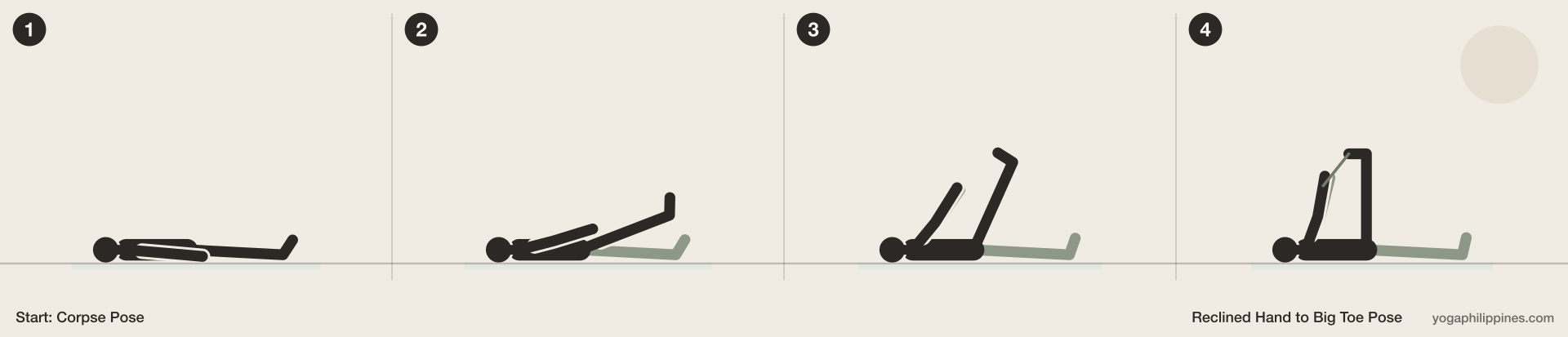
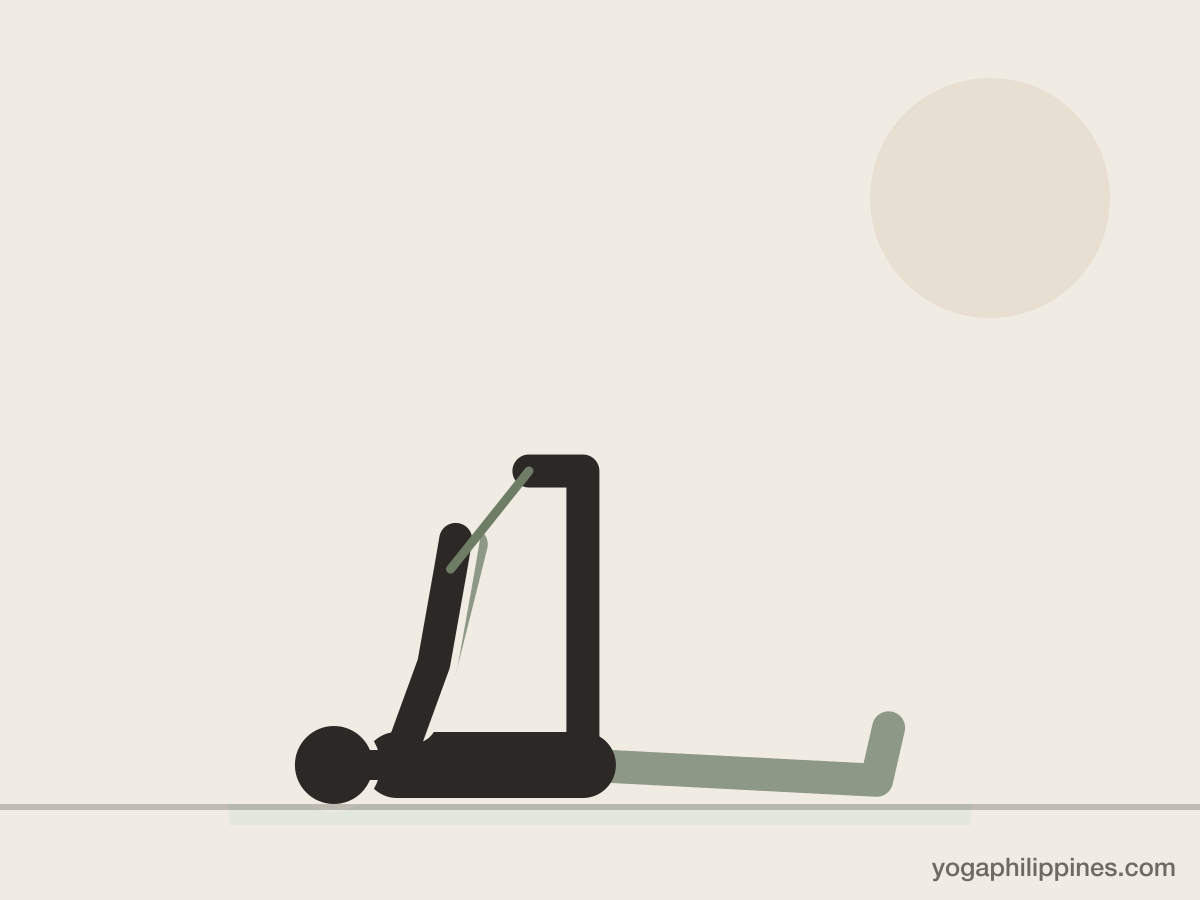
Drawings and video by YogaPhilippines.com, free to reuse under CC BY 4.0 with credit and a link: see the image licence for how to credit.
For other poses that work the hamstrings, open the pose finder set to the hamstrings.
Make it easier
- Keep the bottom knee bent with the foot flat, which takes pressure off the lower back.
- Use a longer strap, a belt or a towel so the arms can stay straight and the shoulders stay down.
Pregnancy and after birth
Pregnancy. Adapt. Later in pregnancy, prop the head and upper back on a bolster rather than lying flat, and keep the side opening small. Check with your OB or midwife.
After birth. Adapt. Once your doctor or midwife has cleared you, start with the bottom knee bent and a long strap. Ease off at any pull at the pubic bone or along a caesarean scar.
Expecting? Joahnna Lee Yoga has notes on adapting each trimester.
Common mistakes
- Letting the hip of the lifted leg hike up toward the ribs, which turns the stretch into a pull on the lower back.
- Gripping the strap so hard that the shoulders and neck lift off the mat.
Reclined Hand to Big Toe Pose is the lying-down hamstring stretch most teachers reach for near the end of a class. The floor supports the back, so the backs of the legs can let go without the effort of standing or the rounding that often creeps into seated folds.
It suits beginners, runners and anyone whose hamstrings feel tight after sitting. It belongs among the yoga poses lying down, from twists to Savasana, and it prepares the legs for Seated Forward Bend, Paschimottanasana, where the same stretch meets gravity.
How is it different from a standing hamstring stretch?
Standing versions ask you to balance and hold the trunk up. Here the back rests and the strap does the holding, and the side opening reaches the inner thigh too.
If the backs of the legs are your main limit, the routine of seven hamstring stretches, from standing to lying down adds a few options for days off the mat, and the leg stretches for the whole lower body cover the calves and quads too.
Stop if you feel nerve-like pain, tingling or numbness down the leg, and see a doctor or physio if it keeps coming back.
Prep poses for Reclined Hand to Big Toe Pose
Poses that warm up the same body areas at a lower intensity, so Reclined Hand to Big Toe Pose feels steadier when you get there.
- Legs Up the Wall (Viparita Karani) gentler work for the same area, beginner
Props that help in Reclined Hand to Big Toe Pose
- Strap: extends the arms when the hands do not reach the feet or each other yet.
- Block: goes under the sacrum, the head or a knee for support.
Programs and sessions that use Reclined Hand to Big Toe Pose
- The 14-day flexibility plan 2 of its 14 sessions
- The one-month challenge 1 of its 30 sessions
- Sequences: back-friendly session
- Practice app sessions: back-friendly
Sources: Mayo Clinic, Fitness program: 5 steps to get started; NCCIH (US National Institutes of Health), Yoga: Effectiveness and Safety. Last reviewed 2 October 2026.
Reclined Hand to Big Toe Pose questions
Do you need a strap for Supta Padangusthasana?
Most people do. Holding the big toe with straight arms needs a lot of hamstring length. A strap, a belt or a towel keeps the shoulders down and the leg in a comfortable range.
Why does the bottom leg lift in reclined hand to big toe pose?
As the lifted leg moves toward you, the pelvis tends to tip, and the other thigh comes off the floor. Press the back of the bottom thigh down, or bend that knee and plant the foot. Keeping the bottom leg steady matters more than how high the top leg goes.
Is reclined hand to big toe pose good for beginners?
Yes. Lying on your back takes the balance out of a hamstring stretch, so beginners can relax into it. Keep a bend in the lifted knee at first.
What are the benefits of Supta Padangusthasana?
Supta Padangusthasana stretches the hamstrings and calf of the lifted leg while the floor supports your back, so the legs can let go without the effort of balancing. The side version also reaches the inner thigh. Many people find it a good finish after running or a day of sitting, and it prepares the legs for seated forward bends.
Pairs well with
Updated