Stretches
Leg stretches for the whole lower body in 12 minutes
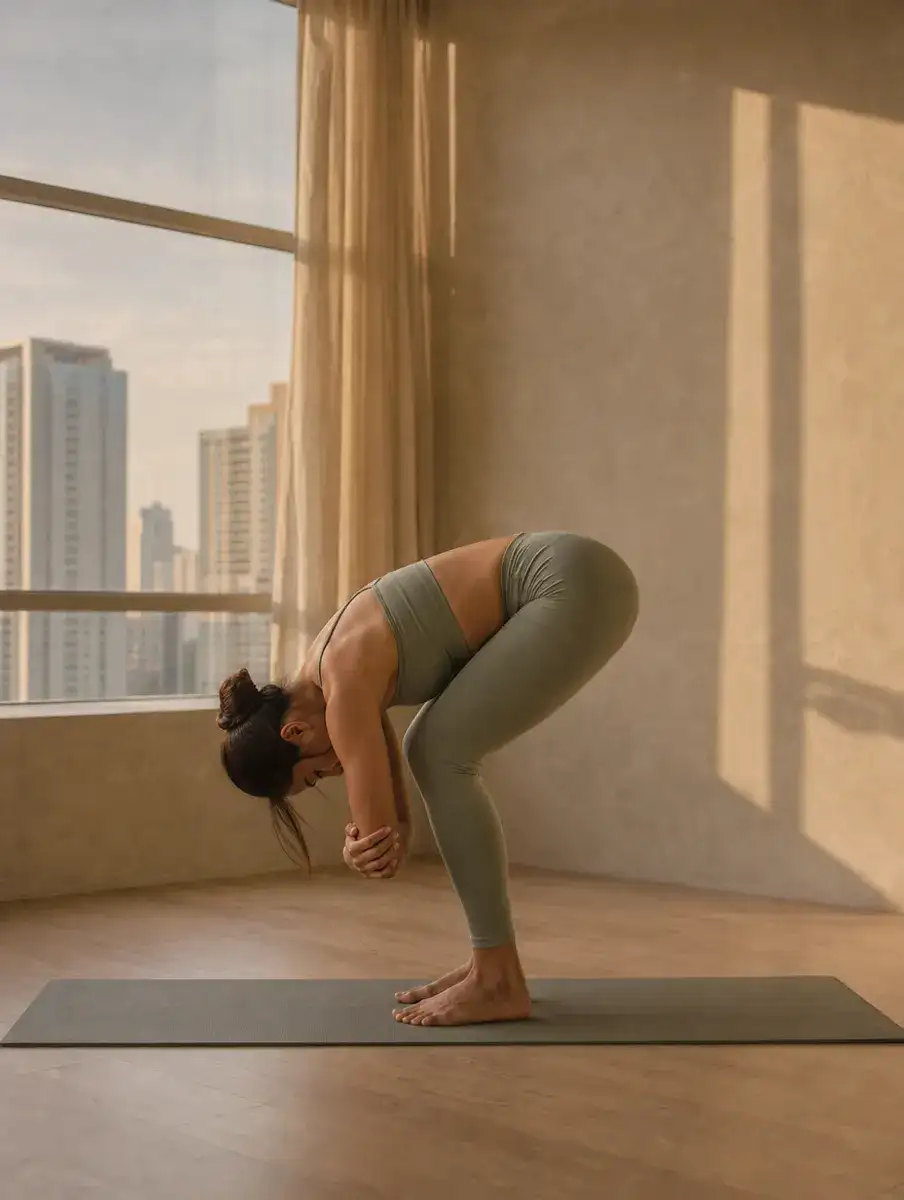
A complete leg stretch routine works each part of the leg in turn: calves at a wall, quads standing, hamstrings in a forward fold, hip flexors in a low lunge, inner thighs in a wide squat or butterfly and the outer hip in a figure four. Hold each for five to eight breaths, about 30 seconds, on both sides.
The legs carry us all day, and each part tightens in its own way. Sitting shortens the hip flexors and the backs of the thighs; stairs, cycling and running tire the quads; heels and long walks load the calves. A leg stretch routine moves each of these once, so nothing is left out.
The nine stretches below take about twelve minutes and run from standing to lying down. Each one has a longer page of its own if you want more. If you run, yoga for runners shows how a shorter version fits after a run.
When should you see a doctor or physio?
Check with a doctor or physiotherapist before stretching if you have:
- a sudden sharp pain, a pop or bruising in a muscle;
- pain, tingling or numbness that travels down the leg;
- swelling, warmth or redness in one calf (get this checked promptly);
- pain inside the knee or hip joint rather than in the muscle;
- recent surgery on the hip, knee or ankle.
How do you do a leg stretch routine?
Walk for a few minutes first. Hold each stretch for five to eight slow breaths, about 30 seconds, on each side, breathing out as you settle.
- Calf stretch at a wall. Hands on the wall, right foot stepped back, heel down, knee straight. Then bend the back knee for a second round. The calf stretch page has five more versions.
- Standing quad stretch. Hold a wall with the left hand, bend the right knee and hold the ankle or a strap, knees side by side, tailbone slightly tucked. See the quad stretch for the front of the thigh for kneeling and lying options.
- Standing forward fold. Feet hip-width apart, knees bent generously, fold from the hips and let the head hang. Roll up slowly, head last.
- Low lunge. Step the right foot forward and lower the left knee onto a cushion. Tuck the tailbone a little and ease the hips forward, as in Anjaneyasana, the yoga low lunge. You feel the front of the back hip.
- Half splits. From the low lunge, shift the hips back over the back knee and straighten the front leg, heel down, hands on blocks. Fold forward with a long back.
- Wide squat. Feet wider than the hips, toes turned out, lower the hips towards a block or cushion with the elbows inside the knees. Five breaths for the inner thighs and hips.
- Butterfly. Sit on a cushion with the soles of the feet together and the knees falling open. Fold forward gently from the hips. Eight breaths.
- Figure four on your back. Lie down with the knees bent, cross the right ankle over the left knee and draw the left thigh towards you. This reaches the outer hip and buttock; the glute stretches lying down and seated go further.
- Lying hamstring stretch with a strap. Loop a strap around the right foot and lift the leg towards the ceiling, knee soft. Eight breaths each side, then rest flat for a minute.
Which muscles does each stretch reach?
| Muscle group | Where it sits | Stretches above |
|---|---|---|
| Calves | Back of the lower leg | 1 |
| Quadriceps | Front of the thigh | 2 |
| Hip flexors | Front of the hip | 4 |
| Hamstrings | Back of the thigh | 3, 5, 9 |
| Adductors | Inner thigh | 6, 7 |
| Glutes and outer hip | Buttock and side of the hip | 8 |
How should you change the routine for different days?
The same stretches work differently depending on when you do them.
- Before a run, a game of basketball or leg day: skip the long holds. Walk for five minutes, then do walking lunges, leg swings forward and back, and slow bodyweight squats, about ten of each.
- After training: pick four stretches that match what you worked, for example calves, quads and hamstrings after a run, and hold each for five to eight breaths.
- On a rest day: do the full nine, holding each for about a minute, and finish lying down.
- Before bed: stretches 7 to 9 only, slow and easy, with the lights low.
How long until your legs feel more flexible?
The first change most people notice is that the stretches feel less awkward, often within a week or two. A measurable change, such as fingertips reaching closer to the floor in the forward fold, usually takes several weeks of stretching most days. Progress is rarely even, and the hamstrings tend to feel tighter on mornings after a long day of sitting. Keep a simple note of how far you reach in the forward fold once a week.
A note for hot, sweaty sessions
In Philippine heat the muscles warm up quickly, which can make it tempting to push further than usual. Stay at the same easy edge you would use on a cool morning, keep a towel on the mat so the hands and feet do not slide in the lunge and half splits, and drink water before you start.
Common mistakes
- Stretching cold. A short walk first makes every stretch easier.
- Locking the knees. In hamstring stretches, a soft knee keeps the stretch in the muscle.
- Bouncing. Hold still at a comfortable point instead.
- Knees falling in. In the wide squat, keep the knees pointing the same way as the toes.
Make it easier or harder
- Easier: hold a chair for the standing stretches; put blocks under the hands in the lunge and half splits; sit higher in butterfly; swap the squat for butterfly lying down if the knees complain.
- Harder: hold for longer on rest days, lower the blocks, straighten the legs a little more, or reach the arms up in the lunge.
Where can you go deeper on each part?
The hamstring stretches from standing to lying down and the hip stretches for every direction the hip moves expand stretches 3 to 8. If a longer goal helps you keep going, the eight-week plan for the splits builds directly on stretches 4 and 5. At the far end of the leg, the seven foot stretches for tired feet work the toes and arches.
Best time to do it
Of the 9 moves, 5 work as warm-up moves and 6 as slower cool-down holds (some do both), so it fits most times of day after a few minutes of walking or easy movement. You can also split it: the gentler moving parts before exercise, the longer holds after.
How long to hold each move
Holds below are for a medium pace; at a slower pace, stay up to the longer time. Moves marked each side are done on both sides.
| Move | Hold | Slower pace |
|---|---|---|
| Wall Calf Stretch | 30 s each side | 45 s |
| Standing Quad Stretch | 30 s each side | 45 s |
| Standing Forward Bend | 30 s | 45 s |
| Low Lunge | 30 s each side | 45 s |
| Half Splits | 30 s each side | 45 s |
| Garland Pose | 30 s | 45 s |
| Butterfly Pose | 45 s | 1 min 10 s |
| Figure Four | 45 s each side | 1 min 10 s |
| Reclined Hand to Big Toe Pose | 45 s each side | 1 min 10 s |
Pair it with
Other stretching routines that work the same areas, for a longer session or the next day:
- Static vs dynamic stretching: what is the difference? also works the hips and calves
- Stretching before running: a six minute warm-up also works the hips and calves
- Inner thigh stretches also works the hips and lower back
Browse every stretch by body area.
Sources: Mayo Clinic, Fitness program: 5 steps to get started; NCCIH (US National Institutes of Health), Yoga: Effectiveness and Safety. Last reviewed 2 October 2026.
Questions
What order should you stretch the legs in?
There is no set rule, but many teachers start standing with the calves and quads, then move to the floor for the hamstrings, hips and inner thighs, so you only get down to the mat once. Ending lying down lets the legs rest.
How often should you do leg stretches?
A few minutes most days tends to suit the body better than one long session a week. A routine like this one, three or four times a week after a walk or in the evening, is a sensible place to start.
Do you need to warm up before leg stretches?
A little. Five minutes of walking, marching on the spot or a few slow lunges warms the muscles so they stretch more comfortably. Stretching straight after hours in a chair, or straight out of bed, tends to feel stiffer.
Should you stretch your legs before or after running?
Before a run, use moving stretches such as leg swings, walking lunges and gentle knee lifts. After the run, when the muscles are warm, hold the calf, quad, hamstring and hip stretches for five to eight breaths each. Long holds before a run can leave the legs feeling a little flat.
Can you do leg stretches in bed?
Several work well lying down: a strap or towel around one foot for the hamstrings, knee hugs, a figure four for the outer hip and a gentle butterfly with the soles together. A firm mattress helps. They are an easy way to stretch before sleep or on a slow morning.
What are the five best leg stretches?
A good five covers each part of the leg: a calf stretch at a wall, a standing quad stretch, a low lunge for the front of the hip, a lying hamstring stretch with a strap, and a figure four on your back for the outer hip. Hold each for five to eight slow breaths, about 30 seconds, on both sides.
Pairs well with
Your yoga calendar
We track every yoga event, workshop and pop-up class so you don't have to.
Updated