Stretches
Gentle knee stretches for stiff, tired knees
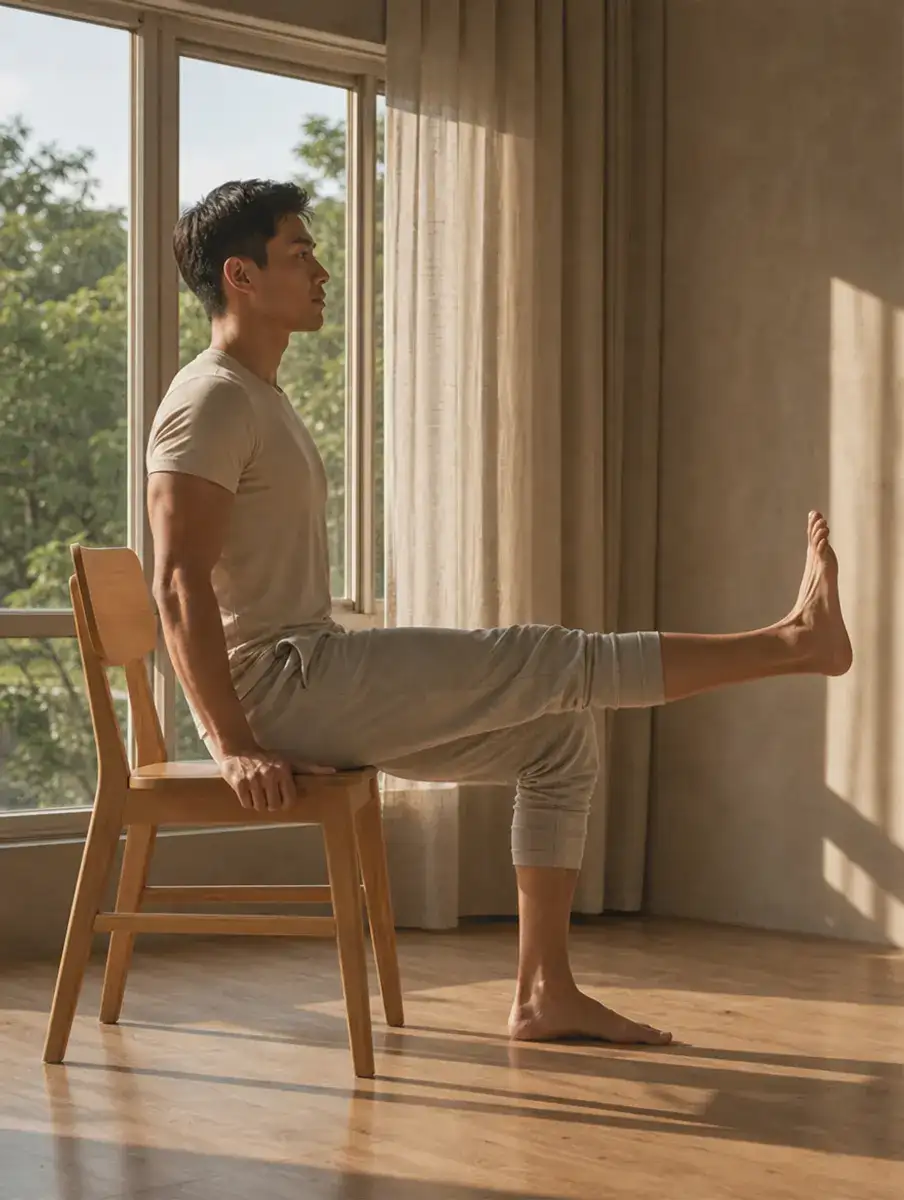
Knee stretches work the muscles around the joint, the quads, hamstrings and calves, rather than the joint itself. Move slowly, keep every stretch mild, hold for five to eight breaths and never push into pain inside the knee. If the knee is swollen, locks, gives way or follows an injury, see a doctor or physio first.
The knee is a hinge that carries you all day: up the stairs of an MRT station, down into a chair, through every step of a run. When it feels stiff, the cause is often the muscles around it rather than the joint. Tight quads on the front of the thigh, hamstrings on the back and calves below all cross the knee, and easing them is what knee stretches are really about.
Everything on this page is gentle and slow. Please read the safety section first. Knees are not the place to push.
When should you see a doctor or physio instead?
Do not stretch the leg, and see a doctor or physiotherapist, if:
- the knee is swollen, hot or red;
- it locks, catches or gives way under you;
- the pain followed a twist, a fall or a blow to the knee;
- you cannot put weight on the leg or straighten it fully;
- pain wakes you at night or has lasted more than a few weeks;
- you have had knee surgery and have not been cleared to stretch.
Nothing here is a treatment for a knee condition. If you have arthritis or a diagnosed knee problem, ask your doctor or physio which of these suit you.
How should knee stretches feel?
Mild. You want a broad stretch in the belly of a muscle, in the thigh or the calf, never a sharp, pinching or deep ache inside the knee. Hold each stretch for five to eight slow breaths, around 30 seconds. Never bounce, and never let the knee twist.
The routine: seven gentle knee stretches
- Heel slides. Lie on your back with both legs long. Slowly slide the right heel towards the hips, bending the knee as far as is comfortable, then slide it back out. Ten slow slides each leg, breathing out as the knee bends. This is movement, not a hold.
- Seated knee straightener. Sit tall on a chair. Straighten the right leg in front, flex the toes towards you and hold for three breaths, then lower. Five times each side. You feel the front of the thigh work and the back of the knee lengthen.
- Lying quad stretch. Lie on your left side, head on your arm. Bend the right knee and hold the ankle or a strap looped around it, drawing the heel gently towards the buttock. Keep the knees in line. Five breaths, then turn over.
- Strapped hamstring stretch. Lie on your back, knees bent. Loop a strap around the right foot and straighten the leg towards the ceiling with the knee soft. The strapped hamstring stretch lying down has more detail. Eight breaths each side.
- Calf stretch at a wall. Hands on a wall, step the right foot back with the heel down and the toes forward. Bend the front knee until you feel the back calf. Five breaths each side.
- Low lunge with padding. Kneel with a folded blanket under the back knee and ease the hips forward to feel the front of the back hip and thigh. If kneeling is uncomfortable, hold a chair and do it standing. The low lunge stretches for the hip flexors show both versions. Five breaths each side.
- Legs up the wall to finish. Rest the legs up a wall, knees soft, for two minutes. Legs Up the Wall, set up with the hips back, lets the legs rest completely.
Which muscles do these knee stretches reach?
| Muscle | Where it is | Stretches above |
|---|---|---|
| Quadriceps | Front of the thigh | 3 (lying quad), 6 (low lunge) |
| Hamstrings | Back of the thigh | 2 (seated straightener), 4 (strapped hamstring) |
| Calves | Back of the lower leg | 5 (wall calf stretch) |
| Hip flexors | Front of the hip | 6 (low lunge) |
| Outer thigh and hip | Side of the thigh | Add the IT band stretches for the outer thigh |
Should you strengthen as well as stretch?
Usually, yes. Stretching keeps the muscles around the knee supple, and gentle strength helps them share the load. Three simple moves pair well with the routine above. Ask a physio first if you have a diagnosed knee problem.
- Straight leg raise, 8 each leg. Lie on your back with the left knee bent. Tighten the front of the right thigh, then lift the straight right leg to the height of the left knee, breathing out. Lower slowly.
- Side-lying leg lift, 8 each leg. Lie on your side with the bottom knee bent. Lift the straight top leg a little, toes facing forward, and lower slowly. This works the side of the hip, which helps keep the knee from rolling in.
- Mini squat at a counter, 8 reps. Hold a kitchen counter, feet hip-width apart, and bend the knees a little as if starting to sit. Keep the knees over the toes and stand up slowly.
How often, and when might the knees feel different?
Two or three sessions a week of the stretches and the strength moves together is a sensible start. Changes tend to come gradually over several weeks of steady practice, and they are usually small: stairs at the MRT station or getting up from a low chair start to feel a little easier. If pain is getting worse rather than better, stop and see a doctor or physio.
Common mistakes
- Pulling the heel hard in a quad stretch. That compresses the knee. Use a strap and keep it gentle.
- Locking the knee straight. Keep a soft bend in standing and hamstring stretches.
- Letting the knee drift inward. In lunges and squats, point the knee the same way as the toes.
- Kneeling on a hard floor. Always pad the knee.
Make it easier or harder
Easier: do everything lying down or seated. Swap the lunge for a standing quad stretch holding a chair. Use a towel instead of a strap if you do not have one.
Harder: hold the floor stretches a little longer, up to a minute, and add a slow, supported squat holding a door frame. Keep the depth well inside comfort. Strong knees also depend on the ankles and hips, so the ankle stretches for stiff feet make a good partner.
How a teacher works with sensitive knees
A careful teacher asks about your knees before class: what hurts, since when and what a doctor has said. Then they pad every kneeling shape, swap deep knee bends for gentler options and watch the line from hip to knee to foot. For an older body, gentle yoga for seniors follows the same approach.
Best time to do it
Of the 10 moves, 4 work as warm-up moves and 4 as slower cool-down holds, so it fits most times of day after a few minutes of walking or easy movement. You can also split it: the gentler moving parts before exercise, the longer holds after.
How long to hold each move
Holds below are for a medium pace; at a slower pace, stay up to the longer time. Moves marked each side are done on both sides.
| Move | Hold | Slower pace |
|---|---|---|
| Heel Slides | 30 s of slow rounds each side | 45 s |
| Seated Knee Straightener | 20 s each side | 30 s |
| Side-Lying Quad Stretch | 30 s each side | 45 s |
| Reclined Hand to Big Toe Pose | 45 s each side | 1 min 10 s |
| Wall Calf Stretch | 30 s each side | 45 s |
| Low Lunge | 30 s each side | 45 s |
| Legs Up the Wall | 5 min | 7 min 30 s |
| Straight Leg Raise | 30 s of slow rounds each side | 45 s |
| Side-Lying Leg Lift | 30 s of slow rounds each side | 45 s |
| Mini Squat at a Counter | 30 s of slow rounds | 45 s |
Pair it with
Other stretching routines that work the same areas, for a longer session or the next day:
- Working towards the splits, slowly and safely also works the quads and hips
- Stretching before running: a six minute warm-up also works the quads and hips
- Working towards the middle splits, without forcing the hips also works the quads and hips
Browse all stretching routines.
Sources: Mayo Clinic, Fitness program: 5 steps to get started; NCCIH (US National Institutes of Health), Yoga: Effectiveness and Safety; NHS, Knee pain. Last reviewed 2 October 2026.
Questions
Can you stretch the knee joint itself?
Not really, and it is not a good aim. The knee is held together by ligaments that are meant to stay firm. What people call knee stretches are stretches for the muscles that cross the knee, above and below it. Easing those muscles is what many people find makes the knee feel freer.
Is kneeling bad for the knees in yoga?
Kneeling is fine for many people, but it can be uncomfortable on a hard floor or for sensitive knees. Fold a towel or blanket under the knees, or skip kneeling shapes and choose standing or lying-down versions. A teacher can offer an option for almost every kneeling pose.
Should you stretch a knee that clicks?
Clicking on its own, with no pain or swelling, is common and often harmless. If the click comes with pain, swelling, catching, locking or the knee giving way, stop stretching that leg and have a doctor or physiotherapist look at it.
Should you stretch a knee that hurts?
Only gently, and not if the knee is swollen, hot, locks, gives way or hurts after a twist or fall: see a doctor or physio then. For mild stiffness, stretch the muscles around the knee, keep each hold mild and stop at any sharp or pinching feeling inside the joint. Pain that gets worse means stop.
Pairs well with
Your yoga calendar
We track every yoga event, workshop and pop-up class so you don't have to.
Updated