Stretches
Arm stretches from the shoulders to the wrists
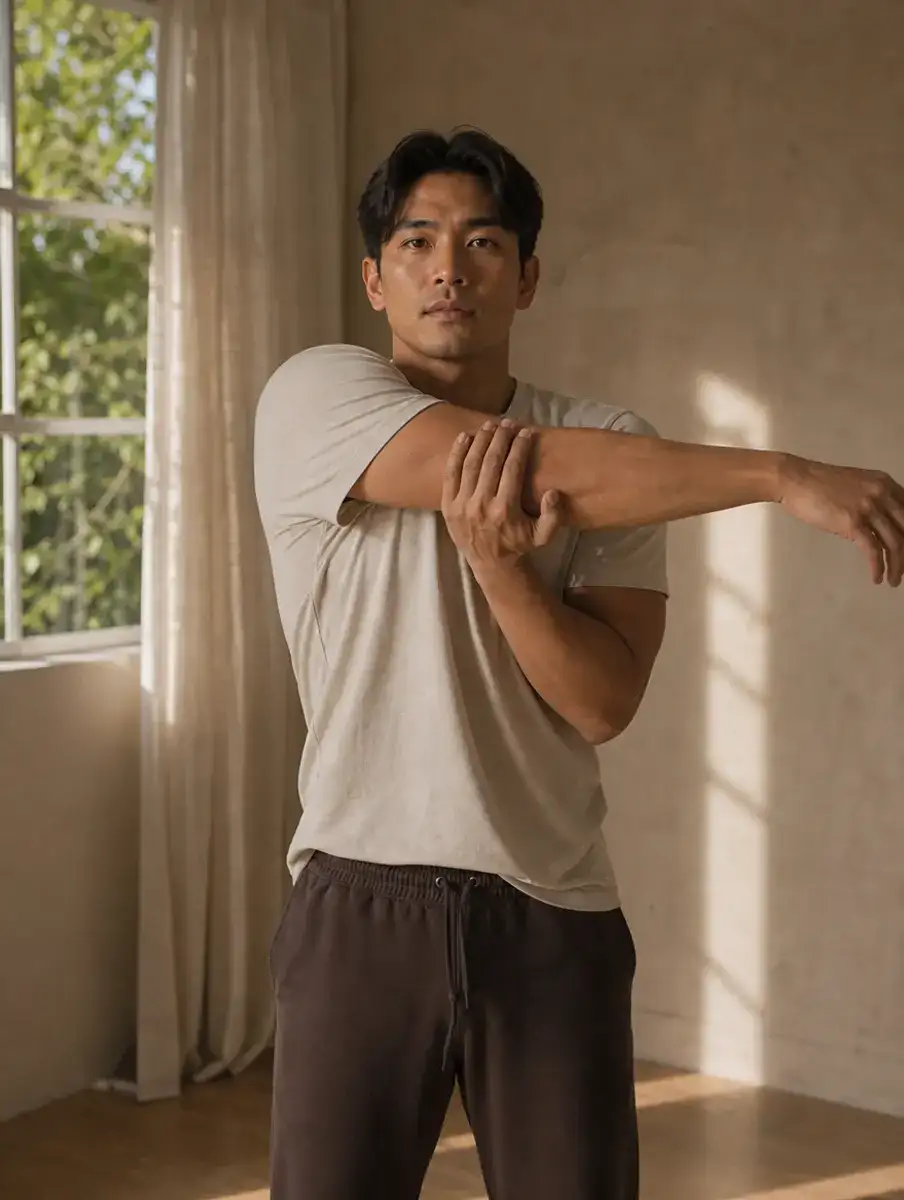
A simple arm stretch routine works down the arm in order: a cross-body stretch for the back of the shoulder, an overhead tricep stretch, a wall biceps stretch, then gentle wrist stretches with the arm straight in front. Hold each for five slow breaths, about 30 seconds, on both arms, and keep the elbows soft.
The arm works as a chain. The shoulder lifts it, the biceps bends the elbow, the triceps straightens it, and the forearm muscles move the wrist and fingers. Long hours of typing, carrying a child or shopping bags, or a strong practice full of plank and push-ups can leave any link in that chain tired and stiff.
The routine below works down the arm in order, takes about eight minutes, and most of it can be done sitting. If the shoulders are the main complaint, the eight stretches for laptop-weary shoulders go further on that part.
When should you see a doctor or physio?
Check first if you have:
- numbness, tingling or weakness in the hand or fingers, especially at night;
- pain on the inner or outer side of the elbow that has lasted more than a couple of weeks;
- a sharp pain or a pop in the front of the upper arm, with bruising;
- a shoulder that catches, clicks painfully or will not lift.
Wrist and forearm stretches should feel gentle. Come out of anything sharp.
How do you do an arm stretch routine?
Hold each stretch for five slow breaths, about 30 seconds, on both arms. Breathe out as you settle into each one.
- Arm circles to warm up. Reach the arms out to the sides at shoulder height and make small, slow circles forward eight times, then back eight times. Breathe normally.
- Cross-body shoulder stretch. Bring the right arm across the chest and hold it above the elbow with the left hand. Keep the right shoulder down. You feel this in the back of the shoulder.
- Overhead tricep stretch. Reach the right arm up, bend the elbow so the hand drops between the shoulder blades, and rest the left hand on the elbow. The tricep stretch page has four more versions.
- Wall biceps stretch. Stand side-on to a wall and place the right palm flat on it at shoulder height, slightly behind you, thumb up. Turn the chest slowly away from the wall until you feel the front of the arm.
- Wrist flexor stretch. Hold the right arm straight in front, palm up. With the left hand, draw the right fingers gently down and back. You feel the inside of the forearm.
- Wrist extensor stretch. Turn the right palm down and press the back of the hand gently so the fingers point down. You feel the top of the forearm.
- Eagle arms. Cross the right elbow under the left, bend the elbows and bring the palms towards each other. Lift the elbows slightly. This reaches between the shoulder blades, as in Eagle Pose. Switch the cross.
- Puppy Pose to finish. From hands and knees, keep the hips over the knees and walk the hands forward until the chest sinks towards the floor, forehead on a cushion. Puppy Pose with the arms long has the set-up. Five to eight breaths.
Which arm stretch suits which complaint?
Pick by where the arm feels tired rather than doing everything every day.
| Where it feels tight | Start with | Good moment |
|---|---|---|
| Back of the shoulder after carrying a bag | Cross-body stretch | On arrival at work |
| Back of the upper arm after push-ups or plank | Overhead tricep stretch | After practice |
| Front of the arm and shoulder after driving | Wall biceps stretch | After a long drive |
| Inside of the forearm after gripping a phone | Wrist flexor stretch | Every hour at the desk |
| Top of the forearm after mouse work | Wrist extensor stretch | Every hour at the desk |
| Between the shoulder blades | Eagle arms | Mid afternoon |
What about the hands and fingers?
Two small movements finish the chain. First, turn the forearms: bend the elbows to a right angle by your sides and rotate the palms slowly up to the ceiling and down to the floor ten times. Then open and close the hands: spread the fingers wide, curl them into a soft fist with the thumb outside, and open again, ten times. Neither is a held stretch, so keep them smooth and easy.
Should you hold or move before a workout?
Before push-ups, a vinyasa class or racquet sports, keep the arms moving: arm circles, slow swings across the chest and the forearm turns above, for a minute or two. Long holds suit the end of a session or a break from the keyboard.
How long until arm stretches make a difference?
Many people notice the arms feel looser straight after a routine, but that feeling fades within hours. A more lasting change in how far the arm reaches usually takes regular practice, most days, for several weeks. A useful test is to try the reverse prayer or the cow face arms from the full Cow Face Pose once a week and see whether the hands come a little closer.
A three-minute desk break
If you work long hours in a Makati or BGC office, try this at the desk, sitting:
- Shoulder rolls back, five slow ones.
- Cross-body stretch, three breaths each arm.
- Overhead tricep stretch, three breaths each arm.
- Wrist flexor and extensor stretch, three breaths each, each arm.
- Forearm turns and hand opening, ten each.
- Eagle arms, three breaths each cross.
Common mistakes
- Locking the elbows. In the wrist and biceps stretches, keep a soft bend.
- Pulling the fingers hard. The wrist is small. A gentle pull is enough.
- Shrugging. Let the shoulders drop away from the ears on every out-breath.
- Rushing. Two quick breaths is not enough for a muscle to settle.
Make it easier or harder
- Easier: do everything seated; use a strap for the tricep stretch; for the wrists, press the palms together in front of the chest and lower the hands slowly instead.
- Harder: for the biceps, clasp both hands behind the back and lift them a little; for the wrists, kneel with the palms on the floor and the fingers turned towards the knees, then lean back gently, only if the wrists are healthy.
Where do arm stretches fit?
The arms rarely tighten alone. The chest stretches for rounded shoulders open the front of the body that the arms pull forward, and the upper back stretches between the shoulder blades complete the picture from behind.
Best time to do it
Of the 8 moves, 5 work as warm-up moves and 7 as slower cool-down holds (some do both), so it fits most times of day after a few minutes of walking or easy movement. You can also split it: the gentler moving parts before exercise, the longer holds after.
How long to hold each move
Holds below are for a medium pace; at a slower pace, stay up to the longer time. Moves marked each side are done on both sides.
| Move | Hold | Slower pace |
|---|---|---|
| Arm Circles | 30 s of slow rounds | 45 s |
| Cross-Body Shoulder Stretch | 25 s each side | 40 s |
| Overhead Tricep Stretch | 25 s each side | 40 s |
| Wall Biceps Stretch | 25 s each side | 40 s |
| Wrist Flexor Stretch | 20 s each side | 30 s |
| Wrist Extensor Stretch | 20 s each side | 30 s |
| Eagle Arms | 25 s each side | 40 s |
| Puppy Pose | 30 s | 45 s |
Pair it with
Other stretching routines that work the same areas, for a longer session or the next day:
- Upper back stretches also works the shoulders and upper back
- Chest stretches also works the shoulders and upper back
- Warm-up routine also works the shoulders and arms
This page feeds the poses-by-body-part finder.
Browse the stretching library.
Sources: Mayo Clinic, Fitness program: 5 steps to get started; NCCIH (US National Institutes of Health), Yoga: Effectiveness and Safety. Last reviewed 2 October 2026.
Questions
How do you stretch the biceps?
The simplest way is at a wall. Place the palm flat on the wall at shoulder height, slightly behind you, with the arm straight and the thumb up, then turn the chest slowly away until you feel the front of the arm and shoulder. Keep the elbow soft rather than locked.
Can you do arm stretches sitting down?
Yes. The cross-body stretch, the overhead tricep stretch, eagle arms and both wrist stretches all work sitting in a chair, in everyday clothes, and take about three minutes together.
Why do the forearms feel tight after typing?
Typing, gripping a phone and holding a mouse keep the small muscles of the forearm working for hours in a similar position. Many people like a few wrist stretches and a shake of the hands every half hour or so. If pain, numbness or tingling comes into the hand, see a doctor or physio.
Should you stretch your arms before a workout?
Before a workout, keep it moving with arm circles, shoulder rolls and gentle swings across the body for a minute or two. Save the held stretches for after the workout or for a break from the keyboard, when the muscles are warm and you can breathe slowly into each one.
What is a cross-body shoulder stretch?
Bring one straight or slightly bent arm across the front of your chest and hold it above the elbow with the other hand, drawing it gently towards you. You should feel it in the back of the shoulder. Keep the shoulder down, away from the ear, and hold for about five slow breaths on each side.
Is it good to stretch your arms regularly?
For most people, yes, as long as it stays gentle. Typing, carrying bags or a child, and plank-heavy practice keep the arm muscles working in one position, and many people find a few slow stretches leave the shoulders, forearms and wrists feeling looser. Keep the elbows soft, and see a doctor or physio for numbness, tingling or lasting pain.
Pairs well with
Your yoga calendar
We track every yoga event, workshop and pop-up class so you don't have to.
Updated