Stretches · reviewed by a teacher
Eight stretches for tight, laptop-weary shoulders
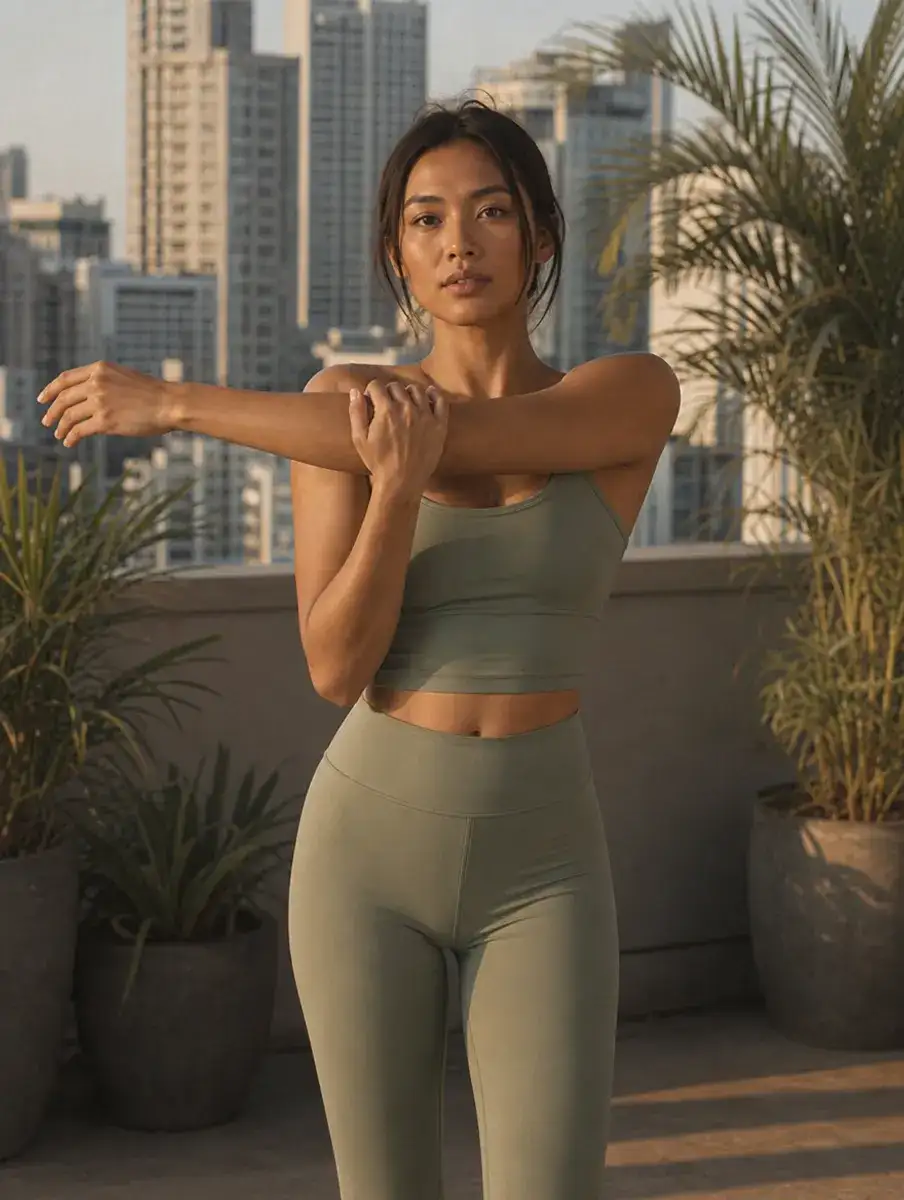
Shoulder stretches work best as a small set done often: roll and shrug the shoulders to warm them, then open the chest, stretch the back of the shoulder and finish with eagle and cow face arms, holding each for five slow breaths. Ten minutes once or twice a day suits a laptop schedule better than one long stretch at night.
Teacher's note from Joahnna Lee
“I often start with the shoulders, because the rest of the body tends to relax once they do.”
By mid-afternoon on a laptop day, the shoulders have crept towards the ears, the chest has folded in and the space between the shoulder blades aches. Nothing is wrong, exactly. The shoulders have simply held one shape for too long, and they like to move in every direction.
If you spend your days in a Makati office tower, a class before or after work can begin exactly here, and the page on yoga in Makati is a good place to start looking. Many teachers start with the shoulders, because the rest of the body tends to relax once they do.
The eight stretches below take about ten minutes. You can do the first five sitting at your desk.
Before you start: what should you feel?
A stretch across the chest, the back of the shoulder or between the shoulder blades should feel broad and mild. Stop, and see a doctor or physiotherapist, if you feel a sharp or catching pain in the joint, clicking with pain, numbness or tingling down the arm, or if you cannot lift the arm above shoulder height. A recent dislocation, a shoulder injury or surgery needs their clearance first.
How long should you hold each stretch?
Five slow breaths, around 30 seconds, then change sides. Repeat the ones that feel useful. Breathe out as you settle into each stretch and let the shoulders drop on every out-breath. If you hold your breath, you have gone too far.
The routine: eight shoulder stretches
- Shoulder rolls and shrugs. Lift both shoulders to the ears as you breathe in, then let them drop as you breathe out. Do it five times, then roll the shoulders slowly back five times. This warms the joint before anything else.
- Clasped hands behind the back. Sit or stand tall, interlace the fingers behind you (or hold a towel between the hands) and draw the knuckles gently down and away. The chest widens. Keep the chin level rather than lifting it.
- Cross-body arm stretch. Bring the right arm across the chest and hold it above the elbow with the left hand. Keep the right shoulder down, away from the ear. You feel this in the back of the shoulder. Switch sides.
- Eagle arms. Reach both arms forward, cross the right elbow under the left, bend the elbows and bring the palms or the backs of the hands towards each other. Lift the elbows a little and move them away from your face. If the hands do not meet, hold opposite shoulders in a self-hug. You feel this between the shoulder blades, the exact spot a laptop tightens.
- Cow face arms with a strap. Reach the right arm up, bend the elbow and let the hand fall down the back. Take the left hand behind the lower back, palm out. If the fingers do not meet, and for most people they do not, hold a strap or towel between them. Keep the head upright instead of letting it push forward. Switch sides.
- Doorway chest opener. Stand in a doorway with the forearms on the frame, elbows at shoulder height. Step one foot through until you feel the front of the chest and shoulders open. Small step, not a lunge.
- Thread the needle. On hands and knees, slide the right arm under the left, palm up, and rest the right shoulder and the side of the head on the floor or a cushion. Breathe into the upper back. Switch sides. Warm up first with a few rounds of Cat-Cow to move the upper spine.
- Puppy pose to finish. From hands and knees, keep the hips over the knees and walk the hands forward until the chest sinks towards the floor and the forehead rests on a cushion. This is a half-way shape between a kneeling rest in Child’s Pose and Downward Dog with the arms long. Five to eight breaths.
Which of these work at a desk?
Stretches 1 to 5 all work in an office chair, in work clothes. Sit on the front edge of the seat with both feet flat. Eagle arms and the cross-body stretch are discreet enough for the end of a video call. If the mouse hand aches too, add the wrist stretches for desk days.
Are shoulder stretches enough on their own?
Rarely. Laptop shoulders usually come with a tight neck and a stiff upper back, and the muscles that hold the shoulder blades back often need gentle strengthening as much as stretching, which the shoulder exercises from yoga, such as wall push ups, cover. Slow shoulder mobility exercises such as wall slides ask those muscles to work through the full range. The neck stretches for desk days pair naturally with this page, and the ten-minute morning routine for small condos includes a few of these shapes to start the day. For a slower look at how you sit and stand, yoga for posture at a desk goes further.
How a teacher works with tight shoulders
A good teacher will ask how you work: laptop or desktop, how many hours, which hand holds the mouse. Then the shoulders move through every direction before anything is held still, with straps and cushions to adapt each shape. At home, the arm and shoulder circles in the warm up exercises before yoga or a workout do the same job before you hold anything. Stressful seasons tend to live in the shoulders, which is why they come up so often in yoga for stress and burnout.
Best time to do it
Of the 8 moves, 5 work as warm-up moves and 7 as slower cool-down holds (some do both), so it fits most times of day after a few minutes of walking or easy movement. You can also split it: the gentler moving parts before exercise, the longer holds after.
How long to hold each move
Holds below are for a medium pace; at a slower pace, stay up to the longer time. Moves marked each side are done on both sides.
| Move | Hold | Slower pace |
|---|---|---|
| Shoulder Rolls and Shrugs | 30 s of slow rounds | 45 s |
| Clasped Hands Chest Opener | 25 s | 40 s |
| Cross-Body Shoulder Stretch | 25 s each side | 40 s |
| Eagle Arms | 25 s each side | 40 s |
| Cow Face Arms with a Strap | 25 s each side | 40 s |
| Doorway Chest Stretch | 30 s | 45 s |
| Thread the Needle | 30 s each side | 45 s |
| Puppy Pose | 30 s | 45 s |
Pair it with
Other stretching routines that work the same areas, for a longer session or the next day:
- Upper back stretches also works the shoulders and upper back
- Mobility exercises for the hips, spine and shoulders also works the shoulders and upper back
- Thoracic spine drills also works the shoulders and upper back
This page feeds the poses-by-body-part finder, the at-home flexibility check and the mobility assessment.
Browse the stretching library.
Sources: Mayo Clinic, Fitness program: 5 steps to get started; NCCIH (US National Institutes of Health), Yoga: Effectiveness and Safety; NHS, Exercise in pregnancy; CDC, Pregnant & Postpartum Activity: An Overview; Canadian Family Physician (Chan et al., 2014), via PubMed Central, Hot yoga and pregnancy: Fitness and hyperthermia. Last reviewed 2 October 2026.
Questions
Why do my shoulders feel tight after working on a laptop?
A laptop pulls the hands forward and the eyes down, so the shoulders round, the chest stays closed and the upper back holds the head up for hours. Raising the screen to eye level, using a separate keyboard and standing up every half hour or so help as much as any stretch.
Is it normal for one shoulder to feel tighter than the other?
Very common. Most of us carry the bag, hold the phone and use the mouse on the same side. Stretch both sides, and give the tighter one an extra round. If one shoulder is painful rather than tight, or you cannot lift the arm, see a doctor or physiotherapist instead.
Can you stretch your shoulders in bed?
Yes. Sit on the edge of the bed with both feet flat and try shoulder rolls, the cross-body arm stretch, eagle arms or a self hug, holding each for five slow breaths. Cow face arms with a towel works seated too. Save thread the needle and Puppy Pose for the floor, where you have a firm surface under you.
Pairs well with
Your yoga calendar
We track every yoga event, workshop and pop-up class so you don't have to.
Updated