Pose library · Adho Mukha Svanasana · reviewed by a teacher
Downward-Facing Dog (Adho Mukha Svanasana)
Adho means downward, mukha means face, svana means dog and asana means posture: the downward-facing dog posture. It looks like a dog stretching forward with its hips high after a nap.
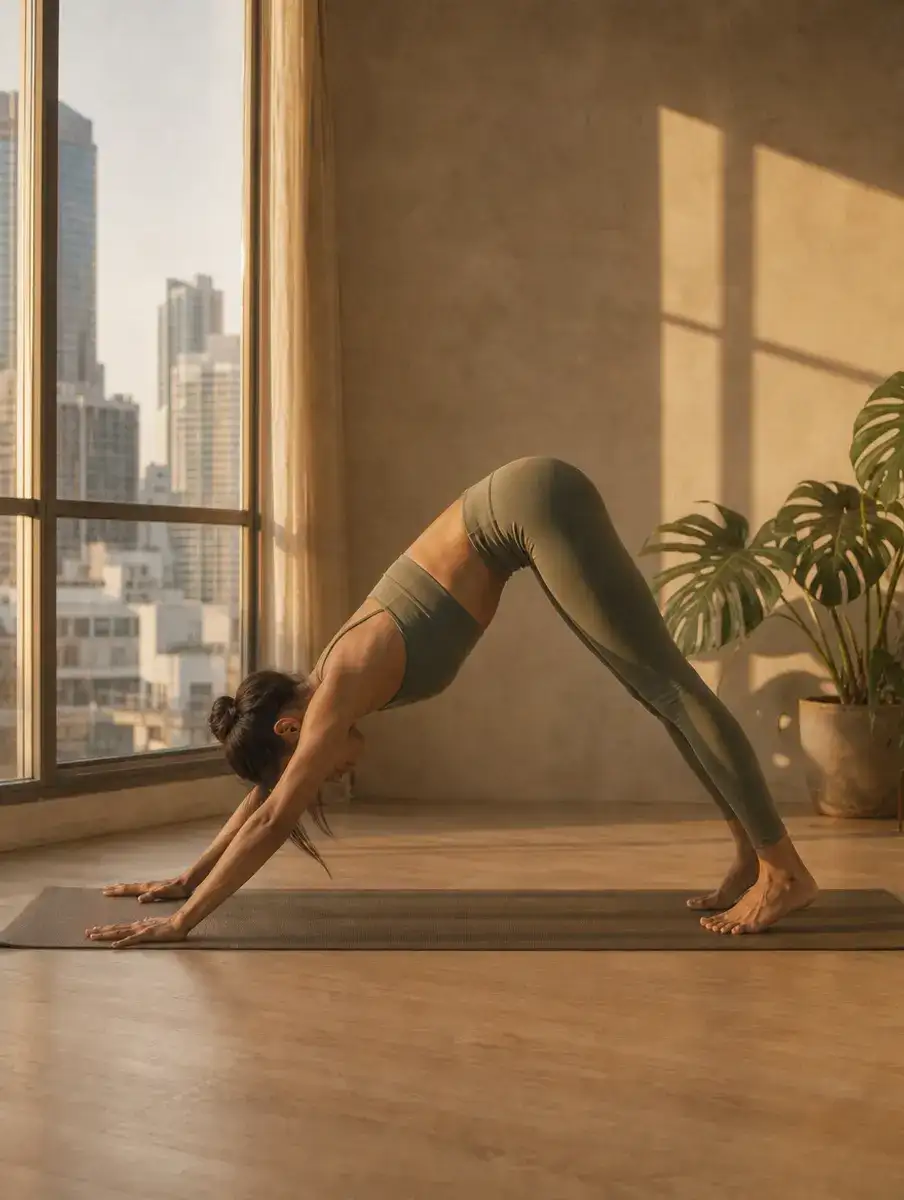
Downward-Facing Dog (Adho Mukha Svanasana) is an upside-down V that stretches the backs of the legs and lengthens the spine. From hands and knees, tuck the toes and lift the hips up and back, knees bent at first, for five breaths. Never force the heels down; bend the knees generously if the hamstrings are tight.
Pronunciation and meaning
Adho Mukha Svanasana: AH-doh MOO-kuh shvah-NAHS-uh-nuh. Svana is often said with a soft sh sound at the start.
Adho means downward, mukha means face, svana means dog and asana means posture: the downward-facing dog posture. It looks like a dog stretching forward with its hips high after a nap.
How to do Downward-Facing Dog
- Come onto hands and knees with the wrists under the shoulders and the knees under the hips. Spread the fingers wide with the middle fingers pointing forward.
- Tuck the toes under and, on an exhale, lift the knees off the mat, sending the hips up and back.
- Keep the knees bent at first so you can lengthen the spine all the way from the hands to the sitting bones.
- Press evenly through the whole hand, especially the knuckles of the index finger and thumb, and turn the upper arms slightly outward so the shoulders widen.
- Slowly straighten the legs as far as your hamstrings allow, reaching the heels toward the floor without needing them to touch.
- Let the head hang between the upper arms, breathe for five breaths, then bend the knees and lower back down to rest.
Downward-Facing Dog step by step

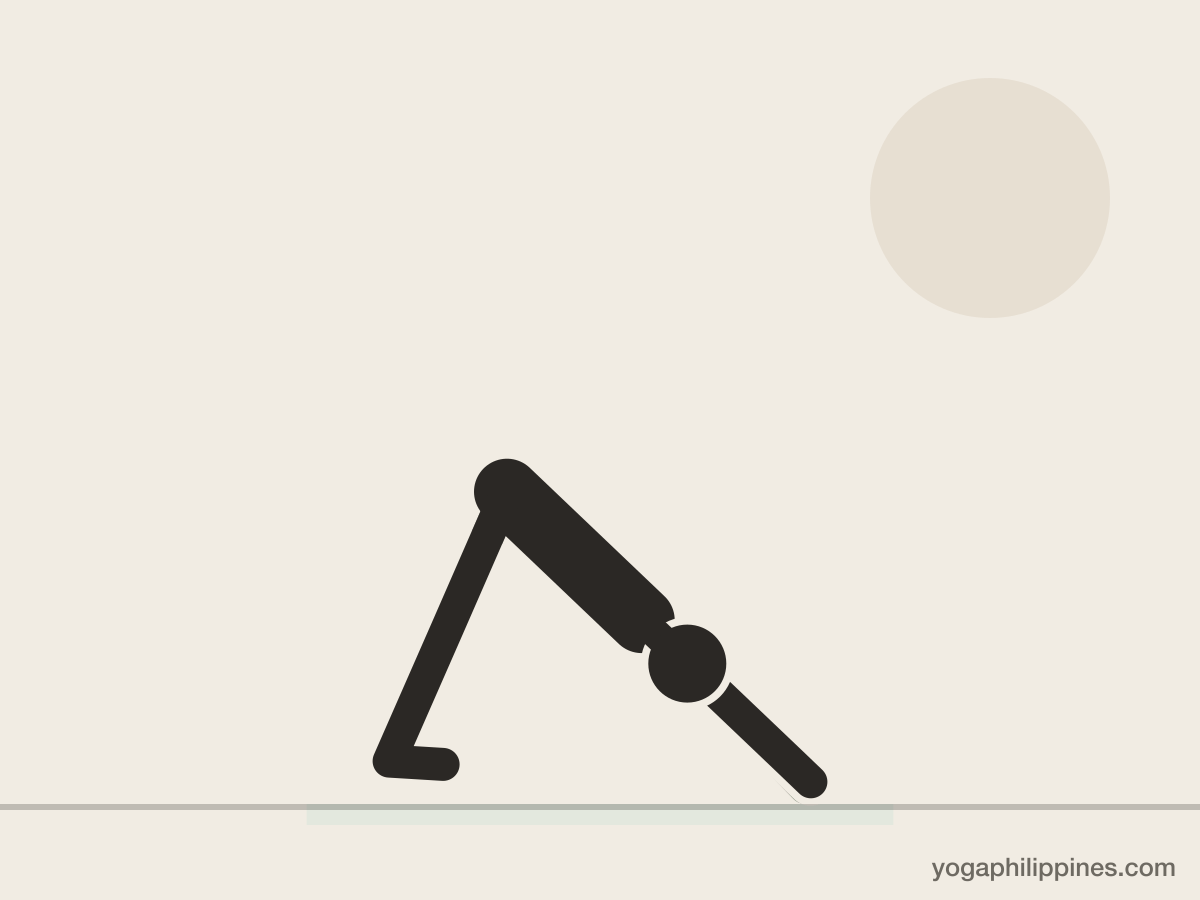
Drawings and video by YogaPhilippines.com, free to reuse under CC BY 4.0 with credit and a link: see the image licence for how to credit.
Downward-Facing Dog appears in the beginner yoga sequence and the morning yoga sequence, both printable with holds and cues. For other poses that work the hamstrings, open the pose finder set to the hamstrings.
Teacher's note from Joahnna Lee
“Long spine first, straight legs second. I would take bent knees and a flat back over straight legs and a rounded one every time.”
“Push the floor away with your hands, as if you wanted to slide the mat forward. The weight travels back into the legs and the wrists get lighter.”
“Pedal the feet for a few breaths when you first arrive, bending one knee and then the other, before you let it settle.”
Make it easier
- Bend the knees generously and lift the heels high if the hamstrings are tight.
- Put the hands on blocks, or on a wall or a chair seat, to take load off the wrists and shoulders.
- Fold the edge of the mat or a towel under the heels of the hands if the wrists feel sore.
- Rest in Child's Pose between rounds instead of holding for a long time.
Pregnancy and after birth
Pregnancy. Adapt. If it feels comfortable, keep holds short, the feet wider apart and the hands on blocks. Because the head is below the heart, come out if you feel dizzy, breathless or unwell. Check with your OB or midwife before you start.
After birth. Adapt. When your doctor or midwife has cleared you to exercise, start with the hands on a chair or wall for a few breaths at a time. The wrists and shoulders may be tired from carrying and feeding, so add weight to them gradually.
Read Joahnna Lee's notes on yoga in pregnancy and after birth.
Common mistakes
- Forcing the heels to the floor while the back rounds. The heels are the last thing to worry about.
- Walking the feet too close to the hands, which cramps the shape into a short arch.
- Leaning into the heels of the hands and letting the index-finger side of the hand lift.
Downward-Facing Dog is the pose a Vinyasa class keeps coming back to, a place to pause between flowing sequences once it becomes familiar. At first it rarely feels restful, and that is normal.
In Vinyasa yoga it is worth shaping the pose to your own hamstrings and shoulders, bent knees included, until it starts to feel like the pause it is meant to be. It opens the short practice of yoga for tight hamstrings, with the knees bent as much as you need.
In a flowing sequence it often follows Upward-Facing Dog, its partner in the flow, lifting the hips back as you breathe out. The Sun Salutation round timer paces that rhythm one breath at a time.
Lowering onto the forearms gives you Dolphin Pose, a stronger shoulder version. Years of steady Downward Dog are part of the base for Scorpion Pose, an advanced inversion.
Downward Dog variations
| Variation | How it differs | Why try it |
|---|---|---|
| Wall Dog | Hands on a wall at hip height, walk back to an L shape | Wrist or shoulder limits, or a first try |
| Puppy Pose | Knees stay down, chest sinks towards the floor | A shoulder stretch without the leg work |
| Pedalling Dog | Bend one knee, then the other | Warming the calves and hamstrings |
| Three-Legged Dog | One leg lifts straight back from the hips | Strength and a longer line through one side |
| Dolphin | Forearms down instead of the hands | More shoulder work, less wrist load |
Who should check with a doctor first?
Because the head is below the heart, check with a doctor before practising Downward Dog if you have glaucoma, uncontrolled high blood pressure, a heart condition, or a history of dizziness or fainting. Wall Dog keeps the head level and is a useful substitute while you ask.
Where does Downward Dog come from?
The name does not appear in the medieval hatha yoga texts. A similar shape is described in an eighteenth-century source under a different name, and the pose became widespread in the twentieth century through the Sun Salutation, which made it one of the most familiar shapes in modern yoga.
How long before the heels come lower?
Some people find the heels drift closer to the floor within a few weeks of regular practice; for others, especially those with long legs or stiff calves, they stay well above it for months or for good. That is fine. A better sign of progress is a long, flat back with the knees only slightly bent, held for five calm breaths.
Keeping your hands from sliding on a humid day
In a warm room the palms sweat quickly and can slide forward, which strains the wrists and shoulders. Spread the fingers wide and press the knuckles down from the start, wipe the hands in Child’s Pose between rounds, or lay a small towel at the top of the mat. A mat with a grippy top makes a clear difference here; the guide to the best yoga mats in the Philippines compares materials for sweaty hands.
Downward-Facing Dog or Dolphin Pose?
Dolphin is Downward Dog on the forearms. It is easier on the wrists and harder on the shoulders.
| Compare | Downward-Facing Dog | Dolphin Pose |
|---|---|---|
| Position | Hands and knees or hands and feet | Hands and knees or hands and feet |
| What it works | hamstrings, calves and shoulders | shoulders, upper back and hamstrings |
| Level | Beginner plus | Intermediate |
| Key difference | Weight on the hands with straight arms, hips up and back, knees soft. | Weight on the forearms, pressing them down so the shoulders lift away from the floor. |
Prep poses for Downward-Facing Dog
Poses that warm up the same body areas at a lower intensity, so Downward-Facing Dog feels steadier when you get there.
- Table Top Pose (Bharmanasana) a direct preparation, beginner
- Legs Up the Wall (Viparita Karani) gentler work for the same area, beginner
Counter-poses for Downward-Facing Dog
Shapes that move the body the other way or let it rest straight after Downward-Facing Dog.
- Balasana (Child's Pose) beginner
Poses that lead into Downward-Facing Dog
In a sequence, Downward-Facing Dog often follows these poses as their counter-pose or rest.
- Crescent Lunge (Ashta Chandrasana) beginner plus
- Lizard Pose (Utthan Pristhasana) intermediate
- Pigeon Pose (Eka Pada Rajakapotasana) intermediate
- Upward-Facing Dog (Urdhva Mukha Svanasana) intermediate
Where to go next after Downward-Facing Dog
These poses list Downward-Facing Dog as a preparation, so they are a natural next step once it feels comfortable.
- Sun Salutation (Surya Namaskar) beginner plus
- Dolphin Pose (Ardha Pincha Mayurasana) intermediate
- Handstand (Adho Mukha Vrksasana) advanced plus
Props that help in Downward-Facing Dog
- Block: brings the floor closer under the hands.
- Chair: brings the floor closer, or gives a seat or a hand rest for a gentler version.
- Blanket: pads the knees on a hard floor.
Programs and sessions that use Downward-Facing Dog
- The 14-day flexibility plan 3 of its 14 sessions
- The month-long yoga challenge 3 of its 30 sessions
- The 4-week beginner program 2 of its 12 sessions
- Sequences: 10-minute yoga, 30-minute flow, slow 45-minute session, first home sequence, wake-up sequence and runner's recovery sequence
- Practice app sessions: 10-minute reset, 20-minute flow, 30-minute practice, morning wake-up and hip opener
- Generated example flows: 20-minute hip flow and 45-minute yin-style wind-down
This page is one of the sources behind the tool for building your own sequence, the Sun Salutation round timer, the pose name quiz, the random yoga flow and the app's alignment check.
Sources: Mayo Clinic, Fitness program: 5 steps to get started; NCCIH (US National Institutes of Health), Yoga: Effectiveness and Safety; NHS, Exercise in pregnancy; CDC, Pregnant & Postpartum Activity: An Overview; Canadian Family Physician (Chan et al., 2014), via PubMed Central, Hot yoga and pregnancy: Fitness and hyperthermia. Last reviewed 2 October 2026.
Downward-Facing Dog questions
Why don't my heels touch the floor in downward dog?
Tight calves and hamstrings, and the proportions of your legs and feet, all play a part. For many people the heels never reach the floor, and that is not a problem. The pose works just as well with the heels lifted.
Why do my wrists hurt in downward dog?
Usually too much weight is falling into the heels of the hands. Press through the knuckles and fingertips, bend the knees to send the hips further back, and try blocks or a folded mat. If the pain stays, rest the wrists and ask your doctor.
How long should you hold downward dog?
In a flowing class it is often held for about five breaths, sometimes as a short rest between sequences. When you are learning it, start with three to five breaths, rest in Child's Pose, and build up gradually towards a minute as the arms and shoulders get stronger.
Should you bend your knees in downward dog?
Yes, if your hamstrings are tight. Bending the knees lets the hips lift and the back lengthen, which matters more than straight legs or heels on the floor. You can straighten the legs a little more over time, as long as the back stays long.
Is downward dog an inversion?
It is a mild inversion, since the head is lower than the heart. Most people are fine with it, but if you have high blood pressure, glaucoma or problems with dizziness, check with your doctor first. Come up slowly through a forward fold or kneel down into Child's Pose afterwards.
What is Downward Dog good for?
Downward Dog stretches the backs of the legs, lengthens the spine and builds strength in the arms and shoulders as you press the floor away. In a flowing class it works as a pause between sequences once it feels familiar, and it is part of the base for stronger shapes such as Dolphin Pose and later inversions.
Updated