Pose library · Vasisthasana · reviewed by a teacher
Side Plank (Vasisthasana)
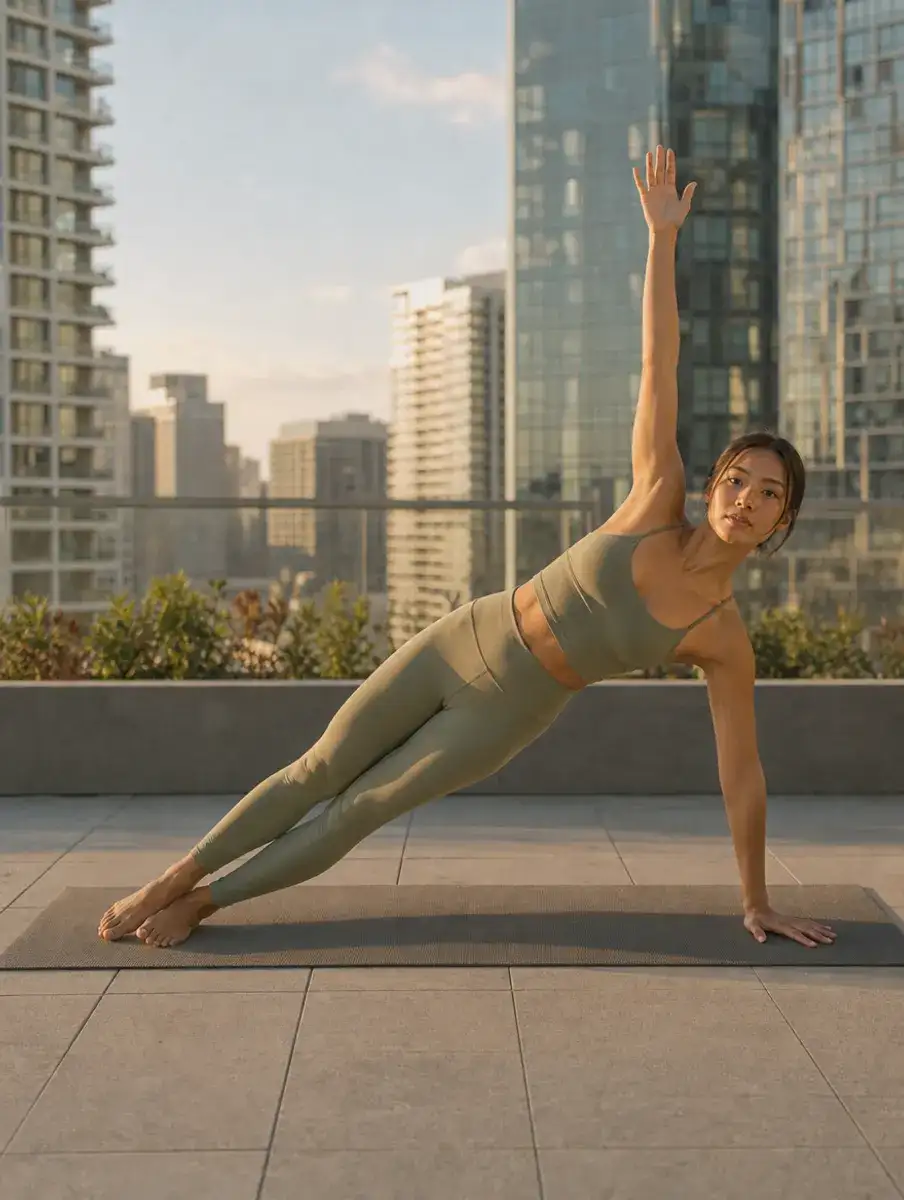
Side Plank is an arm balance where you hold your body in one long line on one hand and the outer edge of one foot, with the hips lifted and the chest turned to the side. Its Sanskrit name comes from Vasistha, a sage in Indian stories, and asana, posture. It asks for steady shoulders and a strong waist.
Side Plank (Vasisthasana) is an arm balance in one long line on one hand and one foot, asking for steady shoulders and a strong waist. From Plank, roll onto the outer edge of the bottom foot, press the floor away, lift the hips and reach the top arm up for three to five breaths. Lower the bottom knee for support.
Pronunciation and meaning
Vasisthasana: vah-shish-TAHS-uh-nuh. The sh sound comes twice, and the stress falls on TAHS.
Side Plank is an arm balance where you hold your body in one long line on one hand and the outer edge of one foot, with the hips lifted and the chest turned to the side. Its Sanskrit name comes from Vasistha, a sage in Indian stories, and asana, posture. It asks for steady shoulders and a strong waist.
How to do Side Plank
- Start in Plank Pose with your hands under your shoulders and your body in one line from head to heels.
- Shift your weight into your right hand and roll onto the outer edge of your right foot, stacking the left foot on top or placing it on the floor in front.
- Press the floor away with the right hand so the shoulder lifts out of the wrist rather than sinking into it.
- Lift your hips until the body makes one line again, then reach the left arm up toward the ceiling.
- Look forward, or up at the top hand if your neck is happy there. Stay for three to five breaths.
- Lower the top hand, come back to Plank and rest on your knees before the second side.
Side Plank step by step
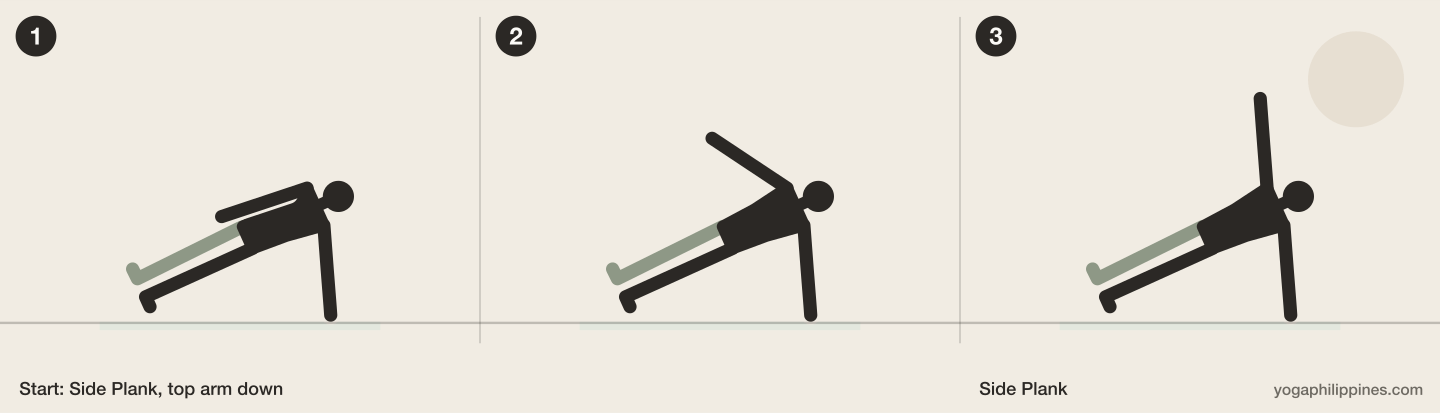
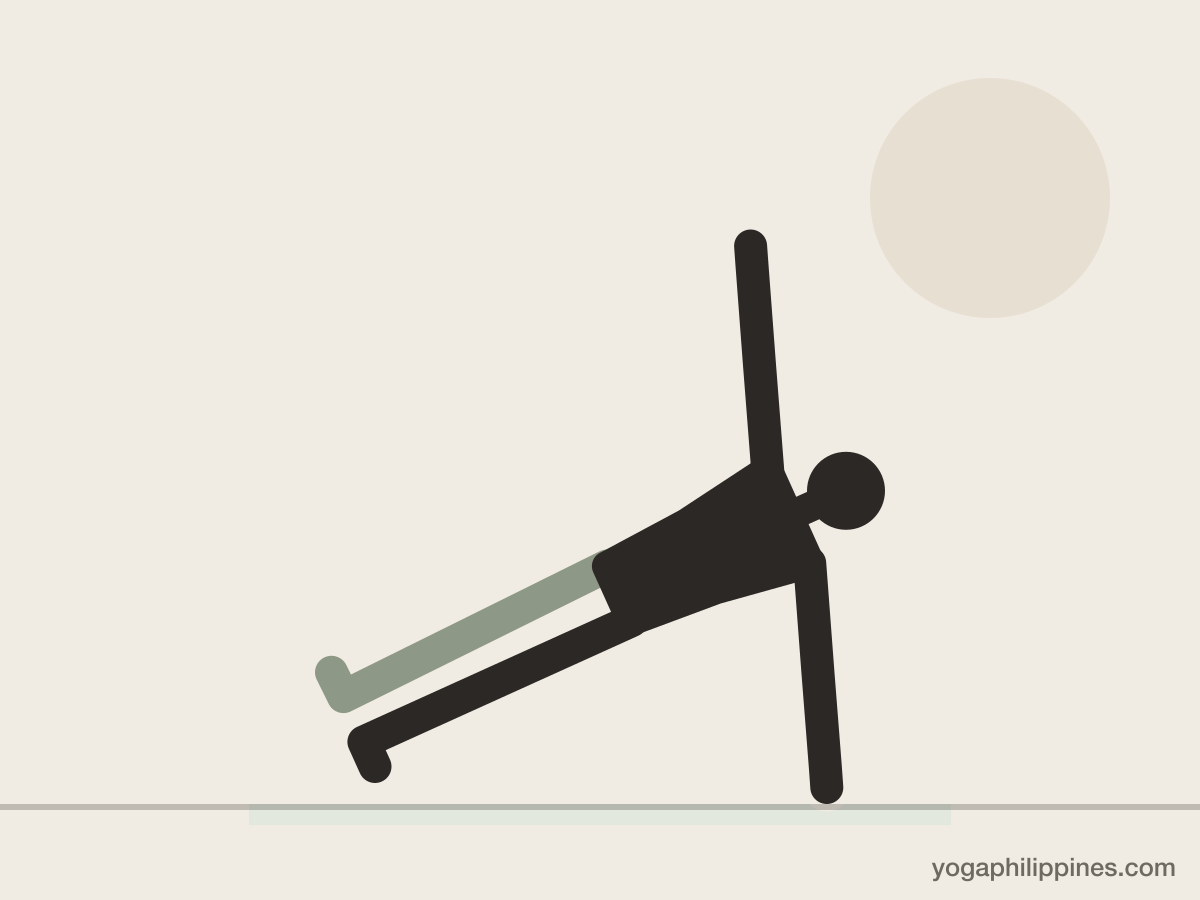
Drawings and video by YogaPhilippines.com, free to reuse under CC BY 4.0 with credit and a link: see the image licence for how to credit.
Side Plank appears in the core strength sequence card, which is printable with holds and cues. For other poses that work the core, open the pose finder set to the core.
Teacher's note from Joahnna Lee
“Think of pushing the floor away from you. The more the bottom arm works, the lighter the shoulder feels.”
“Lift the underside of your waist, as if a string pulled it toward the ceiling. If the hips sag, come down to the knee version.”
“Keep the top hip stacked over the bottom one. Rolling forward toward the floor turns it back into a plank on one arm.”
Make it easier
- Kneeling Side Plank: lower the bottom knee to the mat with the shin angled back, and lift from there.
- Forearm Side Plank: rest on the forearm with the elbow under the shoulder, which takes the weight off the wrist.
- Stagger the feet, top foot in front of the bottom one, so balancing on the edge of the foot is easier.
Pregnancy and after birth
Pregnancy. Adapt. If it already feels steady, use the kneeling or forearm version and keep the hold short; leave it out if you feel any pulling along the middle of the belly, and most people drop it later in pregnancy. Check with your OB or midwife before you start.
After birth. Adapt. Once your doctor or midwife has cleared you, rebuild with the kneeling forearm version first. If you see the middle of the belly dome or bulge, or feel pressure at the pelvic floor, come down and give it more time.
Expecting? Joahnna Lee Yoga has notes on adapting each trimester.
Common mistakes
- Letting the bottom shoulder collapse toward the ear, which loads the wrist and the shoulder joint.
- Placing the bottom hand too far forward of the shoulder, so the arm leans instead of stacking.
- Letting the hips sink or pike up out of line. Come down to the knee version and keep the line.
Side Plank turns a familiar shape onto its edge. Everything that holds you up in a straight-armed Plank still works, but now one arm and the side of the waist carry most of it, and balance joins in.
In Vinyasa that builds strength slowly it is usually taught from the knee first, so the shoulder learns to lift before it carries the full weight.
It also works as a quiet test of the bottom arm: if you can hold the kneeling version for five easy breaths with the shoulder lifted, the full shape is usually not far away.
Turned fully face up, the same straight-armed strength is used in Reverse Plank, the face-up plank.
A gentler side stretch from kneeling is Gate Pose, Parighasana. The side-body strength built here supports Eight Angle Pose, an advanced arm balance.
Prep poses for Side Plank
Poses that warm up the same body areas at a lower intensity, so Side Plank feels steadier when you get there.
- Plank Pose (Phalakasana) a direct preparation, beginner plus
- Table Top Pose (Bharmanasana) gentler work for the same area, beginner
- Crescent Lunge (Ashta Chandrasana) gentler work for the same area, beginner plus
- Dolphin Pose (Ardha Pincha Mayurasana) gentler work for the same area, intermediate
Counter-poses for Side Plank
Shapes that move the body the other way or let it rest straight after Side Plank.
- Balasana (Child's Pose) beginner
Where to go next after Side Plank
These poses list Side Plank as a preparation, so they are a natural next step once it feels comfortable.
- Eight Angle Pose (Astavakrasana) advanced plus
Easier and harder variations of Side Plank
Related poses from the same family that start from the same position and do a similar kind of work; Side Plank itself is intermediate.
- Harder: Crow Pose (Bakasana) advanced
- Harder: Firefly Pose (Tittibhasana) advanced plus
Props that help in Side Plank
- Blanket: pads the knees on a hard floor.
Programs and sessions that use Side Plank
- The one-month challenge 1 of its 30 sessions
- Sequences: core-strength session
This page feeds the form check.
Sources: Mayo Clinic, Fitness program: 5 steps to get started; NCCIH (US National Institutes of Health), Yoga: Effectiveness and Safety; NHS, Exercise in pregnancy; CDC, Pregnant & Postpartum Activity: An Overview; Canadian Family Physician (Chan et al., 2014), via PubMed Central, Hot yoga and pregnancy: Fitness and hyperthermia. Last reviewed 2 October 2026.
Side Plank questions
Why does Side Plank hurt my wrist?
Usually the shoulder has sunk and the weight is falling into the heel of the hand. Spread the fingers, press through the knuckles and push the floor away. If the wrist still complains, use the forearm version, and see a doctor about any pain that stays.
Is Side Plank good for beginners?
The kneeling version is. The full pose takes some shoulder and core strength, so build up from Plank and from Side Plank with the bottom knee down. There is no rush to lift the knee.
What is Side Plank good for?
Side Plank builds strength in the bottom shoulder and arm and along the side of the waist, while balance on one hand and one foot keeps the whole body working. It is a step toward harder arm balances such as Eight Angle Pose. The kneeling and forearm versions let you build that strength gradually without loading the wrist too soon.
Is Side Plank harder than Plank?
For most people, yes. Everything that holds you up in Plank still works, but one arm and the side of the waist now carry most of the weight, and balance joins in. That is why it is usually taught from the knee first. If you can hold the kneeling version for five easy breaths, the full pose is usually close.
Updated