Pose library · Adho Mukha Vrksasana · reviewed by a teacher
Handstand (Adho Mukha Vrksasana)
Handstand is an inversion where you balance upside down on your hands, arms straight and legs reaching up. The Sanskrit name means downward-facing tree: adho is downward, mukha is face, vrksa is tree. The safe way to learn it is in stages at a wall, building the shoulders and wrists before you ever kick up.
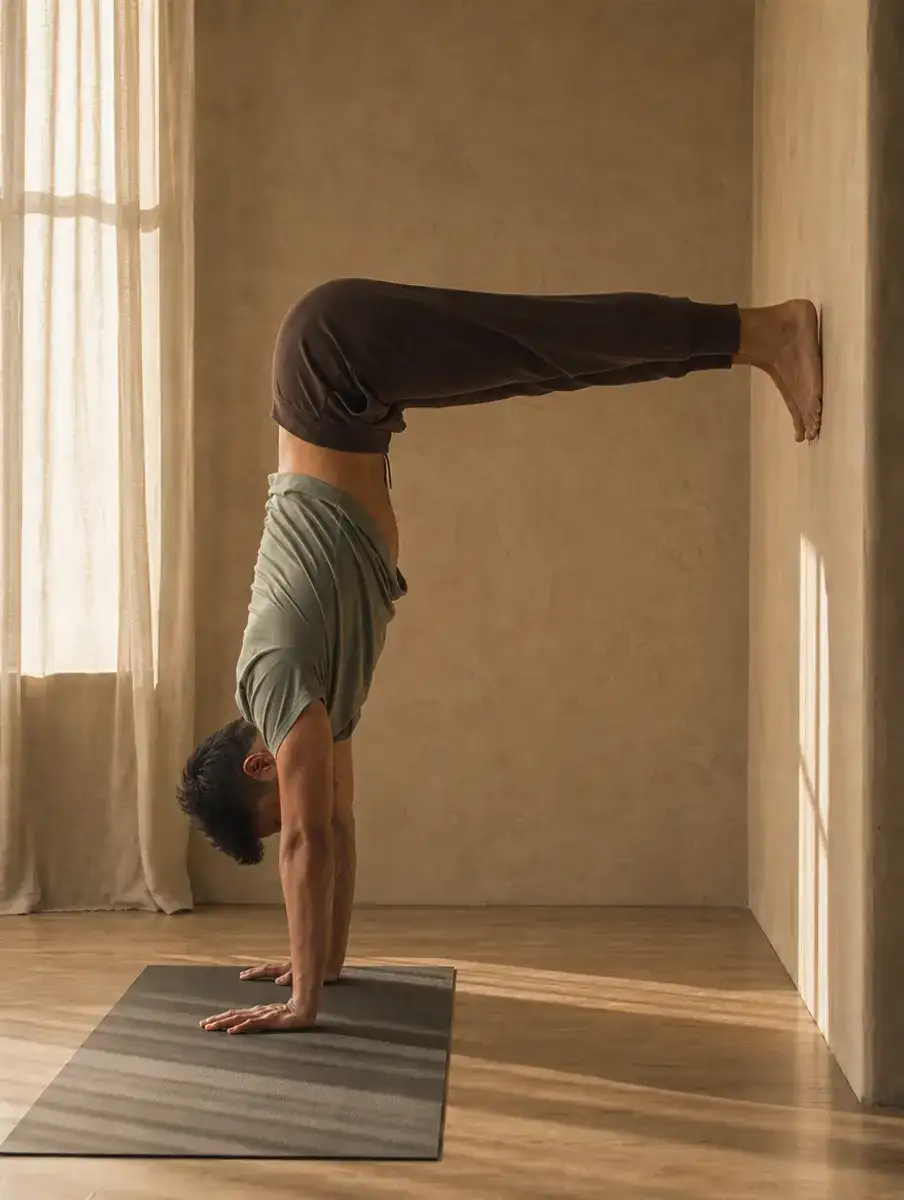
Handstand (Adho Mukha Vrksasana) is an inversion on straight arms that asks for strong shoulders and wrists. Learn it in stages at a wall: walk the feet up the wall into an L shape for three to five breaths, and only later hop up facing the wall. Never kick up hard, or practise in an open room without a teacher.
Pronunciation and meaning
Adho Mukha Vrksasana: AH-doh MOO-kuh vrik-SHAHS-uh-nuh.
Handstand is an inversion where you balance upside down on your hands, arms straight and legs reaching up. The Sanskrit name means downward-facing tree: adho is downward, mukha is face, vrksa is tree. The safe way to learn it is in stages at a wall, building the shoulders and wrists before you ever kick up.
How to do Handstand
- Warm the wrists on hands and knees, then hold Downward-Facing Dog for five breaths with the fingers spread wide.
- Stage one, the L at the wall: sit with your back to the wall, legs straight, and mark where your heels reach. Place your hands at that mark.
- From Downward Dog, walk your feet up the wall until the legs are level with the hips and the body makes an L. Stay for three to five breaths, then walk down.
- Stage two, once the L has felt steady for some weeks: place your hands a hand's length from the wall, facing it, in a short Downward Dog.
- Lift one leg, bend the other knee and give a small, soft hop so the hips rise over the shoulders and the heels find the wall. Stay a few breaths.
- Come down one leg at a time and rest, kneeling, with the forehead on the mat. Never kick up in the middle of a room until a teacher has seen you at the wall.
Handstand step by step

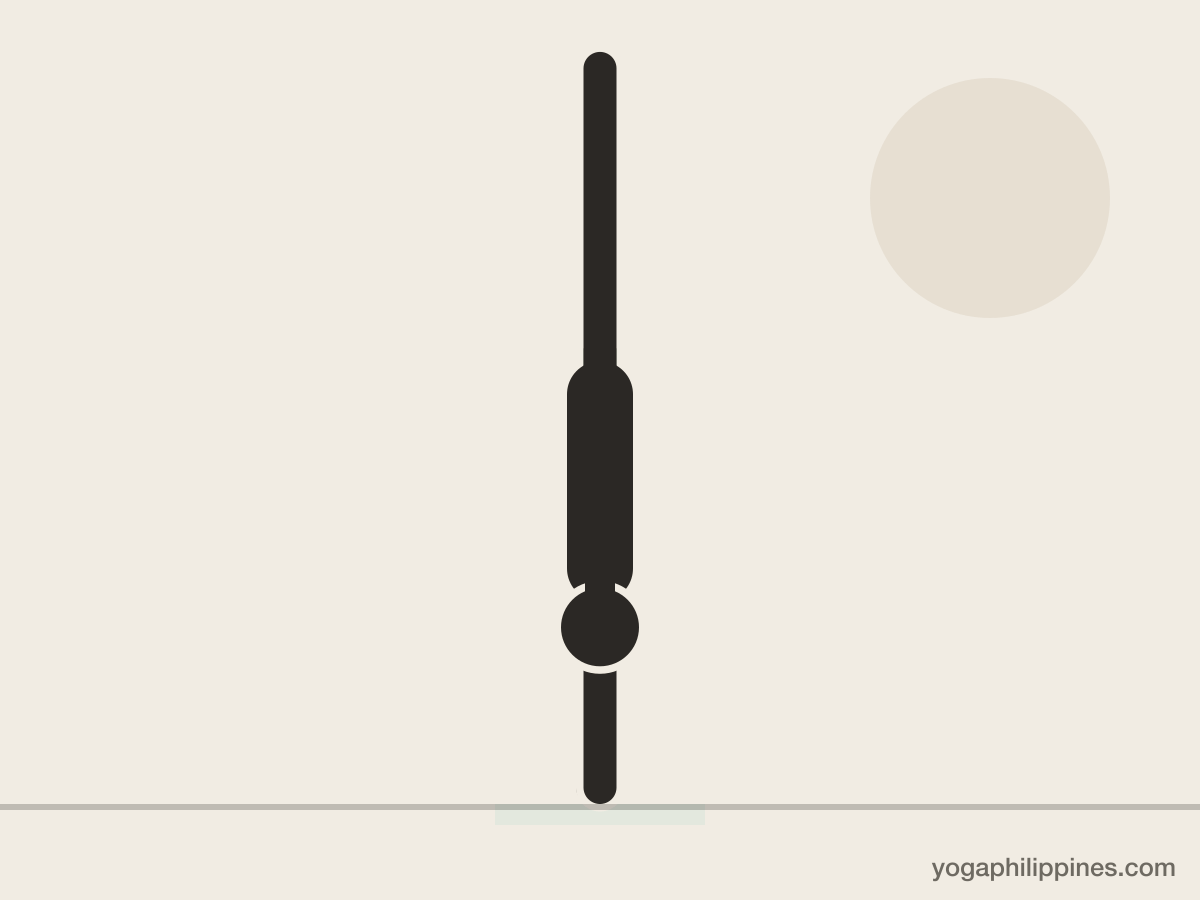
Drawings and video by YogaPhilippines.com, free to reuse under CC BY 4.0 with credit and a link: see the image licence for how to credit.
For other poses that work the shoulders, open the pose finder set to the shoulders.
Teacher's note from Joahnna Lee
“Push the floor away as if you wanted to grow taller through the arms. Bent elbows are where most falls start.”
“Draw the lower ribs in so the body stays in a line instead of a banana shape against the wall.”
“A small hop, many times, beats one big kick. If you need a big kick, the shoulders are not ready yet, and that is fine.”
Make it easier
- Stay with the L at the wall for as long as you like. It is a full pose in its own right, not a lesser one.
- Dolphin Pose, Downward Dog on the forearms, builds the shoulders without loading the wrists.
Pregnancy and after birth
Pregnancy. Avoid. Do not learn or practise handstand in pregnancy. Balance and blood pressure both change, and a fall is a real risk. Gentle shoulder work on hands and knees is a kinder way to stay strong; check with your OB or midwife before you start.
After birth. Avoid. Leave inversions until your doctor or midwife has cleared you and your core, pelvic floor and upper body strength have come back. Rebuild with Downward Dog and Dolphin first, and go back to the wall stages slowly.
Expecting? Joahnna Lee Yoga has notes on adapting each trimester.
Common mistakes
- Kicking up hard from far away, which throws you past the balance point and into the wall or onto the back.
- Bending the elbows or letting the shoulders sink toward the floor, so the neck and wrists take the load.
- Practising without a wall, a clear floor and a plan for coming down.
Handstand is the pose people ask about most and need least. It is a lovely thing to learn, but it is a long project, and the useful work happens at the wall, weeks before the feet leave it.
It is worth building towards only in a Vinyasa practice that works at the wall, after the shoulders and wrists have had time to get strong in Down Dog, held for longer each week.
Before you try it
Handstand puts your full weight on the wrists and shoulders and turns you upside down. Leave it out with high blood pressure, glaucoma, a recent injury to the head, neck, wrists or shoulders, or if you feel dizzy upside down, and ask your doctor first if any of these apply. Clear the space around you, practise on a mat against a solid wall, and stop at any sharp pain.
Once Handstand and Forearm Stand are steady, a few students go on to Scorpion Pose, a forearm balance with a deep backbend.
Prep poses for Handstand
Poses that warm up the same body areas at a lower intensity, so Handstand feels steadier when you get there.
- Downward-Facing Dog (Adho Mukha Svanasana) a direct preparation, beginner plus
- Dolphin Pose (Ardha Pincha Mayurasana) a direct preparation, intermediate
- Crow Pose (Bakasana) gentler work for the same area, advanced
- Side Plank (Vasisthasana) gentler work for the same area, intermediate
Counter-poses for Handstand
Shapes that move the body the other way or let it rest straight after Handstand.
- Balasana (Child's Pose) beginner
Where to go next after Handstand
These poses list Handstand as a preparation, so they are a natural next step once it feels comfortable.
- Scorpion Pose (Vrschikasana) advanced plus
Easier and harder variations of Handstand
Related poses from the same family that start from the same position and do a similar kind of work; Handstand itself is advanced plus.
- Easier: Shoulder Stand (Salamba Sarvangasana) advanced
Props that help in Handstand
- Wall: gives a steady point to lean on or press into for balance and alignment.
Sources: Mayo Clinic, Fitness program: 5 steps to get started; NCCIH (US National Institutes of Health), Yoga: Effectiveness and Safety; PLoS One (Cramer et al., 2013), via PubMed Central, Adverse Events Associated with Yoga: A Systematic Review of Published Case Reports and Case Series; PLoS One (Jasien et al., 2015), via PubMed Central, Intraocular Pressure Rise in Subjects with and without Glaucoma during Four Common Yoga Positions; NHS, Exercise in pregnancy; CDC, Pregnant & Postpartum Activity: An Overview. Last reviewed 2 October 2026.
Handstand questions
How long does it take to learn a handstand?
It varies a great deal. Some students hold the L at the wall within weeks; a steady handstand away from the wall can take a year or more of regular practice.
Is handstand safe?
It can be, learned slowly at a wall with a teacher. The note above lists who should leave it out; ask your doctor if you are unsure.
Is Handstand good for you?
Learned slowly at a wall, Handstand builds strength in the shoulders, arms and wrists and teaches the whole body to stay in one line upside down. It is not for everyone. Leave it out with high blood pressure, glaucoma, a recent head, neck, wrist or shoulder injury, or if you feel dizzy upside down.
Why is Handstand so hard to learn?
It puts your whole weight on the wrists and shoulders, turns you upside down and asks you to balance on a small base. Most people need weeks of strength work before the hips rise over the shoulders easily. Staying with the L shape at the wall and small hops builds the skill far more safely than big kicks.
How long should you hold a handstand?
At first, three to five breaths in the L shape at the wall, then walk down and rest. Later, facing the wall, stay a few breaths and come down one leg at a time. Quality matters more than time: come down as soon as the elbows bend or the shoulders sink toward the floor.
Updated