Pose library · Bakasana · reviewed by a teacher
Crow Pose (Bakasana)
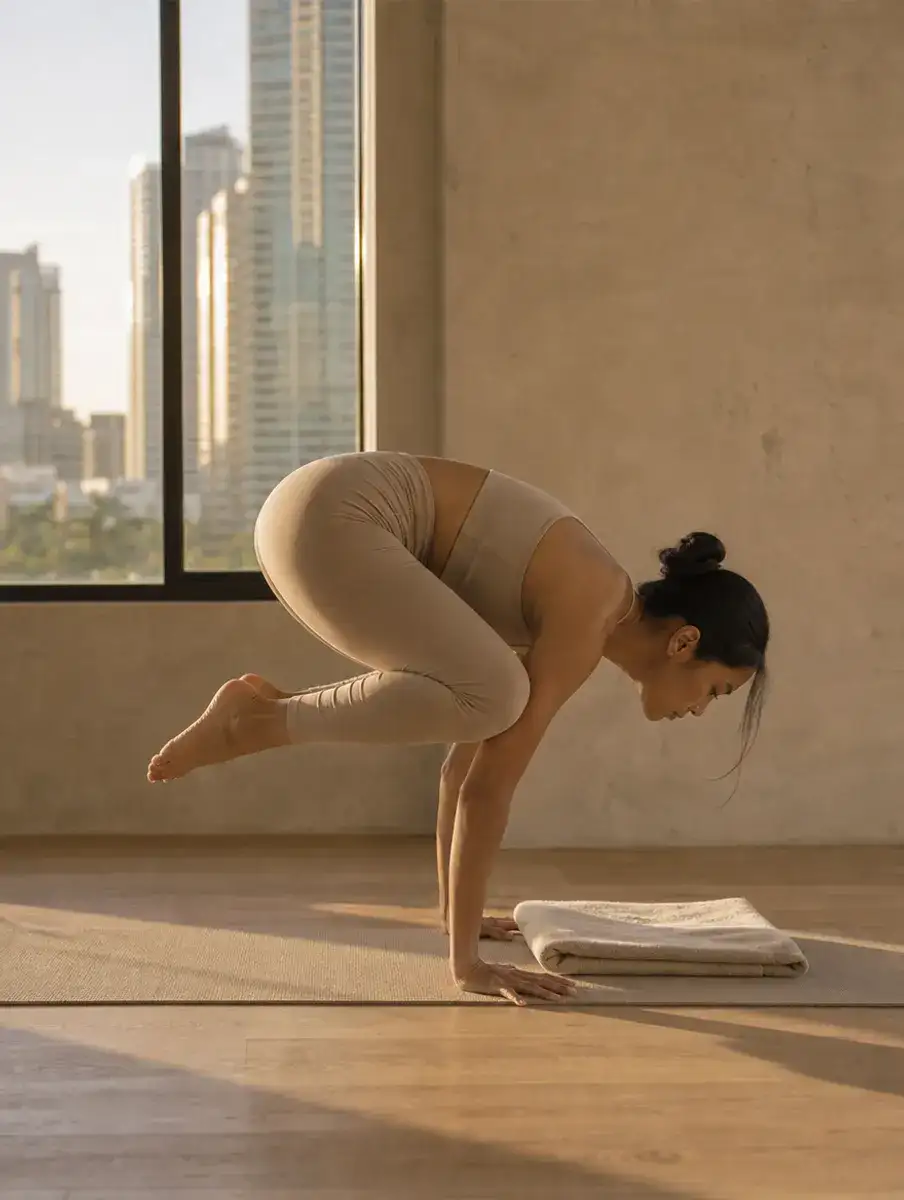
Baka means crane or heron and asana means posture, so it is sometimes called Crane Pose. In English it is usually taught as Crow, with the knees resting high on bent arms and the feet lifted off the floor.
Crow Pose (Bakasana) is an arm balance that works the wrists, arms and belly. From a squat, plant the hands, bend the elbows straight back, set the knees high on the upper arms and shift forward until the feet feel light. Keep a cushion in front of your face, and learn it with a teacher watching.
Pronunciation and meaning
Bakasana: bah-KAHS-uh-nuh. Baka is said with two short, even syllables.
Baka means crane or heron and asana means posture, so it is sometimes called Crane Pose. In English it is usually taught as Crow, with the knees resting high on bent arms and the feet lifted off the floor.
How to do Crow Pose
- Start in a low squat with your feet a little apart and a folded blanket or a cushion on the mat in front of you, in case you tip forward.
- Place your hands flat on the mat shoulder-width apart, fingers spread, about a forearm's length in front of your feet.
- Bend your elbows straight back, not out to the sides, and bring your knees as high as you can onto the backs of the upper arms, toward the armpits.
- Round your upper back, draw the belly in and look at the floor a little ahead of your hands rather than straight down.
- Shift your weight forward into the hands until the feet feel light. Lift one foot, then try the other. Stay here for a few breaths, with both toes or one toe still touching down if that is where you are.
- Come down by lowering the feet slowly back to the mat, then sit back and release the wrists.
Crow Pose step by step

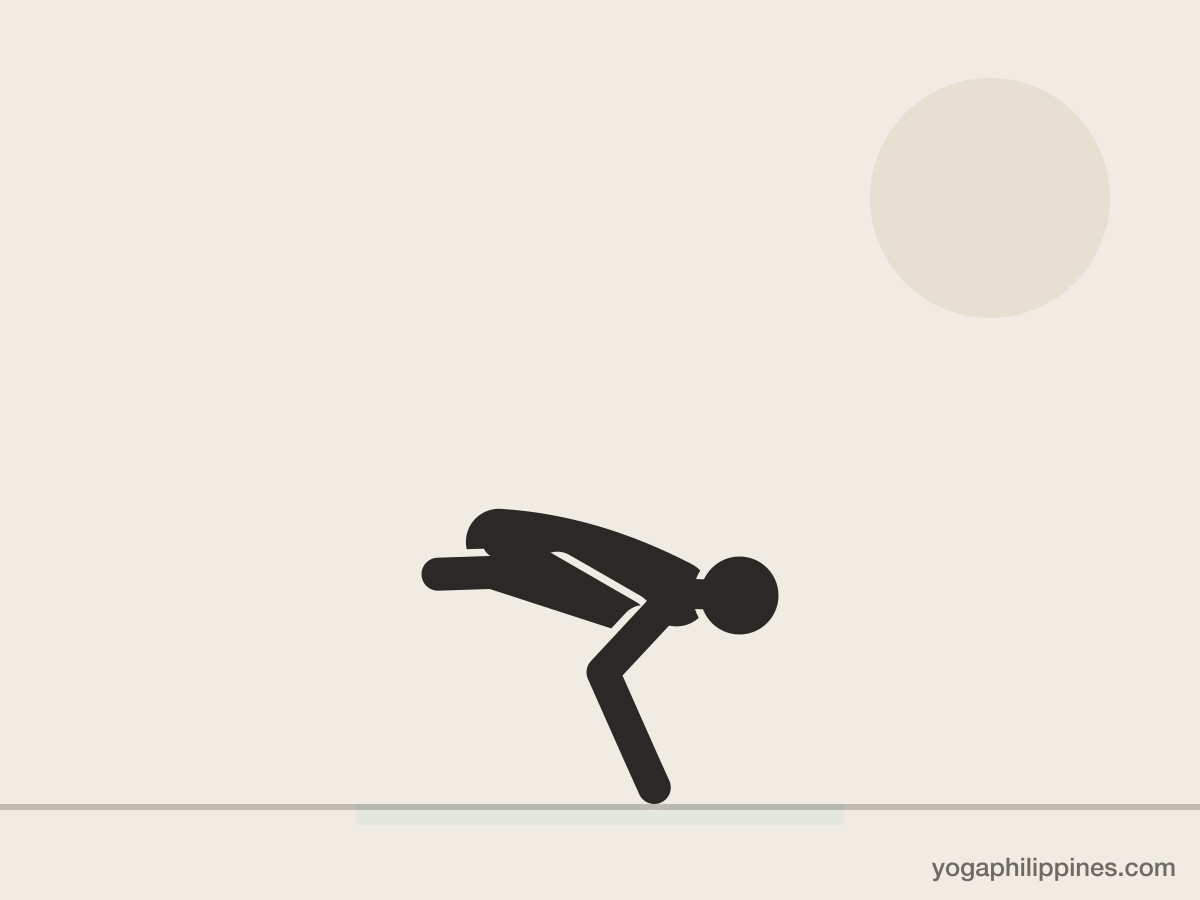
Drawings and video by YogaPhilippines.com, free to reuse under CC BY 4.0 with credit and a link: see the image licence for how to credit.
For other poses that work the wrists, open the pose finder set to the wrists.
Teacher's note from Joahnna Lee
“Lean forward further than feels sensible. Crow is a balance of weight, not a lift of strength, and the feet only rise once the shoulders pass over the hands.”
“Squeeze the knees into the arms and the arms back into the knees. That hug is what holds you up.”
“Keep the gaze forward on the floor. When you look back at your feet, your head drops and the balance goes with it.”
Make it easier
- Stand your feet on a block so the hips start higher and the knees reach the arms more easily.
- Always have a cushion or folded blanket under your face while you learn, and practise it with a teacher watching before you try it alone.
Pregnancy and after birth
Pregnancy. Avoid. Crow puts pressure on the belly and carries a real risk of tipping forward, so skip it in pregnancy even if it was part of your practice before. Squatting in Garland Pose with support is a gentler option if your OB or midwife is happy with squats.
After birth. Avoid. Leave Crow out until your doctor or midwife has cleared you, your core and pelvic floor feel strong again, and your wrists are no longer tired from carrying a baby. Then rebuild slowly with blocks under the feet and a teacher beside you.
Expecting or postpartum? See joahnnalee.com for the stage-by-stage guides.
Common mistakes
- Letting the elbows splay out to the sides, so the knees slide down the arms and the shoulders take strain.
- Jumping or hopping the feet up to get airborne. The lift should come from shifting weight, which is controlled and quiet.
- Putting all the weight in the heels of the hands. Grip the floor with the fingertips so you can brake if you tip forward.
Crow is often the first arm balance people try, and the moment the feet lift is a fun one. It is still an arm balance, with a fall forward always possible, so learn it slowly, with padding under your face and a teacher who can spot you.
Vinyasa yoga at your own pace suits it well: the wrists, the core and your nerve all get time to catch up with each other.
Crow is often the first arm balance on the long road to Handstand, which is learned in stages at a wall. The page of arm balance yoga poses in order of difficulty shows what to practise before and after it, and the wider list of advanced yoga poses sets it among the intermediate steps. It is also the one hand balance in the list of balancing poses.
With the legs straightened out wide over the arms, a similar hand balance becomes Firefly Pose, Tittibhasana. Another arm balance built on Crow is Eight Angle Pose, with the legs hooked over one arm.
How do you build up to Crow Pose?
Most people learn Crow in stages. Spend a few sessions on each step before moving on, and keep the cushion in front of you throughout.
- Squat and round. Sit in Garland Pose for five breaths, then round the back and draw the belly in. This is the shape Crow is held in.
- Plank to knees-down Chaturanga. Three slow lowers build the strength to hold bent elbows.
- Feet on a block. Stand on a block, set the hands down and the knees high on the arms, and lean forward until the heels lift. Stay with the toes touching for three breaths.
- One foot up. From the same set-up, float one foot, then the other, a few centimetres. Lower and switch.
- Both feet up, briefly. Lift both feet for one breath, then two, then three. Lower with control every time.
How long this takes depends on your strength, your wrists and your nerve. It can be a few weeks or several months, and both are normal.
What is the difference between Crow and Crane?
| Version | Arms | Knees |
|---|---|---|
| Crow (Kakasana) | Elbows bent | Resting on the backs of the upper arms |
| Crane (Bakasana) | Arms straight or nearly straight | Tucked high, close to the armpits |
| Side Crow (Parsva Bakasana) | Elbows bent | Both knees stacked on the outside of one arm, after a twist |
Many classes use the names Crow and Crane for the same pose. Crow, with bent arms, is the usual starting point.
What if your hands slip?
In a warm, humid room, sweaty palms slide just when you lean forward. Dry the hands and the front of the mat before each attempt, and practise on a mat with a grippy top or a dry towel under the hands only. Never practise on a towel that can slide on the mat.
Prep poses for Crow Pose
Poses that warm up the same body areas at a lower intensity, so Crow Pose feels steadier when you get there.
- Garland Pose (Malasana) a direct preparation, beginner plus
- Plank Pose (Phalakasana) a direct preparation, beginner plus
- Downward-Facing Dog (Adho Mukha Svanasana) gentler work for the same area, beginner plus
Counter-poses for Crow Pose
Shapes that move the body the other way or let it rest straight after Crow Pose.
- Balasana (Child's Pose) beginner
Where to go next after Crow Pose
These poses list Crow Pose as a preparation, so they are a natural next step once it feels comfortable.
- Eight Angle Pose (Astavakrasana) advanced plus
- Firefly Pose (Tittibhasana) advanced plus
Easier and harder variations of Crow Pose
Related poses from the same family that start from the same position and do a similar kind of work; Crow Pose itself is advanced.
- Easier: Four-Limbed Staff Pose (Chaturanga Dandasana) intermediate
- Easier: Side Plank (Vasisthasana) intermediate
Props that help in Crow Pose
- Block: brings the floor closer under the hands.
- Blanket: pads the knees on a hard floor.
This page feeds the pose name quiz.
Sources: Mayo Clinic, Fitness program: 5 steps to get started; NCCIH (US National Institutes of Health), Yoga: Effectiveness and Safety; NHS, Exercise in pregnancy; CDC, Pregnant & Postpartum Activity: An Overview; Canadian Family Physician (Chan et al., 2014), via PubMed Central, Hot yoga and pregnancy: Fitness and hyperthermia. Last reviewed 2 October 2026.
Crow Pose questions
Why can't I lift my feet in Crow Pose?
Usually because the weight is still back over the feet. Bring the hips higher, set the knees further up the arms, and lean the shoulders forward past the wrists.
Is Crow Pose safe for beginners?
The preparation is, with a cushion in front and a teacher nearby. Beginners should build wrist and core strength first and think of the lift as something that comes later, never something to force.
What is Crow Pose good for?
Crow Pose works the wrists, arms and belly, and it trains balance on the hands rather than the feet. The hug of the knees into the arms asks for steady core work, and leaning forward asks for some nerve. It is often the first arm balance people learn, and a step toward harder ones such as Handstand.
Why is Crow Pose so difficult?
Crow is a balance of weight more than a lift of strength, and the feet only rise once the shoulders pass over the hands. Leaning that far forward feels wrong at first, so most people hold back. It also needs wrist and core strength. A cushion under your face and a block under your feet make the lean easier.
Is Crow Pose harder than frog stand?
Usually, yes. In frog stand, the arm balance taught in many fitness classes, the hands are on the floor and the knees rest on the outside of the bent elbows, low and close to the body, so it is often learned first. In Crow the knees climb higher, onto the backs of the upper arms, and you lean further forward. Yoga's own Frog Pose is a different shape altogether: a floor stretch for the inner hips.
Updated