Gear
Yoga blocks and straps: what they do and how to use them
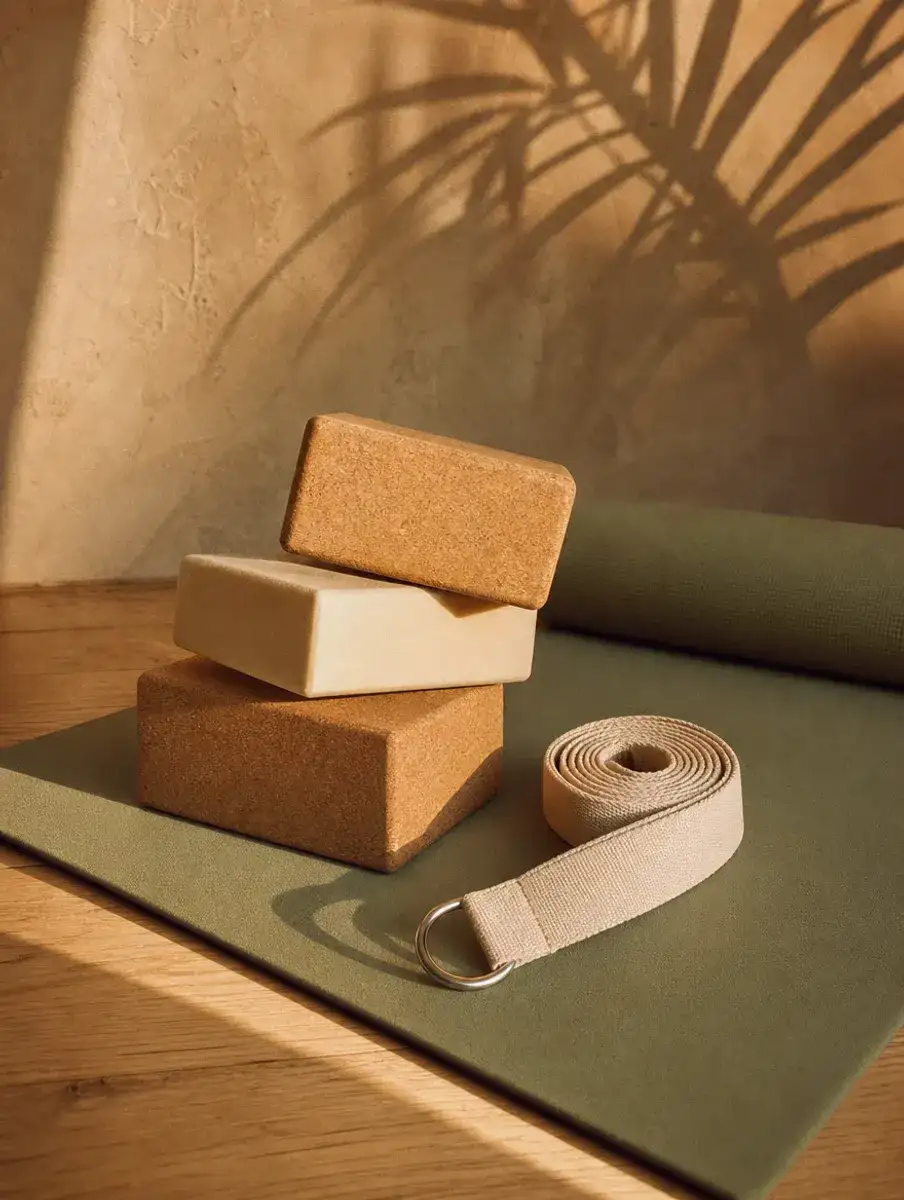
A yoga block brings the floor closer, so you can keep a long spine in poses like Triangle and Half Moon. A yoga strap extends your arms, so you can reach your feet without rounding or straining. Foam blocks are light and soft; cork blocks are heavier and steadier. A 2.5 to 3 m strap suits most people.
Blocks and straps are the two props most yoga classes keep in a pile by the door. Neither is a sign that you are behind. They let you do a pose with good shape in the body you have today, instead of forcing a reach your hips or hamstrings are not ready for.
What does a yoga block do?
A block raises the floor. In Triangle Pose, or Trikonasana, a block under the lower hand keeps the side body long instead of collapsing toward the floor. In Half Moon Pose, it takes real weight under the hand so the standing leg is not doing everything. Blocks have three heights, depending on which face you stand them on, so you can adjust as you go.
Blocks also support you in rest. Slid under the sacrum in Bridge Pose, a block turns it into a supported backbend. Under each thigh in Reclined Butterfly, two blocks hold the knees so the inner thighs can relax. In Hero Pose, sitting on a block takes pressure off the knees.
Foam or cork? Foam blocks are light, soft and low cost, and are comfortable to sit on or lie over. Cork is denser and heavier, so it feels steadier under a hand in a standing balance. Decathlon makes the same suggestion: foam for seated poses and heart openers, cork for standing and balancing.
Foam, cork or wood in a humid climate?
| Material | Weight and feel | In Philippine humidity | Care |
|---|---|---|---|
| EVA or polyethylene foam | Light, soft, easy to sit on | Does not absorb sweat; can get slick when wet | Wipe with a damp cloth and mild soap |
| Cork | Heavier, firm, grippy | Grips well even with damp hands, but can hold odours and stain | Wipe and let it air dry fully, out of direct sun |
| Wood | Heavy, hard, very stable | Can get slippery when wet and may swell if left damp | Wipe dry after use and store indoors |
3-inch or 4-inch? Most blocks are about 7.5 cm or 10 cm thick. A thinner block is lighter to carry and comfortable for sitting. A thicker block brings the floor closer and suits standing poses if the hamstrings are tight.
Five ways to use a block in your first week
- Under the hands in a Standing Forward Bend, so you can fold with a long back and soft knees.
- Under the hand in Triangle Pose, on the inside of the front foot.
- Under the hips in Bridge Pose, on its lowest height, for a supported rest.
- Under the sitting bones in Easy Pose, so the knees can drop below the hips.
- Between the thighs in Chair Pose, or Utkatasana, squeezed gently to keep the knees in line.
Start on the lowest height for anything you lie on or sit on, and the tallest for anything you rest a hand on. Lower the block as the pose gets easier.
What does a yoga strap do?
A strap makes your arms longer. In a seated forward bend, a strap around the soles of the feet lets you fold from the hips with a long spine. Lying on your back, a strap around one foot gives the gentlest hamstring stretch, as in the hamstring stretch routine. In Cow Face Pose, holding a strap between the hands bridges the gap behind the back.
Hold the strap, do not pull on it. Its job is to keep you in the shape comfortably, not to drag you deeper.
Which length? A 2.5 m strap is enough for most people. A 3 m strap is useful if you are tall or want to loop it around both legs for supported poses.
Yoga blocks and straps sold in the Philippines
Specs and prices below are as each store lists them. YogaPhilippines.com has not handled these products, and the links are plain store links.
| Item | Store | Size (as stated) | Material | Price as of October 2026 |
|---|---|---|---|---|
| Kimjaly Yoga Foam Block | Decathlon | 22.5 x 13.5 x 7.5 cm, 100 g | Polyethylene foam | PHP 340 |
| Kimjaly Yoga Foam Brick XL | Decathlon | 22.5 x 17.5 x 7.5 cm, 150 g | Polyethylene foam | PHP 390 |
| Kimjaly Cork Yoga Brick | Decathlon | 22 x 12 x 7.5 cm, 570 g | Cork | PHP 790 |
| Manduka Mini Travel Block | Certified Calm | 10 x 11.5 x 15 cm, 200 g | EVA foam, part recycled | PHP 1,550 |
| Kimjaly Yoga Strap, Grey | Decathlon | 4 cm wide, 2.5 m long (as stated) | Cotton, steel buckle | PHP 290 |
| Kimjaly Yoga Strap 2.5 m | Decathlon | 2.5 m, 4 cm wide | Cotton, steel buckle | PHP 430 |
| Kimjaly Yoga Strap 3 m | Decathlon | 3 m | Cotton, round steel buckle | PHP 490 |
The grey strap and the 3 m strap were marked down when the pages were loaded, so those prices may change. Certified Calm also lists full-size Manduka foam and cork blocks, which were out of stock when checked.
Which should you buy first?
If you only buy one thing after a mat, make it a block. Add a strap if your hamstrings or shoulders are tight, or use a belt at home until you know you want one. For long restful holds, the next props are a bolster and a blanket, covered in yoga bolsters and blankets. If you still need a mat, start with the best yoga mats in the Philippines. A yoga ball is another home prop, handy for a supported chest opener.
This page feeds the yoga mat chooser.
Browse all gear guides.
Sources: Mayo Clinic, Fitness program: 5 steps to get started; NCCIH (US National Institutes of Health), Yoga: Effectiveness and Safety; NHS, Exercise in pregnancy; CDC, Pregnant & Postpartum Activity: An Overview; Canadian Family Physician (Chan et al., 2014), via PubMed Central, Hot yoga and pregnancy: Fitness and hyperthermia. Last reviewed 2 October 2026.
Questions
Do you need one yoga block or two?
One is enough to start, since most standing poses use a single block under one hand. A pair is useful for supported floor poses, where a block goes under each knee or thigh, and for Bridge or seated poses where both hands rest on blocks.
What can you use instead of a yoga block at home?
A stack of firm hardback books, a sturdy shoebox or a folded, firm cushion can work for many poses. Make sure whatever you use will not slide or collapse when you put weight on it, especially in standing balances.
What can you use instead of a yoga strap?
A long belt, a dressing-gown cord, a scarf or a towel can all stand in for a strap. Choose something that does not stretch much and is long enough to loop around your foot while you hold both ends.
What are yoga blocks also called?
Yoga blocks are also called yoga bricks, and some stores list them that way, such as the foam and cork bricks sold at Decathlon. Whatever the label, it is a firm rectangle of foam, cork or wood, about 7.5 cm or 10 cm thick, that brings the floor closer to your hands or supports you in rest.
Keep reading
Your yoga calendar
We track every yoga event, workshop and pop-up class so you don't have to.
Updated