Pose library · Utkatasana · reviewed by a teacher
Chair Pose (Utkatasana)
Utkata can be read as powerful, fierce or uneven, and asana means posture. In English it is Chair Pose, because you sit back as if lowering onto a seat that is not there.
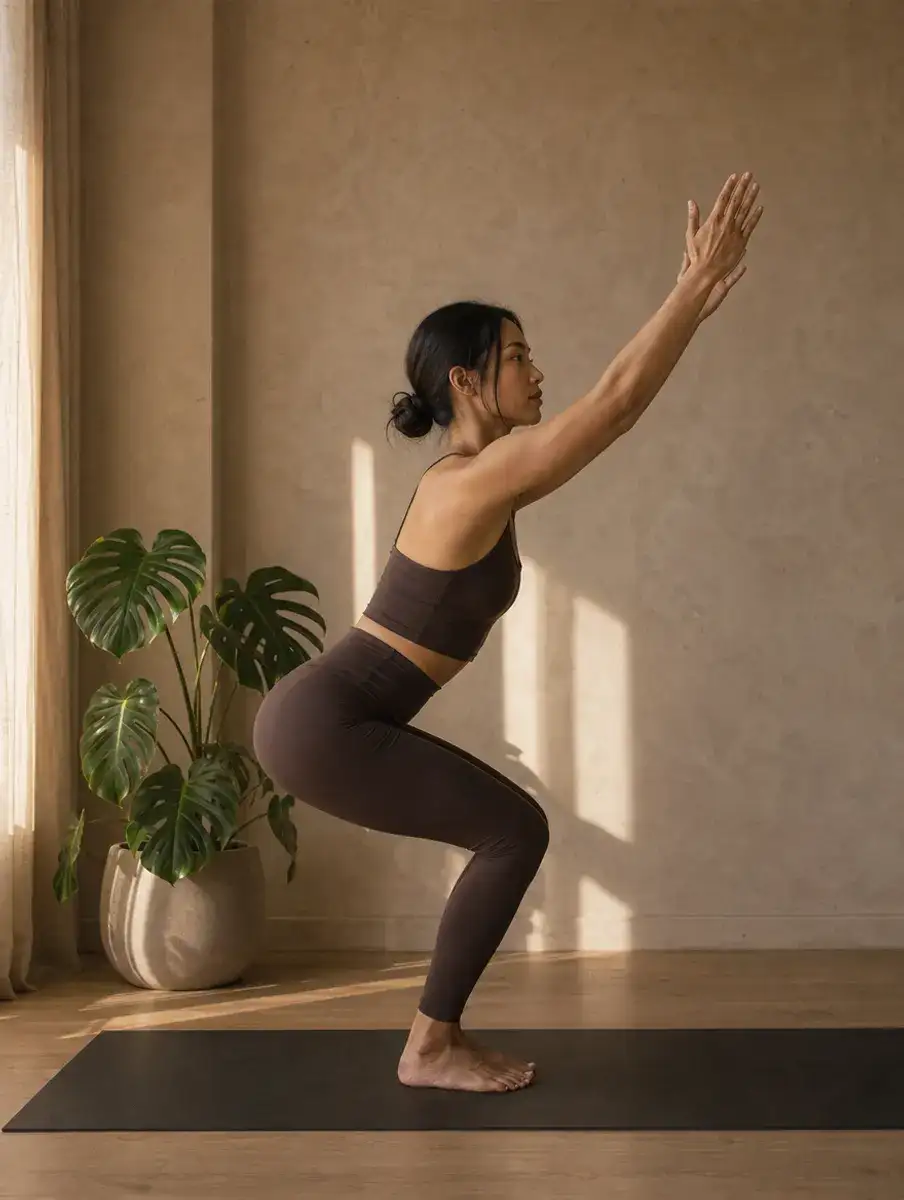
Chair Pose (Utkatasana) is a standing pose that works the legs as you sit back onto an invisible seat. Lift the arms, bend the knees and send the hips back, weight in the heels, for three to six breaths. Keep the knees pointing toward the second toes, and practise with your back against a wall for support.
Pronunciation and meaning
Utkatasana: oot-kah-TAHS-uh-nuh. Four beats, with the weight of the word landing on TAHS.
Utkata can be read as powerful, fierce or uneven, and asana means posture. In English it is Chair Pose, because you sit back as if lowering onto a seat that is not there.
How to do Chair Pose
- Stand with your feet together or hip-width apart, big toes pointing straight ahead and arms by your sides.
- Breathing in, lift your arms forward and up, shoulder-width apart, palms facing each other.
- Breathing out, bend your knees and send your hips back and down, as though you were about to sit on the edge of a stool behind you.
- Glance down: you should still see your toes past your knees, and your weight should rest more in your heels than in the balls of your feet.
- Draw the low belly gently in, lengthen your tailbone toward the floor so the lower back does not over-arch, and let your chest lift between your arms.
- Hold for three to six breaths, then press through your feet to straighten your legs and lower your arms.
Chair Pose step by step

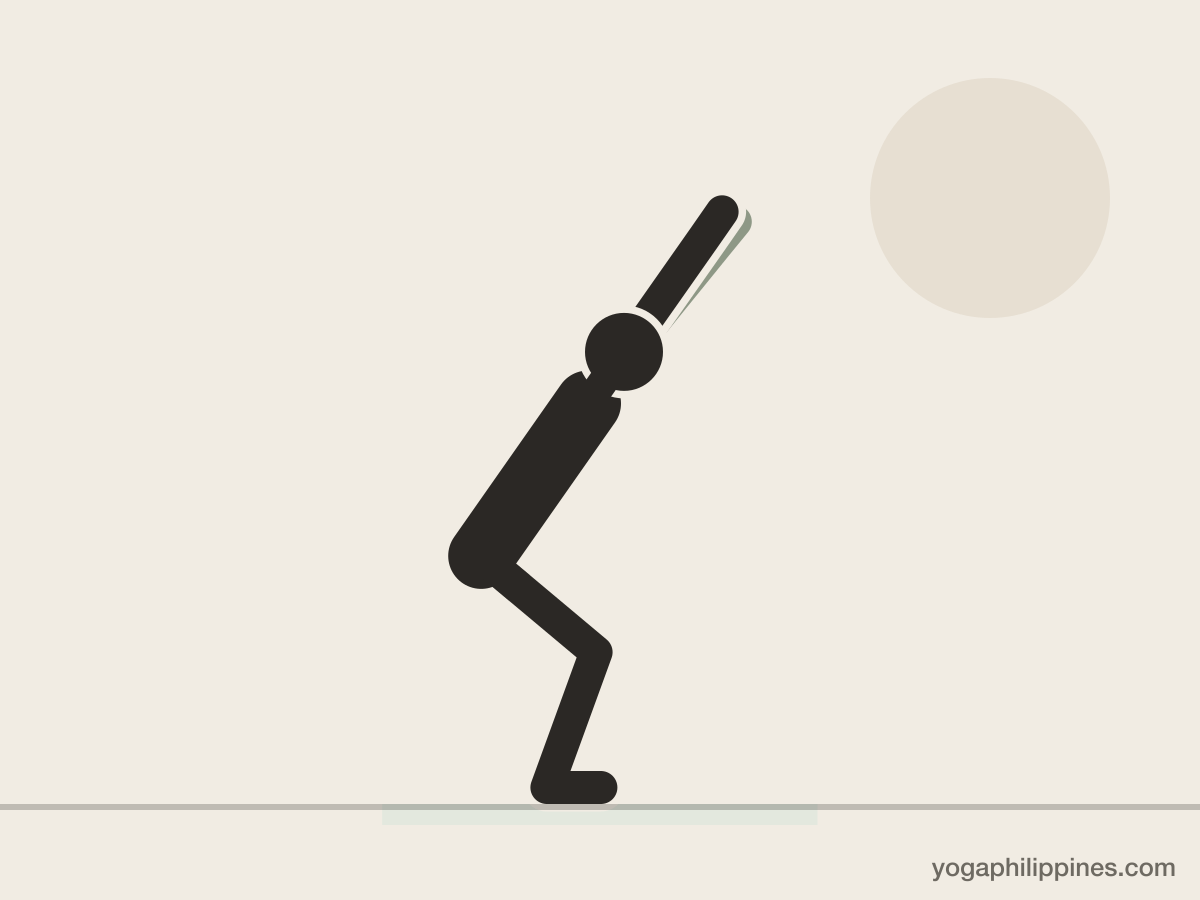
Drawings and video by YogaPhilippines.com, free to reuse under CC BY 4.0 with credit and a link: see the image licence for how to credit.
Chair Pose appears in the 90-minute Ashtanga primary series and the 90-minute Bikram 26 poses, both printable with holds and cues. For other poses that work the quads, open the pose finder set to the quads.
Teacher's note from Joahnna Lee
“I want you to feel your heels working. If you could wiggle your toes right now, you are in the right place.”
“Think of the thighs moving back and the arms reaching forward. Those two directions pull you long instead of folding you in half.”
“Keep the neck easy. If the shoulders crowd your ears, lower the arms to shoulder height or bring the palms to your chest; the legs are doing the real work.”
Make it easier
- Take the feet hip-width apart if keeping them together makes the knees knock or the balance tip.
- Squeeze a yoga block between your thighs to wake up the inner legs and keep the knees tracking forward.
- Rest your back against a wall and slide down only as far as feels steady, with your hands on your thighs.
Pregnancy and after birth
Pregnancy. Adapt. Take your feet wider than your hips so there is room for the belly, bend the knees only a little, and keep a hand on a wall or chair. Come out if you feel short of breath or light-headed, and check with your OB or midwife before starting any new practice.
After birth. Adapt. Once your OB or midwife has cleared you to exercise, keep the bend shallow and the breath easy, and skip any twisting version for now. If you notice pressure low in the pelvis or bulging along the middle of your belly, ease out and mention it to your doctor or midwife.
Wondering about yoga safety in pregnancy? Joahnna Lee covers it trimester by trimester.
Common mistakes
- Letting the knees drift far past the toes, which moves the weight onto the front of the foot and the knee joint.
- Sticking the bottom out and arching hard through the lower back. Lengthen the tailbone down a little instead.
- Knees falling in toward each other. Keep them pointing the same way as the second toe.
Chair Pose looks simple and feels strong within a few breaths. It turns up in many Vinyasa sequences, often between forward folds, and it is a good place to learn how the hips, knees and feet line up whenever you bend your legs.
It comes up again and again in a Vinyasa flow, so the alignment is worth learning early.
It is not the same thing as chair yoga, where you practise sitting on a real chair or holding its back for balance. That gentler practice has its own page: chair yoga and gentle practice for older adults.
From this low seat it is a short step to Eagle Pose, which wraps one leg around the other.
Step the feet wide and turn them out, and the same bend becomes the wide squat pose, Utkata Konasana.
How long should you hold Chair Pose?
Three to six breaths is a good starting hold. As the legs get stronger you can build toward ten breaths, as long as the weight stays in the heels and the breath stays smooth. If the knees start to drift forward or the shoulders climb, that is the end of the hold, whatever the count.
Which variations of Chair Pose are there?
| Variation | What changes | Try it when |
|---|---|---|
| Hands at the heart | Palms together at the chest instead of overhead | The shoulders or neck feel tight |
| Chair at a wall | Back against a wall, sliding down only a little | You are new or the knees need support |
| Revolved Chair | Hands at the heart, one elbow hooked outside the opposite knee | The basic shape feels steady |
| Heels lifted | Rise onto the balls of the feet, knees bent | You want a balance challenge |
A three-minute Chair Pose routine for small spaces
This needs no more room than a doorway, which makes it handy in a condo or before you leave for work.
- Mountain Pose for three breaths.
- Chair Pose for five breaths, then stand up.
- Chair Pose with a block between the thighs for five breaths.
- Revolved Chair, three breaths each side.
- Chair Pose with the back against a wall for five breaths.
- Fold forward with the knees soft for five breaths, then roll up slowly.
On a sweaty morning, do it barefoot on a mat rather than on smooth tiles, so the feet stay put.
Prep poses for Chair Pose
Poses that warm up the same body areas at a lower intensity, so Chair Pose feels steadier when you get there.
- Mountain Pose (Tadasana) a direct preparation, beginner
Counter-poses for Chair Pose
Shapes that move the body the other way or let it rest straight after Chair Pose.
- Standing Forward Bend (Uttanasana) beginner
Where to go next after Chair Pose
These poses list Chair Pose as a preparation, so they are a natural next step once it feels comfortable.
- Eagle Pose (Garudasana) intermediate
Props that help in Chair Pose
- Block: brings the floor closer under the lower hand, so the legs and spine can stay long.
- Wall: gives a steady point to lean on or press into for balance and alignment.
Programs and sessions that use Chair Pose
- The month-long yoga challenge 2 of its 30 sessions
- The 4-week beginner program 1 of its 12 sessions
- Sequences: 30-minute flow, slow 45-minute session, Ashtanga primary sequence, Bikram sequence and standing balance sequence
- Practice app sessions: 20-minute flow, 30-minute practice, morning wake-up and balance
This page is one of the sources behind the camera form check.
Sources: Mayo Clinic, Fitness program: 5 steps to get started; NCCIH (US National Institutes of Health), Yoga: Effectiveness and Safety; NHS, Exercise in pregnancy; CDC, Pregnant & Postpartum Activity: An Overview; Canadian Family Physician (Chan et al., 2014), via PubMed Central, Hot yoga and pregnancy: Fitness and hyperthermia. Last reviewed 2 October 2026.
Chair Pose questions
What muscles does Chair Pose work?
Mostly the front and back of the thighs and the buttocks, with the calves, the muscles along the spine and the shoulders helping to hold the arms up.
Is Chair Pose bad for your knees?
It should not be, as long as the knees track in line with the toes and you bend only as far as you can keep weight in your heels. If you have a knee injury or feel pain, keep the bend shallow, try the wall version, and ask a doctor or physiotherapist what suits you.
What is Chair Pose good for?
Chair Pose builds strength in the fronts and backs of the thighs and the buttocks, with the calves, back muscles and shoulders helping. It also teaches how the hips, knees and feet line up whenever you bend your legs, which carries into many other standing poses. Many teachers use it to warm the legs in a Vinyasa flow.
Why is Chair Pose so hard?
Your thighs and buttocks hold most of your weight in a bent-knee position while your arms reach up, so the legs tire within a few breaths. Keeping the weight in the heels adds work. Lower the arms to the chest, bend the knees less or lean on a wall, and build the hold slowly over time.
Who should avoid Chair Pose?
Take care, or skip it, if you have a knee, hip or ankle injury, or knee pain that gets worse as you bend. Use the wall version with a shallow bend, and lower the arms if your shoulders or neck complain. Stop for any sharp pain, and check with your doctor or physio first if you are unsure.
Is Chair Pose good for beginners?
Yes. It needs no flexibility and no props, so it is one of the first standing poses many beginners learn. Start with three to six breaths, feet hip-width apart, and a modest bend. A wall behind your back or a block between the thighs helps you find the shape before you hold it longer.
Pairs well with
Updated