Pose library · Ashta Chandrasana
Crescent Lunge (Ashta Chandrasana)
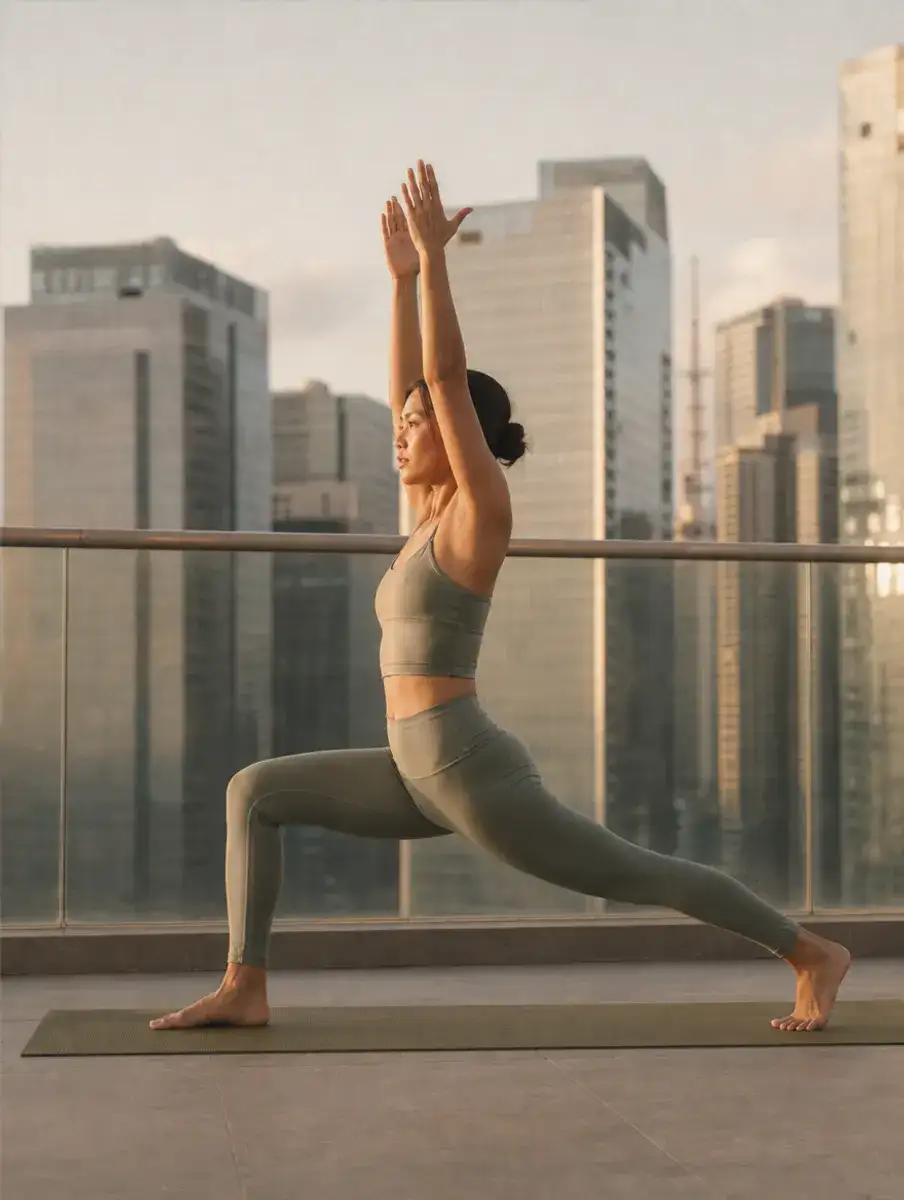
Chandra means moon and asana means posture, and the name is often translated as crescent moon posture. It is a high lunge: the front knee bends over the ankle, the back knee stays lifted off the floor, and the arms reach up so the body makes a long curve.
Crescent Lunge (Ashta Chandrasana) is a high lunge with the back knee lifted, working the legs and opening the front of the back hip. Step one foot forward with the knee over the ankle, keep the back leg long and strong, rise and reach up for five breaths. Lower the back knee to a blanket if balance tires.
Pronunciation and meaning
Ashta Chandrasana: AHSH-tuh chun-DRAHS-uh-nuh. Ashta stresses the first syllable, and Chandrasana stresses DRAHS.
Chandra means moon and asana means posture, and the name is often translated as crescent moon posture. It is a high lunge: the front knee bends over the ankle, the back knee stays lifted off the floor, and the arms reach up so the body makes a long curve.
How to do Crescent Lunge
- From Downward-Facing Dog, step your right foot forward between your hands, with the right knee over the right ankle.
- Keep the back knee lifted. Stand on the ball of the left foot, heel reaching back, and press the back thigh up so the back leg is long and strong.
- Inhale and rise up, lifting the chest and bringing the shoulders over the hips. Hands can rest on the front thigh or on the hips at first.
- Reach the arms overhead, shoulder-width apart, and draw the tailbone gently down so the lower back stays long.
- Stay for five breaths, keeping the front knee tracking over the second toe and the hips level.
- Exhale, bring the hands down beside the front foot, step back to Downward-Facing Dog, and repeat with the left foot forward.
Crescent Lunge step by step

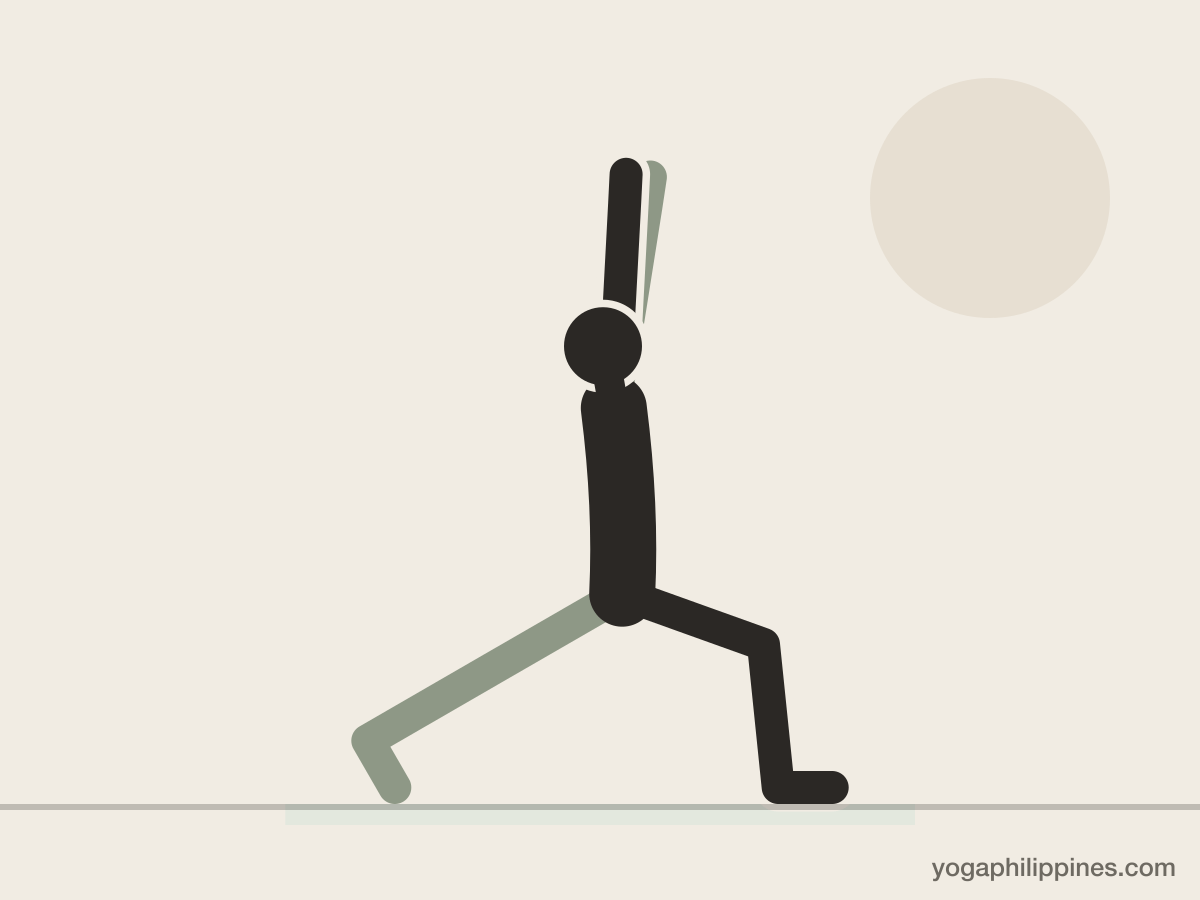
Drawings and video by YogaPhilippines.com, free to reuse under CC BY 4.0 with credit and a link: see the image licence for how to credit.
For other poses that work the hips, open the pose finder set to the hips.
Make it easier
- Lower the back knee onto a blanket and practise Low Lunge instead if the balance or the back leg is tiring.
- Keep the hands on the hips, or on blocks beside the front foot, rather than lifting the arms.
- Shorten the stance a little if the front knee travels past the ankle.
Pregnancy and after birth
Pregnancy. Adapt. Widen the feet side to side for balance and room for the belly, keep a hand on a wall or chair, and keep the front knee bend moderate. Check with your OB or midwife.
After birth. Adapt. After your doctor or midwife has cleared you, begin with the back knee down in Low Lunge and work up to lifting it. Ease off if you feel pain at the pubic bone or along a caesarean scar.
For more on practising through pregnancy, see Joahnna Lee Yoga.
Common mistakes
- Letting the front knee drift past the ankle or cave inward.
- Bending the back knee and sinking, so the back leg stops working.
- Arching hard through the lower back to lift the arms higher.
Crescent Lunge, also called High Lunge, is a standing pose that turns up often in Vinyasa classes and in Sun Salutation B variations. It works the front leg, lengthens the back leg and asks for steady balance.
The key point is the back knee. In this pose it stays lifted, so the back leg is active from heel to hip. When the back knee rests on the floor, the shape is a different pose, Low Lunge, the kneeling version, which is gentler and easier to hold.
When should you choose crescent lunge over low lunge?
Choose crescent lunge when you want strength and balance, and Low Lunge when you want a calmer stretch for the front of the hip. Many teachers move from Low Lunge into crescent lunge as the class warms up. If the back leg shakes or the knee complains, lowering the knee is always fine. For both lunges side by side, with the move from one to the other, see low lunge vs high lunge.
Where does it lead?
It builds the legs for Warrior I, II and III, and its long back leg is the same one used in Downward-Facing Dog. The hip flexor stretches routine pairs well on rest days.
Prep poses for Crescent Lunge
Poses that warm up the same body areas at a lower intensity, so Crescent Lunge feels steadier when you get there.
- Low Lunge (Anjaneyasana) a direct preparation, beginner
- Star Pose (Utthita Tadasana) gentler work for the same area, beginner
- Tree Pose (Vrksasana) gentler work for the same area, beginner
- Garland Pose (Malasana) gentler work for the same area, beginner plus
Counter-poses for Crescent Lunge
Shapes that move the body the other way or let it rest straight after Crescent Lunge.
- Downward-Facing Dog (Adho Mukha Svanasana) beginner plus
Easier and harder variations of Crescent Lunge
Related poses from the same family that start from the same position and do a similar kind of work; Crescent Lunge itself is beginner plus.
- Harder: Warrior III (Virabhadrasana III) intermediate
Props that help in Crescent Lunge
- Block: brings the floor closer under the lower hand, so the legs and spine can stay long.
Programs and sessions that use Crescent Lunge
- The 14-day flexibility plan 1 of its 14 sessions
- The month-long yoga challenge 1 of its 30 sessions
- Sequences: 30-minute flow and flow without wrist load
- Practice app sessions: 30-minute practice and balance
- Generated example flows: 20-minute hip flow
Sources: Mayo Clinic, Fitness program: 5 steps to get started; NCCIH (US National Institutes of Health), Yoga: Effectiveness and Safety. Last reviewed 2 October 2026.
Crescent Lunge questions
What is the difference between crescent lunge and low lunge?
In crescent lunge the back knee is lifted, so the back leg works hard and the pose becomes a standing balance. In Low Lunge the back knee rests on the floor, which makes it steadier and gives a deeper, easier stretch at the front of the back hip.
Is a high lunge the same as crescent lunge?
In most classes, yes. Some teachers use high lunge for the version with hands on the hips or the floor and crescent for the version with arms overhead, but the legs are the same.
How is crescent lunge different from Warrior 1?
In Warrior 1 the back heel is down and the back foot turns out. In crescent lunge the back heel lifts and the back toes point forward, so the hips face the front more easily.
What are the benefits of Crescent Lunge?
Crescent Lunge builds strength in the front leg, works the back leg from heel to hip and stretches the front of the back hip. Lifting the back knee turns it into a standing balance, so it also asks for steadiness. Many people use it to warm the legs for the Warrior poses in a Vinyasa flow.
Pairs well with
Updated