Stretches · reviewed by a teacher
Stretches for hip flexors tightened by sitting
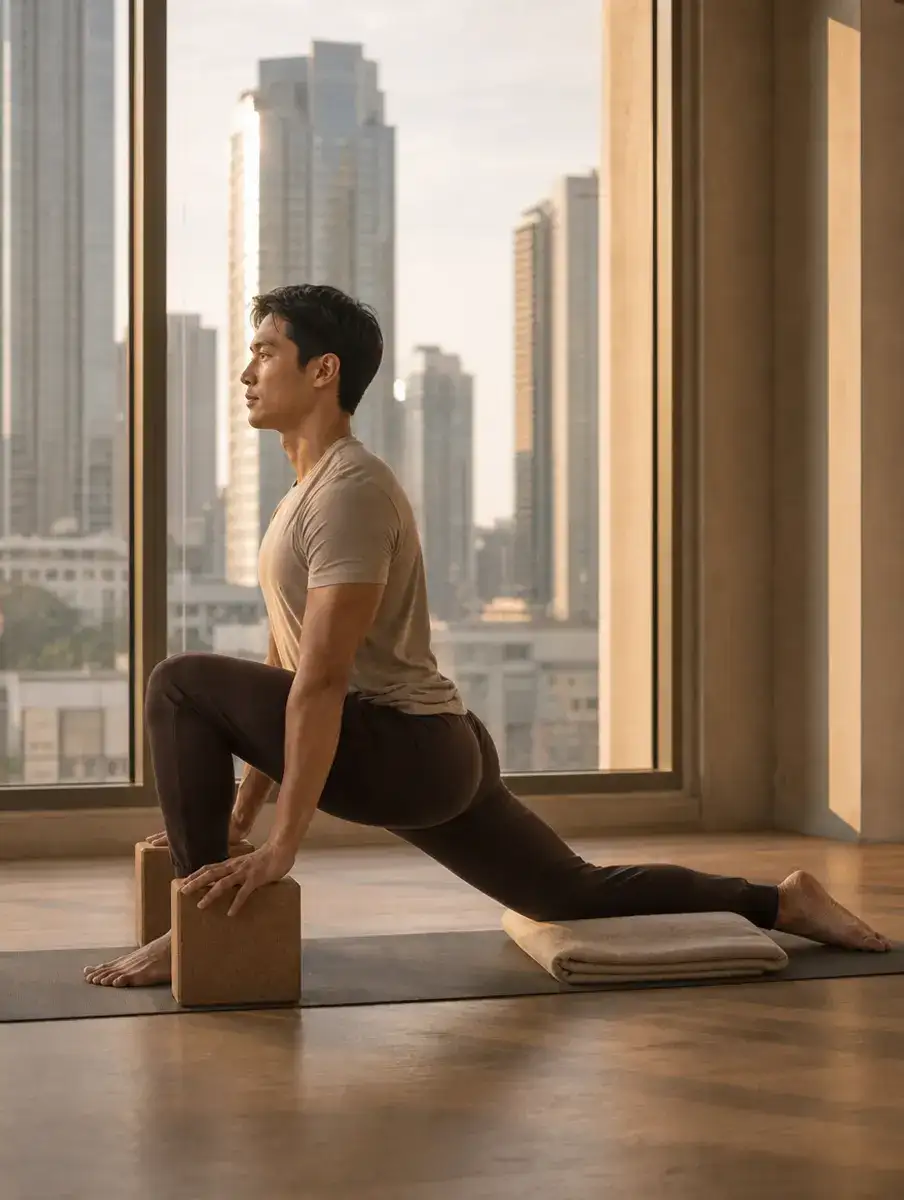
The simplest hip flexor stretch is a low lunge with the back knee on a cushion: tuck the tailbone slightly, keep the front knee over the ankle and ease the hips forward until the front of the back hip opens, holding for five to eight breaths. The variations below make it gentler, deeper or possible at a desk.
Teacher's note from Joahnna Lee
“Many students need more padding under the knee than they expect, or a chair instead of the floor.”
The hip flexors are the muscles at the front of the hip that lift the knee towards the chest. The largest of them, the iliopsoas, runs from the lower spine and pelvis to the top of the thigh bone. When you sit, they rest in a shortened position; when you stand up after hours in a chair, the front of the hips can feel stiff and the first few steps feel short.
The low lunge is the classic stretch for this, and it is also one of the shapes that turns up again and again in a flowing practice. In a Vinyasa practice that moves with the breath, you pass through it in every round, which is a good way to keep the hips used to opening.
Below are five lunge variations, from gentle to deep, then two shapes to finish.
Why does sitting make the hips feel tight?
Muscles adapt to the positions we spend the most time in. A long day at a desk, a long drive and an evening on the sofa keep the hips bent for most of the waking day. The hip flexors are not damaged by this, but many people find the front of the hip feels short and resists the first stretch of the day. Standing up regularly matters as much as stretching: a short walk every half hour or so asks the hips to open without any effort at all.
Before you start: how should it feel?
You should feel a broad stretch across the front of the hip and the top of the thigh on the back leg. Kneeling can be hard on the knees, so always pad the back knee with a folded blanket or cushion. Come out if you feel a pinch at the front of the hip joint, pain in the knee, or pain in the lower back. If you have had a hip replacement or recent hip surgery, ask your surgeon or physiotherapist which positions are safe for you.
The routine: five lunge variations and two finishing shapes
Hold each for five to eight slow breaths, about 30 to 45 seconds, then switch sides.
- Low lunge, hands on blocks. From hands and knees, step the right foot forward between the hands. Lower the left knee to a cushion and slide it back until the front knee is over the ankle. Rest the hands on blocks. Tuck the tailbone a little, as if dropping the belt line towards the floor. That small tuck is what moves the stretch to the front of the back hip.
- Low lunge, arms up. From the same shape, lift the chest and reach the arms up, with the hands on the front thigh if raising the arms tips you into the lower back. Keep the ribs soft. This adds a stretch along the side of the body.
- Standing lunge at a chair. Hold the back of a sturdy chair, step one foot back into a short lunge with the back heel lifted and the back knee slightly bent, and tuck the tailbone. Good for anyone who cannot kneel. It is a gentler cousin of the Warrior poses with a short stance.
- Kneeling lunge with a strap (the gentler couch stretch). In low lunge with the left knee down, loop a strap around the left ankle and hold it over your right shoulder. Gently draw the heel towards the seat only as far as the knee and hip feel comfortable. You get the front-of-thigh stretch of the couch stretch without the wall forcing the knee to bend fully.
- Lizard for the deep version. From low lunge, walk the right foot a little to the right and lower the hands, or the forearms, onto blocks. In Yin this is held for minutes, where it is called Dragon Pose with the back knee down. Stay with the gentle version if the hip pinches.
- Supported bridge. Lie on your back with the knees bent and slide a block under the sacrum. Let the hips rest on it. The fronts of both hips open passively. The Bridge Pose page shows the supported set-up.
- Lying quad and hip stretch. Lie on your side, bend the top knee and hold the ankle or a strap, drawing the knee slightly back. A quiet way to finish.
No blocks at home? Thick books work, or see the guide to yoga blocks and straps.
Can you stretch your hip flexors at a desk?
A little. Sit sideways on a chair so the right thigh hangs off the front edge, then lower the right knee towards the floor and slide that foot back, keeping the left foot flat. Sit tall and tuck the tailbone. It is a seated lunge, and it fits between meetings. Then stand up and walk for a minute.
What else should you stretch with the hips?
The backs of the legs and the lower back often complain on the same long days. The seven hamstring stretches, from standing to lying down balance the lunges here, and the lower back routine that starts on the floor is a good follow-on if your back is stiff. Low lunge and lizard are also the two shapes at the heart of working towards the splits. For runners, Pigeon for the outer hip is the natural partner to this page. The front of the thigh comes next with quad stretches standing, kneeling and lying, while the hip stretches for every direction the hip moves and the glute stretches for the back of the hips cover the rest of the joint.
To see whether the lunges are working, measure the back-hip angle every four weeks with the lunge test in the camera mobility assessment; it stays on your phone and charts each retest.
How a teacher adapts these stretches
A teacher will usually ask about your knees and hips first, then watch how you kneel and step forward. Many people need more padding under the knee than they expect, or a chair instead of the floor. If you are unsure whether to kneel or stand, the comparison of the kneeling and the high lunge shows what each asks of the knees. Warm up with movement before holding anything, and change or leave any shape whenever you need to.
Best time to do it
5 of the 6 moves are slow holds meant for the end of a session, so this routine suits the time after a walk, a workout or a class, when the body is already warm, or a quiet few minutes in the evening.
How long to hold each move
Holds below are for a medium pace; at a slower pace, stay up to the longer time. Moves marked each side are done on both sides.
| Move | Hold | Slower pace |
|---|---|---|
| Low Lunge | 30 s each side | 45 s |
| Standing Lunge at a Chair | 30 s each side | 45 s |
| Kneeling Quad Stretch | 30 s each side | 45 s |
| Lizard Pose | 40 s each side | 1 min |
| Supported Bridge | 1 min | 1 min 30 s |
| Side-Lying Quad Stretch | 30 s each side | 45 s |
Pair it with
Other stretching routines that work the same areas, for a longer session or the next day:
- Gentle knee stretches for stiff, tired knees also works the hips and quads
- Working towards the splits, slowly and safely also works the hips and quads
- Inner thigh stretches also works the hips and quads
This page feeds the body map pose finder.
Browse all stretching routines.
Sources: Mayo Clinic, Fitness program: 5 steps to get started; NCCIH (US National Institutes of Health), Yoga: Effectiveness and Safety; NHS, Exercise in pregnancy; CDC, Pregnant & Postpartum Activity: An Overview; Canadian Family Physician (Chan et al., 2014), via PubMed Central, Hot yoga and pregnancy: Fitness and hyperthermia. Last reviewed 2 October 2026.
Questions
What is the couch stretch, and is it safe?
The couch stretch is a deep kneeling lunge with the back shin propped up against a couch or wall, which bends the back knee fully and stretches the front of the thigh and hip strongly. It is fine for some people, but it puts a lot of pressure through the back kneecap and is easy to overdo. The kneeling lunge with a strap, step 4 below, gives a similar stretch with more control.
Can tight hip flexors cause lower back pain?
Tightness at the front of the hips is often mentioned alongside lower back discomfort, but back pain has many causes and a stretch cannot tell you which one is yours. If your back hurts, see a doctor or physiotherapist, and treat these stretches as gentle movement rather than a treatment.
How do tight hip flexors feel?
Many people notice the front of the hip feels stiff and short after hours of sitting, and the first few steps after standing up feel shorter than usual. A low lunge may resist at first. Tightness is a feeling, not a diagnosis, so if you have pain, a pinch in the hip or back pain, see a doctor or physio.
Does walking loosen tight hip flexors?
Walking helps. Each step takes the back leg behind you, which asks the front of the hip to open without effort. Standing up and walking for a minute every half hour or so matters as much as stretching on long desk days. Add a low lunge or two afterwards for a fuller stretch at the front of the hip.
Pairs well with
Your yoga calendar
We track every yoga event, workshop and pop-up class so you don't have to.
Updated