Stretches · reviewed by a teacher
Gentle stretches for a stiff lower back
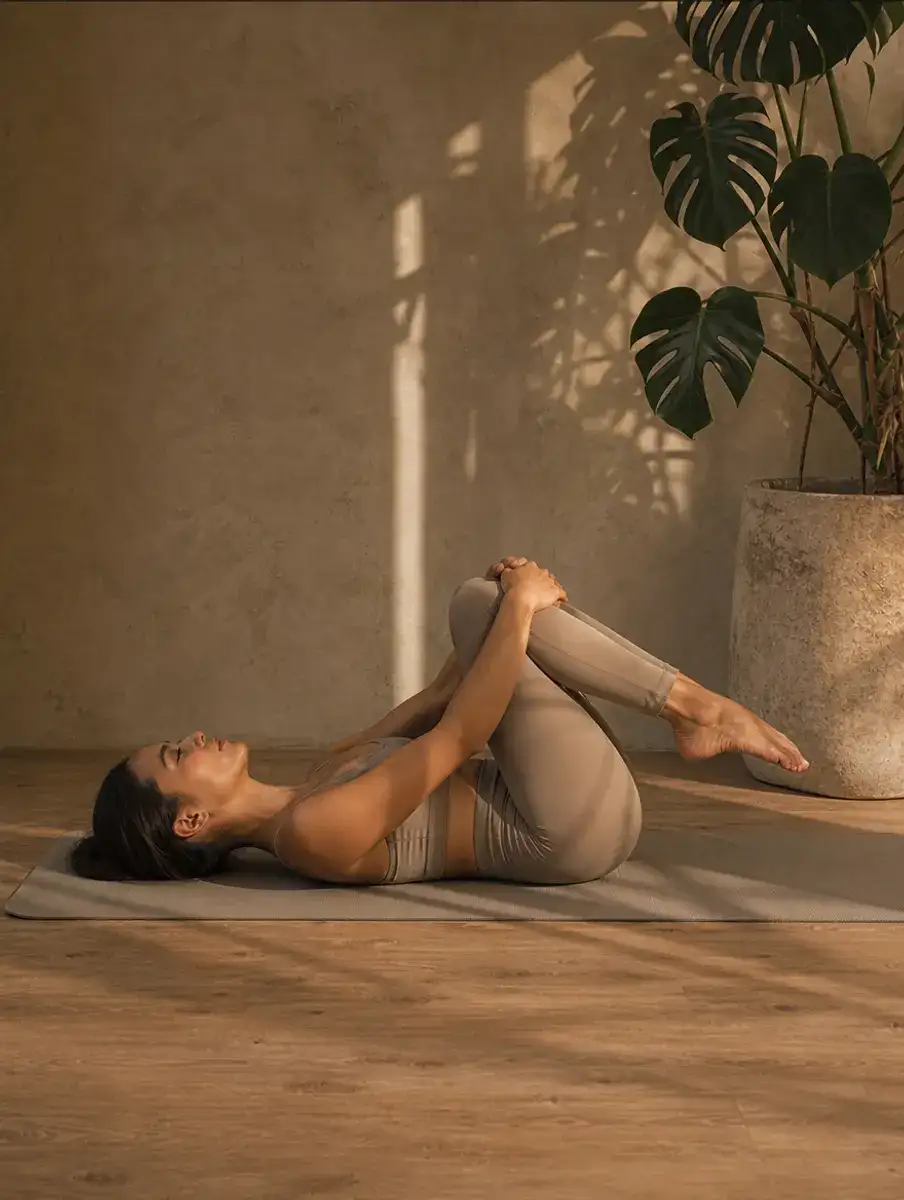
The gentlest lower back stretches are done lying on your back with the knees bent: small pelvic tilts, hugging the knees in, a soft twist and a figure-four hip stretch, each held for five to eight easy breaths. They are for everyday stiffness, not back pain, so see a doctor or physiotherapist first if any warning sign below applies.
Teacher's note from Joahnna Lee
“I am a yoga teacher, not a doctor or physiotherapist. Your clinician's advice always comes before mine.”
A stiff lower back is often a back that has not moved much: a day in a chair, a long drive, a soft sofa, a night curled on one side. The stretches on this page are done almost entirely lying down, with the knees bent, so the back is supported the whole time and gravity does most of the work.
This is the same unhurried, supported way of moving that a restorative practice with bolsters and blankets is built on. Nothing is forced, every shape has a gentler version, and you can stop at any point.
These are yoga stretches, not medical advice, and the health and safety notes apply. Please read the next section before you begin.
When should you see a doctor or physio instead?
See a doctor or physiotherapist before stretching if your lower back pain:
- started after a fall, an accident or lifting something heavy and has not settled;
- travels down a leg, especially below the knee, or comes with numbness, tingling or weakness in a leg or foot;
- comes with fever, unexplained weight changes, or a history of cancer;
- is worse at night or when lying still, or is steadily getting worse.
Go to the emergency room straight away if back pain comes with numbness around the genitals or buttocks, or new trouble passing urine or controlling the bladder or bowels.
The fuller list, and what yoga can and cannot do for a sore back, is on the page about gentle yoga and back pain. If you have a diagnosed disc problem, a spinal fracture or have had back surgery, use these stretches only once your doctor or physio has said they suit you.
How should these stretches feel?
Easy. Think of them as movement rather than stretching hard. You should feel the lower back softening and the hips loosening, never a sharp, pinching or shooting feeling. Breathe slowly, and let each out-breath settle you a little further into the floor. If one shape does not agree with your back today, skip it.
The routine: a gentle 10-minute sequence
Lie on a mat or a rug, knees bent, feet flat and hip-width apart, a folded towel under your head if your chin points upwards.
- Breathe into the back (1 minute). Rest the hands on the lower ribs. Breathe in slowly and feel the ribs widen into the floor; breathe out longer. Six to eight breaths.
- Pelvic tilts (1 minute). Breathing out, gently press the lower back towards the floor by tipping the pelvis; breathing in, let the lower back lift a little. Small, slow, ten times.
- One knee to chest (1 minute). Draw the right knee towards the chest with the hands behind the thigh, the left foot staying on the floor. Five breaths, then the left knee.
- Both knees to chest (1 minute). Hug both knees in and rock gently from side to side, massaging the lower back against the floor.
- Soft supine twist (2 minutes). Arms out wide, let both knees fall slowly to the right, with a cushion under the knees if they do not reach the floor. Keep both shoulders down. Five to eight breaths, then the left side. Small is fine.
- Figure four (2 minutes). Cross the right ankle over the left knee and, if it feels good, lift the left foot and hold behind the left thigh. You feel the outer right hip. Five to eight breaths each side. Leave the left foot on the floor if that is enough.
- Happy baby, gently (1 minute). Hold the backs of the thighs or the outer feet, knees wide, and let the lower back rest. Happy Baby with the hands behind the thighs is the gentler way in.
- Rest (1 minute or more). Roll to the side and come onto hands and knees for a few slow rounds of Cat-Cow with a small range, then sit back into Child’s Pose with a cushion under the chest for as long as you like.
Can you stretch your lower back in a chair?
A little. Sit on the front of the chair, feet flat, and fold forward slowly with the chest resting on the thighs and the arms hanging. Breathe into the back for five breaths and roll up. Then stand and walk; for an office back, getting up often helps more than any single stretch. Gentle mobility exercises for the spine and hips, several of them done seated, are another option between meetings.
What else should you stretch for a stiff back?
The hips and legs pull on the pelvis, so a stiff lower back often comes with tight hamstrings and hip flexors. The strapped hamstring stretch lying down and the low lunge with the back knee padded are the natural next steps. On better days, the 15-minute routine of flexibility exercises works through the hips and legs in one go. If mornings are your stiffest time, the ten-minute morning stretch, starting in bed eases you in. To add a few gentle yoga shapes to these stretches, follow the timed back-friendly floor sequence, which stays mostly on the floor.
How a teacher adapts for a stiff back
A careful teacher will ask where your back feels stiff, what makes it worse and whether a doctor or physio has seen it. If any warning sign applies, they should send you to a clinician first. In a class, expect to stay low and supported, with bolsters under the knees and hips, and your clinician’s advice always comes first.
Best time to do it
Of the 9 moves, 6 work as warm-up moves and 7 as slower cool-down holds (some do both), so it fits most times of day after a few minutes of walking or easy movement. You can also split it: the gentler moving parts before exercise, the longer holds after. Most of the moves are calm, unhurried shapes, which many people like before bed.
How long to hold each move
Holds below are for a medium pace; at a slower pace, stay up to the longer time. Moves marked each side are done on both sides.
| Move | Hold | Slower pace |
|---|---|---|
| Breathing into the Back | 1 min | 1 min 30 s |
| Pelvic Tilts | 40 s of slow rounds | 1 min |
| Single Knee to Chest | 30 s each side | 45 s |
| Knees to Chest | 40 s | 1 min |
| Supine Twist | 1 min each side | 1 min 30 s |
| Figure Four | 45 s each side | 1 min 10 s |
| Happy Baby Pose | 45 s | 1 min 10 s |
| Cat-Cow | 45 s of slow rounds | 1 min 10 s |
| Child's Pose | 45 s | 1 min 10 s |
Pair it with
Other stretching routines that work the same areas, for a longer session or the next day:
- A 10-minute wake-up routine, in bed and on the floor also works the lower back and spine
- Full body stretch routine also works the lower back and spine
- Six IT band stretches for the outside of the thigh also works the lower back and spine
This page is one of the sources behind the sit-and-reach scorer and the body map pose finder.
Browse all stretching routines.
Sources: Mayo Clinic, Fitness program: 5 steps to get started; NCCIH (US National Institutes of Health), Yoga: Effectiveness and Safety; NHS, Exercise in pregnancy; CDC, Pregnant & Postpartum Activity: An Overview; Canadian Family Physician (Chan et al., 2014), via PubMed Central, Hot yoga and pregnancy: Fitness and hyperthermia; NHS, Back pain. Last reviewed 2 October 2026.
Questions
Is it better to stretch my lower back in the morning or at night?
Either works. Many people feel stiffest when they first get up, so a few minutes of slow movement in the morning can help them get going, while the evening suits longer, quieter holds. Go more gently in the first hour after waking, when the back tends to feel least supple.
Should I stretch through lower back pain?
No. Gentle movement that feels easy is fine for everyday stiffness, but a stretch that sharpens the pain, or pain that spreads into the leg, is a sign to stop. Ask a doctor or physiotherapist what kind of movement suits your back before you try again.
Pairs well with
Your yoga calendar
We track every yoga event, workshop and pop-up class so you don't have to.
Updated