Pose library · Balasana · reviewed by a teacher
Child's Pose (Balasana)
Bala means child and asana means posture. You fold forward over your knees with your forehead down, much like the curled shape a small child often sleeps in.
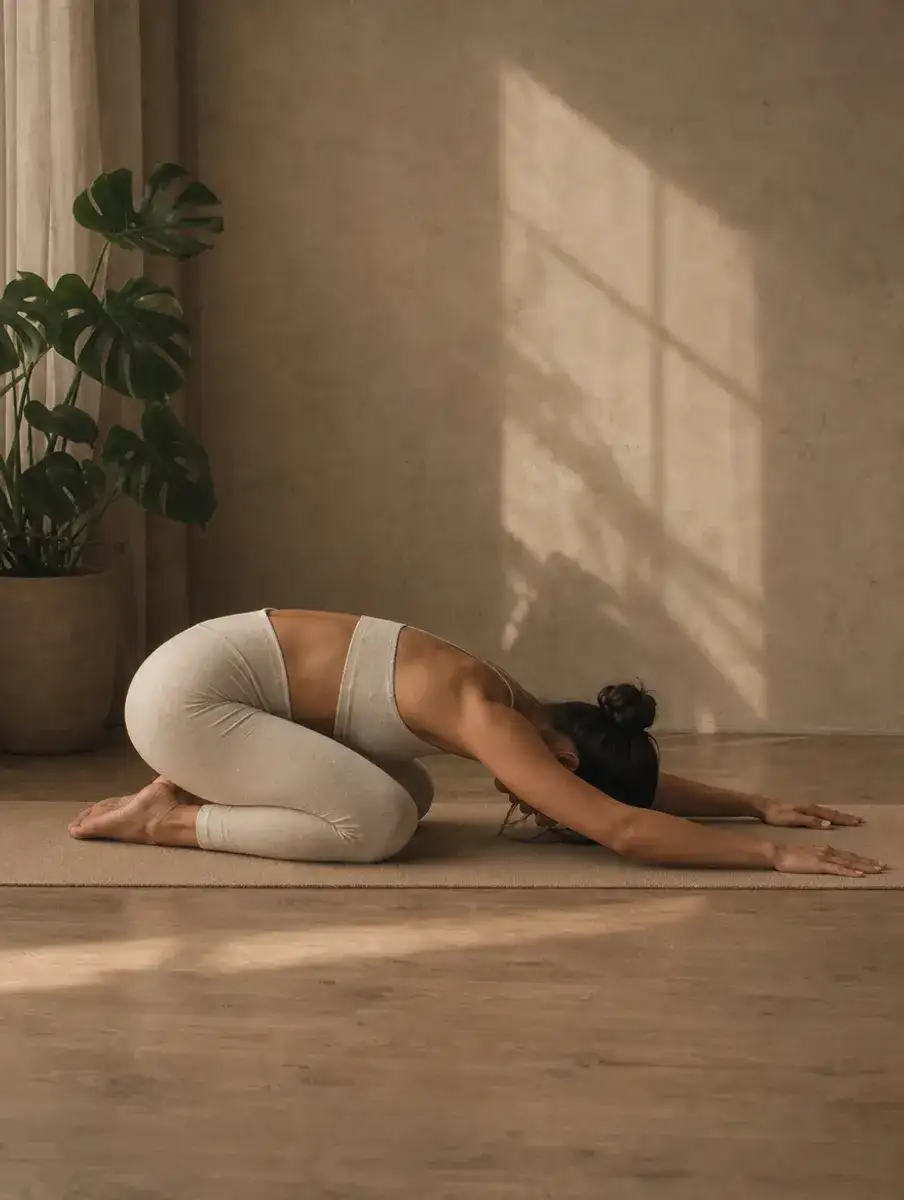
Child's Pose (Balasana) is a resting fold that gently stretches the back. Kneel with the big toes touching, sit the hips toward the heels, walk the hands forward and rest the forehead down for five to ten breaths, breathing into the back of the ribs. Widen the knees if the belly feels squashed, and never force the hips down.
Pronunciation and meaning
Balasana: bah-LAHS-uh-nuh. Lean on LAHS and keep the other syllables soft.
Bala means child and asana means posture. You fold forward over your knees with your forehead down, much like the curled shape a small child often sleeps in.
How to do Child's Pose
- Kneel on your mat with your big toes touching and your knees together or as wide as the mat.
- Sit your hips back toward your heels, only as far as they go easily.
- Walk your hands forward and fold over your thighs until your forehead rests on the mat.
- Choose your arms: reach them long in front with the palms down, or lay them beside your body with the palms up.
- Let your breath move into the back of your ribs, so you can feel your back widen on each inhale.
- Stay for five to ten breaths, or for as long as you like between harder poses, then walk your hands back and rise slowly.
Child's Pose step by step

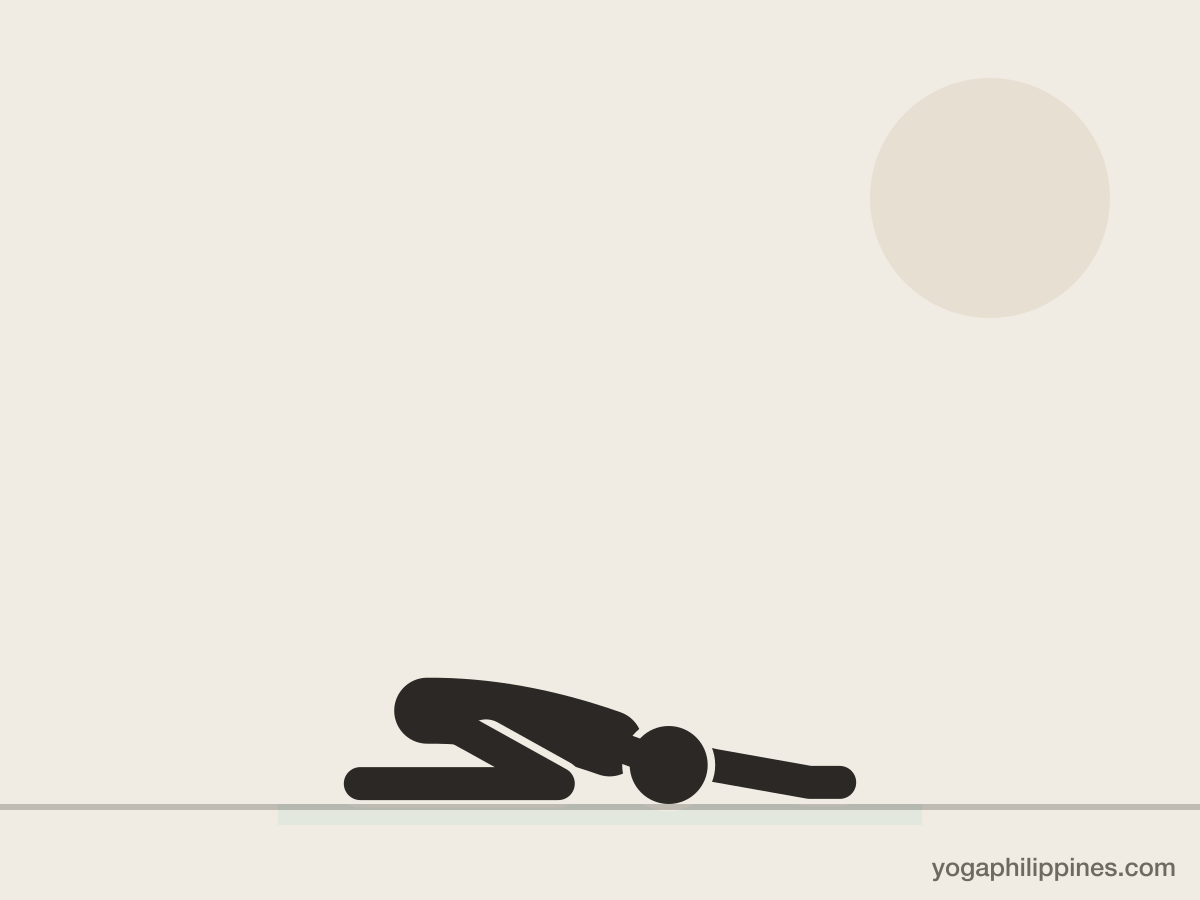
Drawings and video by YogaPhilippines.com, free to reuse under CC BY 4.0 with credit and a link: see the image licence for how to credit.
Child's Pose appears in the 6-pose bedtime wind-down sequence and the 7-pose core strength sequence, both printable with holds and cues. For other poses that work the lower back, open the pose finder set to the lower back.
Teacher's note from Joahnna Lee
“With the arms forward, press your palms lightly into the mat and draw your hips back. I want a gentle stretch along the sides of the body, not a collapse.”
“Breathe into your back body. This is one of the few shapes where you can clearly feel the back ribs move.”
“If your hips hover above your heels, leave them there. Let them be heavy rather than pushing them down.”
Make it easier
- Take the knees wide if your belly, chest or hips feel squashed with them together.
- Put a folded blanket between your hips and heels if the hips do not reach.
- Rest your forehead on a block or on your stacked fists if it does not reach the floor.
- Place a rolled towel under the fronts of your ankles if the tops of the feet complain.
Pregnancy and after birth
Pregnancy. Adapt. Take the knees wide so the belly has room between the thighs, and rest your head on a block or your hands. If folding forward feels uncomfortable or you get breathless, come up. Check with your OB or midwife before starting yoga in pregnancy.
After birth. Adapt. Once your OB or midwife is happy for you to move, rest in the wide-knee version with a blanket under the hips. After a caesarean, wait until the scar is comfortable with pressure from the thighs before folding fully.
Wondering about yoga safety in pregnancy? Joahnna Lee covers it trimester by trimester.
Common mistakes
- Forcing the hips down onto the heels when the knees or ankles do not want it.
- Resting all the weight on the forehead and scrunching the back of the neck.
- Shrugging the shoulders up toward the ears with the arms forward.
- Holding the breath because the belly is squashed. Widen the knees instead.
Child’s Pose is the pause button of most yoga classes. This is the classic version on the mat, with the body folded and the arms working lightly. It is simple, and it still has a few details worth getting right. The forehead rests at the point between the eyebrows, the spot yoga texts call ajna, the third eye.
If you are new to yoga, it is also the pose to come back to whenever you need a rest, for as long as you like. With a cushion under the chest, it closes the ten-minute stretch for a stiff lower back. If you would like a firmer support than a cushion, the guide to yoga bolsters and blankets covers what to use, including household alternatives.
Lift the hips back over the knees and keep the arms long, and you are in Puppy Pose, Child’s Pose with the hips raised.
Before you sit back into Child’s Pose, you often pass through Table Top Pose, on hands and knees.
Child's Pose or Puppy Pose?
Lift the hips back over the knees and keep the arms long, and Child's Pose becomes Puppy Pose. Child's Pose is the rest; Puppy asks more of the shoulders.
| Compare | Child's Pose | Puppy Pose |
|---|---|---|
| Position | Kneeling | Hands and knees or hands and feet |
| What it works | lower back, hips and spine | shoulders, upper back and chest |
| Level | Beginner | Beginner |
| Key difference | Hips sink back toward the heels and the forehead rests down; it is a resting shape. | Hips stay high over the knees while the arms reach forward and the chest softens toward the mat. |
Poses that lead into Child's Pose
In a sequence, Child's Pose often follows these poses as their counter-pose or rest.
- Wheel Pose (Urdhva Dhanurasana) advanced
- Eight Angle Pose (Astavakrasana) advanced plus
- Firefly Pose (Tittibhasana) advanced plus
- Handstand (Adho Mukha Vrksasana) advanced plus
Where to go next after Child's Pose
These poses list Child's Pose as a preparation, so they are a natural next step once it feels comfortable.
- Child's Pose Side Reach beginner
Props that help in Child's Pose
- Blanket: pads the knees and the tops of the feet.
- Block: brings the floor closer under the hands or sits under the hips.
- Bolster: supports the body so you can stay longer with less effort.
Programs and sessions that use Child's Pose
- The month-long yoga challenge 7 of its 30 sessions
- The 4-week beginner program 5 of its 12 sessions
- The 14-day flexibility plan 2 of its 14 sessions
- The 7-day desk reset 1 of its 7 sessions
- Sequences: 10-minute yoga, 30-minute flow, routine for a stiff back, bedtime wind-down sequence, first home sequence, core strength sequence and wake-up sequence
- Practice app sessions: 10-minute reset, 20-minute flow, 30-minute practice, morning wake-up, evening wind-down and back-friendly
- Generated example flows: 45-minute yin-style wind-down
This page feeds the tool for building your own sequence, the pose name quiz and the random yoga flow.
Sources: Mayo Clinic, Fitness program: 5 steps to get started; NCCIH (US National Institutes of Health), Yoga: Effectiveness and Safety; NHS, Exercise in pregnancy; CDC, Pregnant & Postpartum Activity: An Overview; Canadian Family Physician (Chan et al., 2014), via PubMed Central, Hot yoga and pregnancy: Fitness and hyperthermia. Last reviewed 2 October 2026.
Child's Pose questions
Is Child's Pose a resting pose?
Yes. It is the place to go whenever you need a break in a class, and nobody should mind when you take it. With the arms reaching forward it also gives a gentle stretch through the back and shoulders.
Why does Child's Pose hurt my knees?
Deep knee bending does not suit every knee. Put a blanket behind your knees or between your hips and heels, or try hugging your knees while lying on your back instead. If knee pain persists, ask a doctor or physiotherapist.
What are the benefits of Child's Pose?
Child's Pose gently stretches the back, and with the arms forward, the sides of the body and the shoulders. It is mainly a resting shape: many people find it a calm place to slow the breath and feel the back ribs move. In a class it is the pose to return to whenever you need a break.
Pairs well with
Updated