Pose library · Yin shape · reviewed by a teacher
Caterpillar Pose (Yin shape)
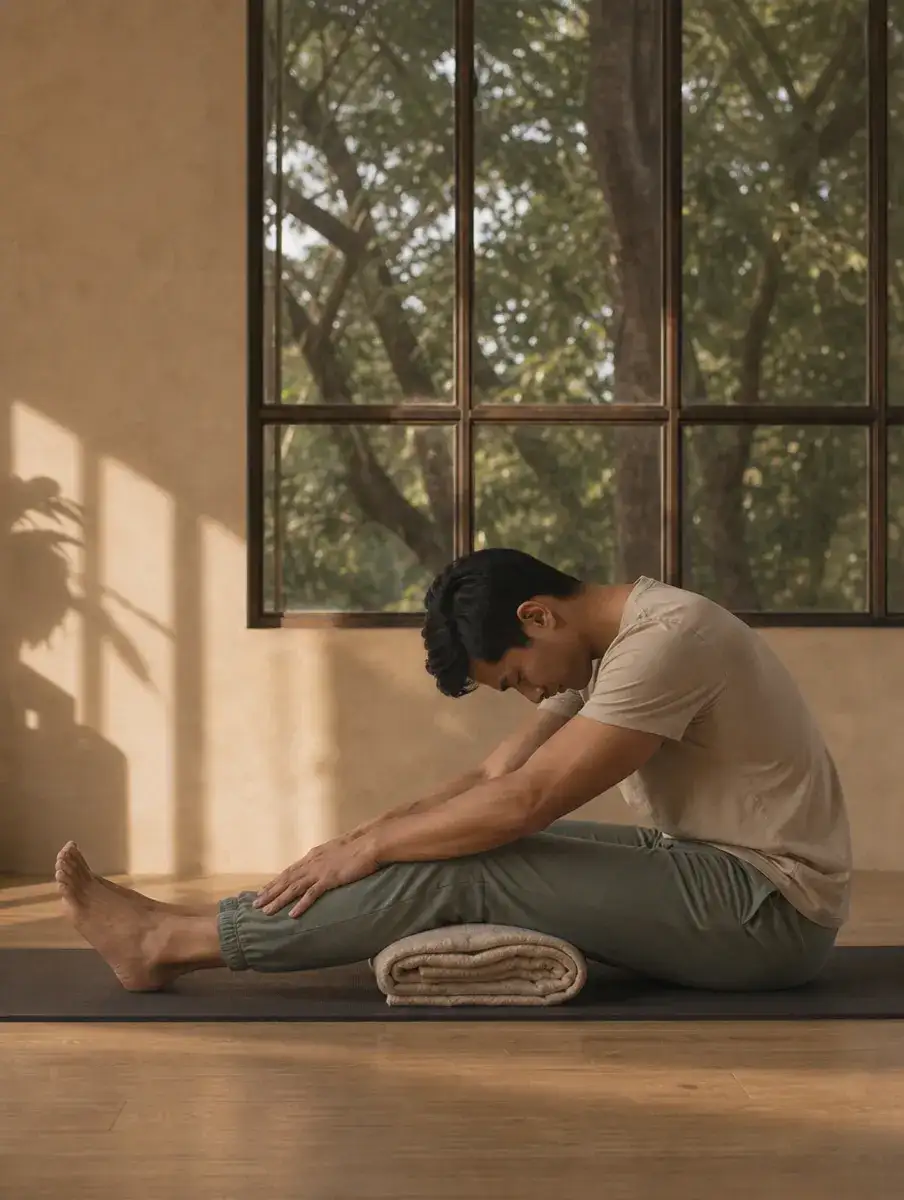
Caterpillar is what Yin yoga calls a seated forward fold with the legs out straight, held passively. The spine is allowed to round like a curled caterpillar, and you stay for minutes instead of reaching for your toes.
Caterpillar Pose is the Yin yoga name for a passive seated forward fold that stretches the backs of the legs and the back. Sit on a cushion with the legs out, bend the knees as needed, fold and let the spine round, resting the hands for three to five minutes. Roll up slowly, lifting the head last.
Pronunciation and meaning
Yin shape: Said as in English. Caterpillar is the Yin yoga name for this shape, and it has no traditional Sanskrit name.
Caterpillar is what Yin yoga calls a seated forward fold with the legs out straight, held passively. The spine is allowed to round like a curled caterpillar, and you stay for minutes instead of reaching for your toes.
How to do Caterpillar Pose
- Sit on a folded blanket or a cushion with your legs stretched out in front of you, together or about hip-width apart.
- Bend your knees as much as you need to, and slide a rolled blanket or a bolster under them if the backs of the legs feel tight.
- Fold forward from the hips, then let the whole spine round and your head hang toward your legs.
- Rest your hands on your shins, on the floor beside your legs or on a bolster laid along your thighs. Do not reach for your feet.
- Stay for three to five minutes, letting the belly and the neck soften with each breath out.
- To come out, place your hands behind you and roll up slowly, lifting the head last, then lean back on your hands for a moment.
Caterpillar Pose step by step

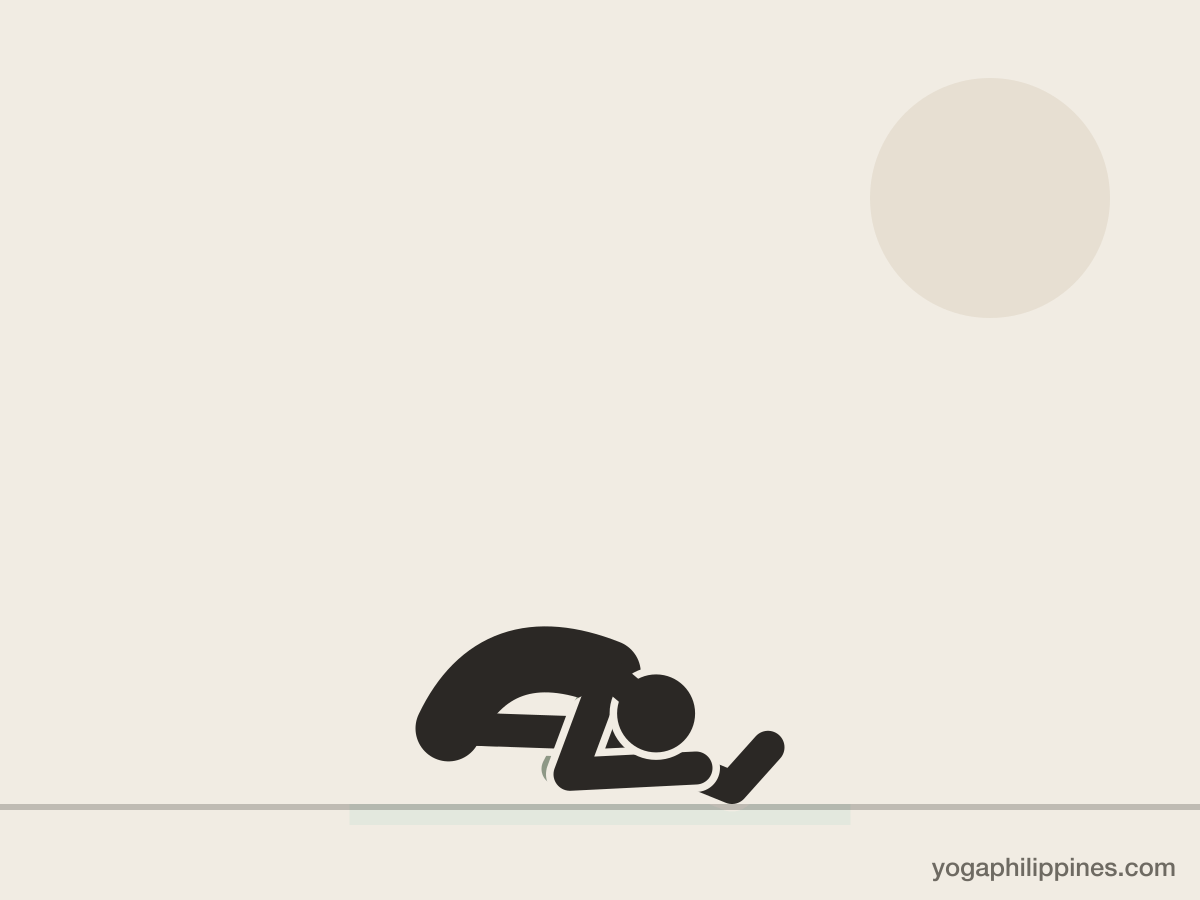
Drawings and video by YogaPhilippines.com, free to reuse under CC BY 4.0 with credit and a link: see the image licence for how to credit.
For other poses that work the hamstrings, open the pose finder set to the hamstrings.
Teacher's note from Joahnna Lee
“Round your back on purpose. This is not Seated Forward Bend with a long spine; here I want you to curl over and let go.”
“Let the head be heavy. If the neck feels strained, give the forehead a block or a bolster to rest on.”
“Wherever you land in the first minute is where you stay. The fold tends to settle a little lower on its own.”
Make it easier
- Lay a bolster along the legs and rest your chest and head on it, with blocks underneath for more height.
- Keep the knees generously bent over a rolled blanket if the backs of the knees or the lower back complain.
- Sit higher, on one or two folded blankets, so the pelvis can tip forward more easily.
Pregnancy and after birth
Pregnancy. Adapt. Take the legs wide so the belly has space between them, sit up high on a blanket and rest your chest on a tall stack of bolster and blocks, so you fold only a little and nothing presses on the belly. If any folding feels uncomfortable, sit upright instead. Check with your OB or midwife before you start.
After birth. Adapt. Once your OB or midwife has cleared you to exercise, begin with a short hold and the bolster stacked high. After a caesarean birth, keep the fold small until the scar feels comfortable when you lean forward.
Expecting or postpartum? See joahnnalee.com for the stage-by-stage guides.
Common mistakes
- Pulling on the feet or shins to go deeper. The pose is passive, so the hands only rest.
- Locking the knees straight when the backs of the legs are tight, which moves the strain into the lower back.
- Sitting up quickly at the end. After minutes in a fold, roll up slowly so you do not feel light-headed.
Caterpillar is a quiet forward fold, and in a Yin practice it often follows a backbend such as Sphinx. There is no goal of touching the toes. The practice is in letting go of the effort to get anywhere.
In Yin yoga, with a bolster under the chest or a blanket under the knees, the fold can be held for several minutes without strain.
On your feet, the same fold becomes Uttanasana, the standing forward fold, held for breaths rather than minutes.
Caterpillar is the usual counterpose after Saddle Pose, a Yin backbend.
Prep poses for Caterpillar Pose
Poses that warm up the same body areas at a lower intensity, so Caterpillar Pose feels steadier when you get there.
- Legs Up the Wall (Viparita Karani) gentler work for the same area, beginner
Counter-poses for Caterpillar Pose
Shapes that move the body the other way or let it rest straight after Caterpillar Pose.
- Sphinx Pose (Salamba Bhujangasana) beginner
Props that help in Caterpillar Pose
- Blanket: lifts the hips a little so the spine can stay tall.
- Bolster: supports the body so you can stay longer with less effort.
- Block: sits under the hips or supports a hand or knee that does not reach the floor.
Programs and sessions that use Caterpillar Pose
- Sequences: 45-minute slow practice
Sources: Mayo Clinic, Fitness program: 5 steps to get started; NCCIH (US National Institutes of Health), Yoga: Effectiveness and Safety; NHS, Exercise in pregnancy; CDC, Pregnant & Postpartum Activity: An Overview; Canadian Family Physician (Chan et al., 2014), via PubMed Central, Hot yoga and pregnancy: Fitness and hyperthermia. Last reviewed 2 October 2026.
Caterpillar Pose questions
Is Caterpillar Pose the same as Seated Forward Bend?
The legs are in the same place, but the approach is different. In Seated Forward Bend (Paschimottanasana) the spine stays long and the legs are active. In Caterpillar the back rounds, the muscles relax and you hold for minutes.
What if I cannot reach my toes in Caterpillar Pose?
You do not need to. The hands rest wherever they land, and bending the knees is part of the pose, not a way of cheating it.
Pairs well with
Updated