Pose library · Bharmanasana
Table Top Pose (Bharmanasana)
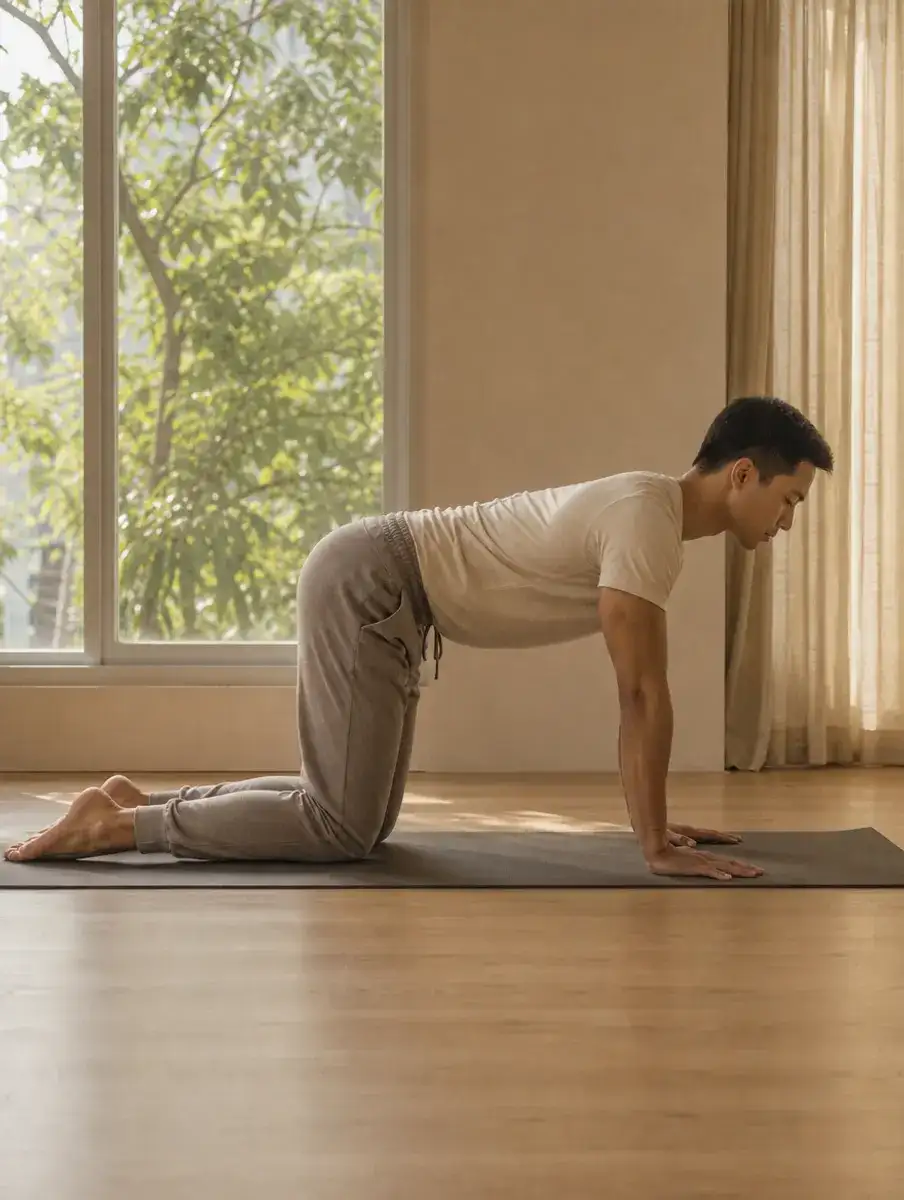
Bharmanasana is usually translated as table posture. On hands and knees, the back is flat like a table top and the arms and thighs are its legs. It is the starting position for Cat-Cow, many balances and the move into Downward-Facing Dog.
Table Top Pose (Bharmanasana) is a hands-and-knees position with a flat back, the starting point for Cat-Cow and many balances. Place the wrists under the shoulders and the knees under the hips, lengthen from tailbone to crown and press the floor away for five breaths. Make fists or use the forearms if the wrists are sore.
Pronunciation and meaning
Bharmanasana: bar-mahn-AHS-uh-nuh. The bh is a breathy b, and the stress falls on AHS.
Bharmanasana is usually translated as table posture. On hands and knees, the back is flat like a table top and the arms and thighs are its legs. It is the starting position for Cat-Cow, many balances and the move into Downward-Facing Dog.
How to do Table Top Pose
- Come onto your hands and knees on the mat, with a blanket under the knees if they are sensitive.
- Place your wrists under your shoulders and your knees under your hips, hip-width apart. Spread the fingers and press the whole hand down.
- Rest the tops of the feet on the mat, or tuck the toes if that feels better for the knees.
- Lengthen the spine from tailbone to crown so the back is flat, the neck long and the gaze on the floor just ahead of the hands.
- Press the floor away so the shoulder blades do not sink. Draw the belly in gently without holding the breath.
- Stay for five breaths, or use this as the base for the next movement, such as Cat-Cow.
Table Top Pose step by step

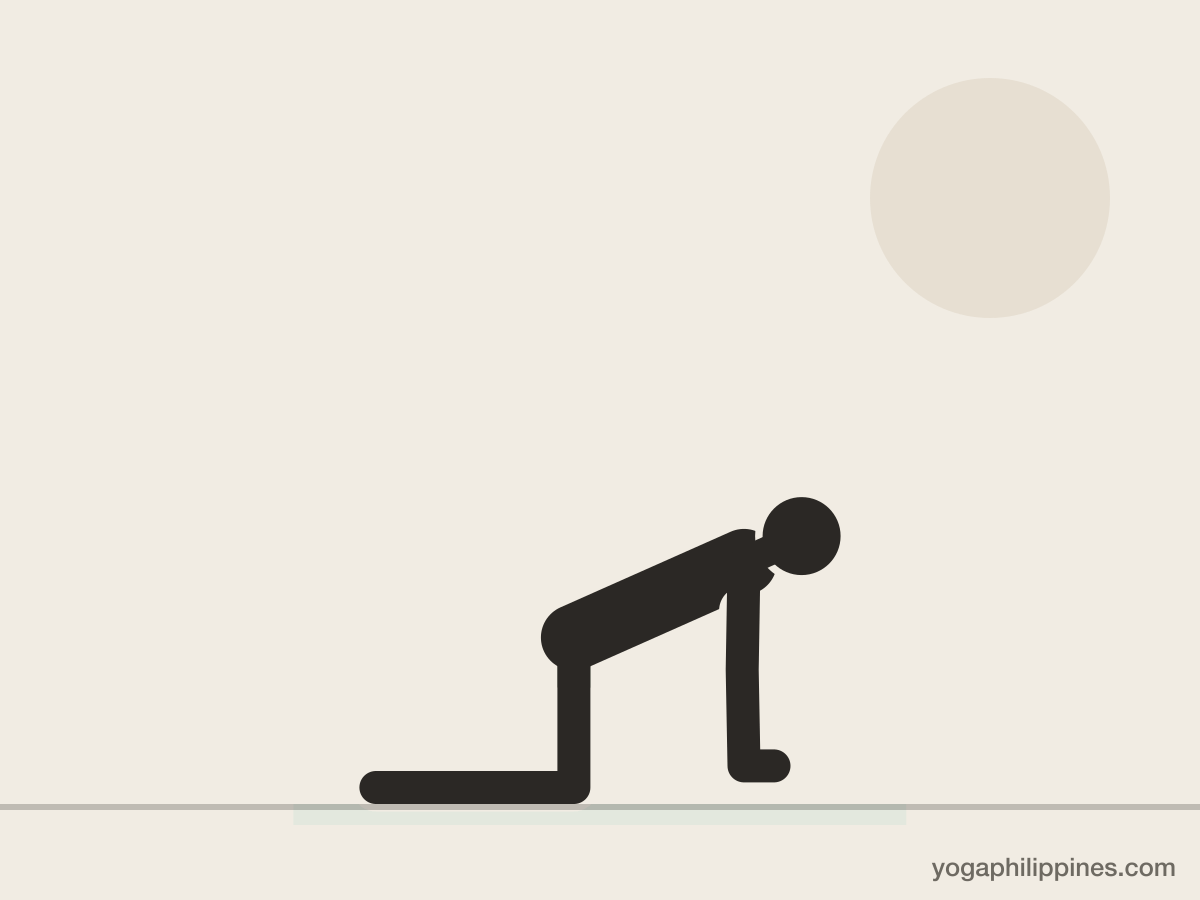
Drawings and video by YogaPhilippines.com, free to reuse under CC BY 4.0 with credit and a link: see the image licence for how to credit.
Table Top Pose appears in the 15-minute core strength sequence, which is printable with holds and cues. For other poses that work the core, open the pose finder set to the core.
Make it easier
- Make fists, or rest the hands on blocks or the forearms on the floor, if the wrists are sore.
- Fold the mat over, or use a thick blanket, under the knees.
- Lift the opposite arm and leg, one pair at a time, for a balance often called bird dog.
Pregnancy and after birth
Pregnancy. Adapt. Table Top is often comfortable in pregnancy and takes the weight of the belly off the back. Widen the knees for room, keep the back neutral rather than letting the belly sag, and pad the knees. Check with your OB or midwife.
After birth. Adapt. Once your doctor or midwife has cleared you, it is a gentle start for breathing and core work. Keep the belly lightly drawn in and stop if you see doming along the middle of the belly.
See prenatal yoga notes by trimester before you adapt a pose.
Common mistakes
- Letting the shoulders sink between the shoulder blades.
- Dropping the head or lifting it to look forward, which strains the neck.
- Placing the hands ahead of the shoulders, which loads the wrists unevenly.
Table Top Pose, or simply hands and knees, is one of the first shapes in many classes. It is the base for Cat-Cow, the spine warm up, the step before Downward-Facing Dog, and a resting point between harder poses.
It looks simple, and it is a good place to learn how to bear weight on the hands. Setting the wrists under the shoulders here makes every later pose on the hands easier.
What is reverse table top pose?
Reverse table top, sometimes called Ardha Purvottanasana, turns the shape face up. Sit with your knees bent and feet flat, hip-width apart. Place your hands behind your hips, fingers pointing toward you or out to the sides. On an inhale, press into the hands and feet and lift the hips until your thighs and body are level, knees over ankles. Keep the chin slightly tucked, or let the head move back only if the neck is comfortable. Stay for three to five breaths, then lower slowly. With the legs straight, the same lift becomes Reverse Plank, Purvottanasana.
It opens the front of the shoulders and chest and works the backs of the legs, a good counter to forward folds. If the wrists or shoulders complain, lift the hips less high. It is a cousin of Bridge Pose, which works the same lift from lying down, and it fits well with Child’s Pose as a rest afterwards.
Counter-poses for Table Top Pose
Shapes that move the body the other way or let it rest straight after Table Top Pose.
- Balasana (Child's Pose) beginner
Where to go next after Table Top Pose
These poses list Table Top Pose as a preparation, so they are a natural next step once it feels comfortable.
- Downward-Facing Dog (Adho Mukha Svanasana) beginner plus
- Plank Pose (Phalakasana) beginner plus
- Reverse Plank (Purvottanasana) intermediate
Props that help in Table Top Pose
- Blanket: pads the knees on a hard floor.
- Block: brings the floor closer under the hands.
Programs and sessions that use Table Top Pose
- The 4-week beginner program 3 of its 12 sessions
- The 30-day challenge 2 of its 30 sessions
- Sequences: longer slow session and core routine
- Generated example flows: 10-minute beginner flow and 20-minute hip flow
Sources: Mayo Clinic, Fitness program: 5 steps to get started; NCCIH (US National Institutes of Health), Yoga: Effectiveness and Safety. Last reviewed 2 October 2026.
Table Top Pose questions
Why do the wrists hurt in table top pose?
The wrists bend back under body weight here. Spread the fingers, press through the base of the index finger, and try fists or forearms. If the pain continues, see a doctor or physio.
What is reverse table top pose?
It is the face-up version: sitting with the hands behind you and the feet flat, you lift the hips until the body from knees to shoulders is level, like an upturned table.
Is table top pose the same as all fours?
Yes. Table Top is the yoga name for kneeling on hands and knees with a flat back. The difference is the attention: aligned wrists, a long spine and a steady breath.
Pairs well with
Updated