Pose library · Urdhva Prasarita Eka Padasana
Standing Split Pose (Urdhva Prasarita Eka Padasana)
Urdhva means upward, prasarita means spread out, eka means one, pada means foot or leg and asana means posture. One leg stretches up behind you while you fold over the other.
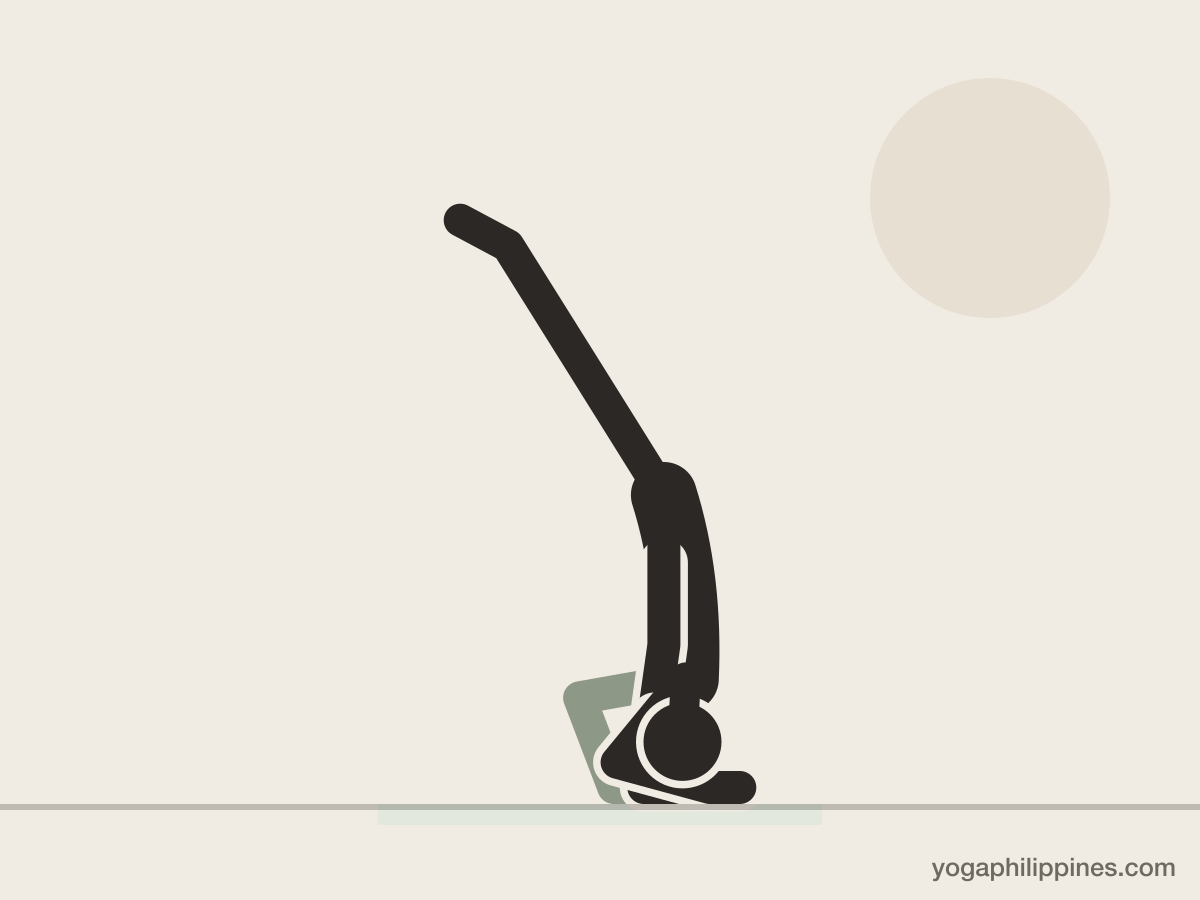
Standing Split Pose (Urdhva Prasarita Eka Padasana) is a standing fold with one leg lifted behind you, stretching the hamstrings and asking for balance. From a forward fold, shift onto one foot, lift the other leg with the toes pointing down and fold in for three to five breaths. Keep a slight bend in the standing knee.
Pronunciation and meaning
Urdhva Prasarita Eka Padasana: OORD-vuh pruh-SAH-ree-tuh AY-kuh pah-DAHS-uh-nuh. Take it one word at a time; each stresses an early syllable except the last, which stresses DAHS.
Urdhva means upward, prasarita means spread out, eka means one, pada means foot or leg and asana means posture. One leg stretches up behind you while you fold over the other.
How to do Standing Split Pose
- Start in Standing Forward Bend with the feet hip-width apart and the knees soft. Place your hands on the floor or on two blocks, a little in front of your feet.
- Shift your weight into your left foot and walk the hands back so they frame the left foot.
- Inhale and lift your right leg up behind you, keeping the right knee and toes pointing roughly down toward the floor rather than turning out.
- Exhale and let the chest fold toward the left leg. Keep a slight bend in the left knee and spread the toes of the standing foot.
- Stay for three to five breaths, reaching the lifted heel up and back. Let the gaze rest on the standing shin.
- Exhale and lower the right foot slowly beside the left, pause in the forward fold, and repeat on the other side.
Standing Split Pose step by step
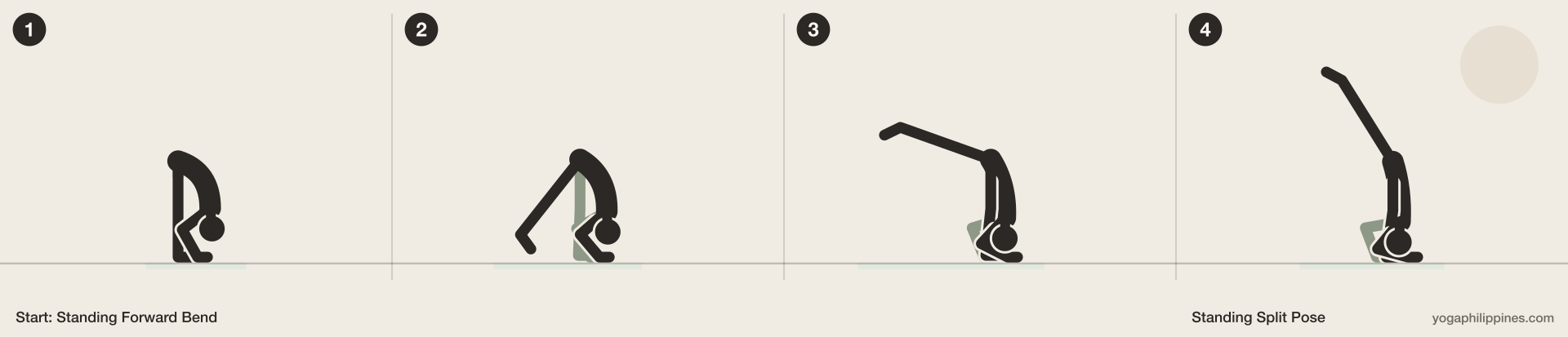
Drawings and video by YogaPhilippines.com, free to reuse under CC BY 4.0 with credit and a link: see the image licence for how to credit.
For other poses that work the hamstrings, open the pose finder set to the hamstrings.
Make it easier
- Keep both hands on high blocks and lift the leg only to hip height.
- Practise with the hands on a wall at hip height, so the body makes an L shape and the balance stays easy.
- Hold the standing ankle with one hand for a deeper fold once the balance is steady.
Pregnancy and after birth
Pregnancy. Adapt. The head goes below the heart and balance changes as the belly grows, so keep the hands on a wall or chair and the lifted leg low, or leave the pose out. Check with your OB or midwife.
After birth. Adapt. Once your doctor or midwife has cleared you, start with the wall version and short holds, and lift the leg gradually.
Prenatal and postpartum guides live on joahnnalee.com.
Common mistakes
- Locking the standing knee, which pushes the strain behind the knee.
- Twisting the hips wide open to get the leg higher.
- Holding the breath while straining for height.
Standing Split Pose often appears in a Vinyasa class after the Warrior poses, sometimes straight from Warrior III or as a transition between standing poses. It folds you over one leg while the other lifts behind you, so it stretches the hamstrings of the standing leg and works the back of the lifted one.
It suits people who already find Standing Forward Bend, Uttanasana calm with the hands near the floor. Blocks make it workable much sooner.
How does it connect to Warrior III and the splits?
Tip Warrior III forward and let the hands come down, and you have Standing Split. The family of Warrior I, II and III builds the leg strength for it, and Half Moon Pose, the sideways balance asks for the same steady standing foot.
If your goal is the splits on the floor, this pose is a useful standing partner to the routine on how to do the splits, step by step. Stop if you feel a sharp pull behind the knee or at the sit bone.
Prep poses for Standing Split Pose
Poses that warm up the same body areas at a lower intensity, so Standing Split Pose feels steadier when you get there.
- Standing Forward Bend (Uttanasana) a direct preparation, beginner
- Warrior III (Virabhadrasana III) a direct preparation, intermediate
- Half Moon Pose (Ardha Chandrasana) gentler work for the same area, intermediate
- Wide Legged Forward Bend (Prasarita Padottanasana) gentler work for the same area, beginner plus
Counter-poses for Standing Split Pose
Shapes that move the body the other way or let it rest straight after Standing Split Pose.
- Mountain Pose (Tadasana) beginner
- Balasana (Child's Pose) beginner
Props that help in Standing Split Pose
- Block: brings the floor closer under the lower hand, so the legs and spine can stay long.
- Wall: gives a steady point to lean on or press into for balance and alignment.
Sources: Mayo Clinic, Fitness program: 5 steps to get started; NCCIH (US National Institutes of Health), Yoga: Effectiveness and Safety. Last reviewed 2 October 2026.
Standing Split Pose questions
Should your hips be square in a standing split?
Roughly. Many teachers ask you to keep the lifted hip from rolling wide open, so the toes point down. A little lift of that hip is normal. Height of the leg matters less than the line of the hips.
Is a standing split the same as the splits?
They use some of the same flexibility, but the standing version is a balance with one foot on the floor and the body folded. The floor splits ask for a long stretch in both legs at once and take most people much longer to reach.
Why do you feel dizzy in standing split pose?
The head is below the heart, and coming up quickly can make some people lightheaded. Rise slowly through a half fold. If you have high or low blood pressure or often feel dizzy, keep the head higher with the hands on a wall, and ask your doctor about forward folds.
What muscles does Standing Split Pose work?
It stretches the hamstrings of the standing leg as you fold over it, and works the back of the lifted leg, the buttock and hamstring, as you reach the heel up. The standing foot, ankle and thigh work to hold the balance. Keep a slight bend in the standing knee so the stretch stays in the muscle.
Pairs well with
Updated