Pose library · Uttanasana · reviewed by a teacher
Standing Forward Bend (Uttanasana)
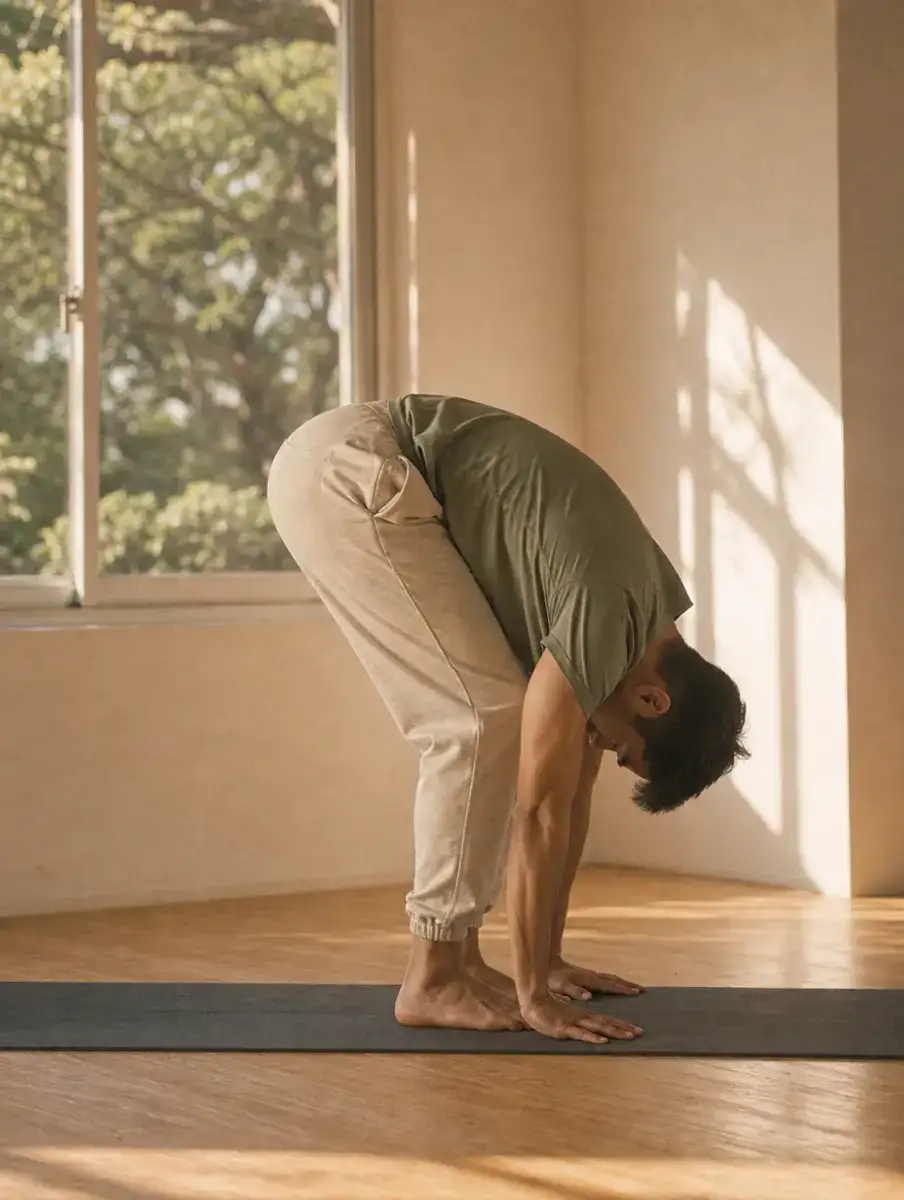
A standing forward bend is a fold from the hips with the head hanging toward the floor. Uttanasana means intense stretch: ut is intense and tan is to stretch. It lengthens the backs of the legs and lets the spine hang, and it is fine, even wise, to bend the knees as much as you need.
Standing Forward Bend (Uttanasana) is a fold from the hips that lengthens the backs of the legs and lets the spine hang. Stand with the feet hip-width, hinge forward on an exhale, bend the knees generously and rest the hands on the shins or blocks for five to eight breaths. Rise slowly with the head coming up last.
Pronunciation and meaning
Uttanasana: oot-tun-AHS-uh-nuh. The double t is held a moment, and the stress falls on AHS.
A standing forward bend is a fold from the hips with the head hanging toward the floor. Uttanasana means intense stretch: ut is intense and tan is to stretch. It lengthens the backs of the legs and lets the spine hang, and it is fine, even wise, to bend the knees as much as you need.
How to do Standing Forward Bend
- Stand tall with your feet hip-width apart and your hands on your hips.
- Breathe in and lengthen up. Breathe out and hinge forward from the hips, keeping the back long at first.
- Bend your knees generously and let your hands rest on your shins, on blocks or on the floor.
- Let the head and neck hang heavy, and shift your weight a little toward the balls of your feet.
- Stay for five to eight breaths. You can hold opposite elbows and sway gently if that feels good.
- To come up, bend the knees, bring the hands to the hips and rise slowly with a long back, head last.
Standing Forward Bend step by step

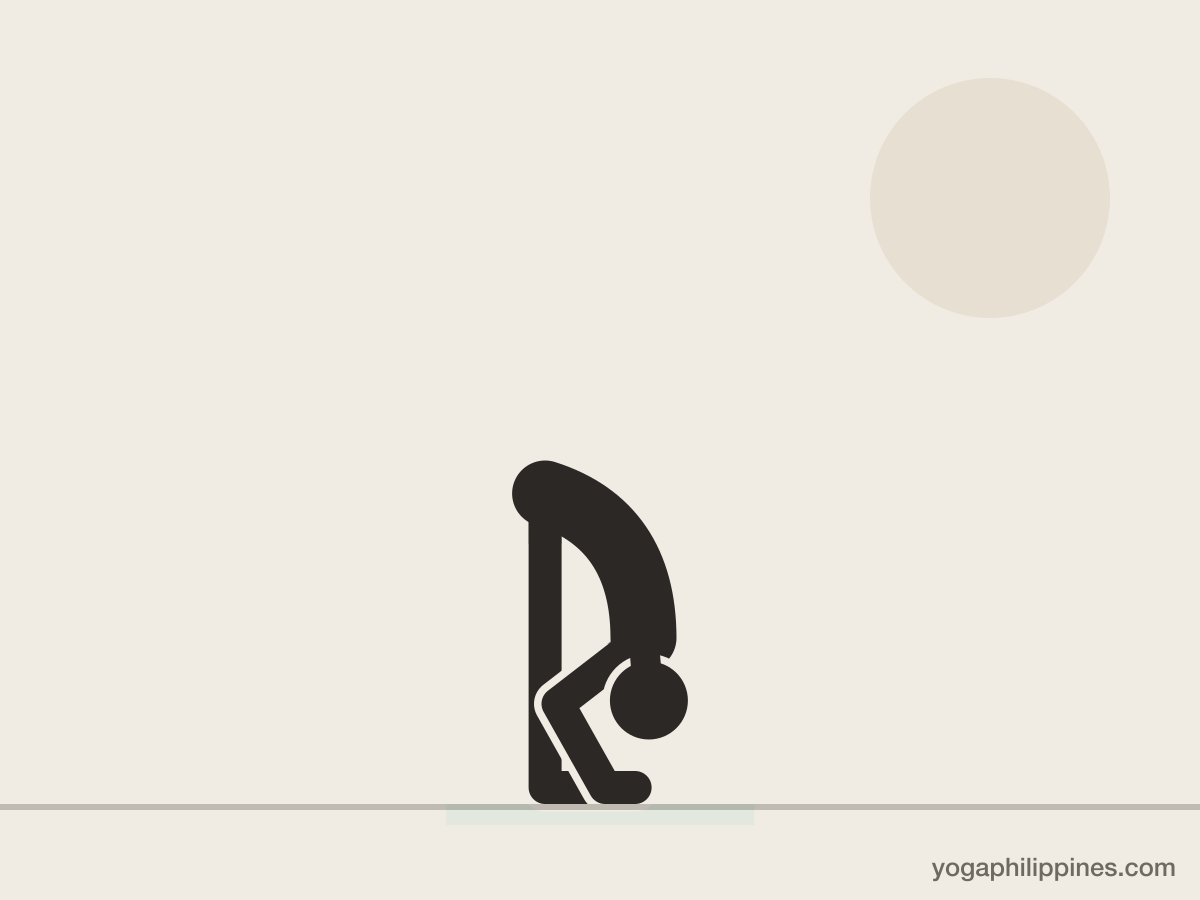
Drawings and video by YogaPhilippines.com, free to reuse under CC BY 4.0 with credit and a link: see the image licence for how to credit.
Standing Forward Bend appears in the 34-pose Ashtanga primary series and the morning yoga sequence card, both printable with holds and cues. For other poses that work the hamstrings, open the pose finder set to the hamstrings.
Teacher's note from Joahnna Lee
“Fold from the hip creases, the way you would bow, not from the waist. The knees can bend as much as they like.”
“Let your belly rest on your thighs before you try to straighten the legs at all.”
“Come up slower than you think you need to, especially in a warm room.”
Make it easier
- Rest the hands on two blocks, a chair seat or a low table.
- Take the feet wider than the hips if the lower back feels the fold.
Pregnancy and after birth
Pregnancy. Adapt. Take the feet wide for the belly, keep the hands on blocks or a chair so the head stays above the hips, and rise very slowly to avoid dizziness. Check with your OB or midwife before you start.
After birth. Adapt. After your doctor or midwife has cleared you, keep the knees bent and the hands on blocks at first, and come up slowly. Long hours of carrying a baby make a gentle hang very welcome.
See prenatal yoga notes by trimester before you adapt a pose.
Common mistakes
- Locking the knees and rounding hard through the lower back to reach the floor.
- Coming up quickly with the head first, which can make you light-headed.
- Hanging all the weight back in the heels.
The standing forward bend is the first fold most people meet, and the one they most often try too hard in. The aim is to hang, not to touch the floor.
Bent knees from the first breath are the kindest start, so the fold comes from the hips and the back stays easy. That is how yoga for beginners usually introduces it.
It is also the fold inside each round of Surya Namaskar, which is where you will meet it most, and one of the shapes on the standing poses page with two lines on each.
Folding over one leg with the hips square is Pyramid Pose, or Parsvottanasana, and with the feet wide it is the wide legged forward bend. Lifting one leg up behind you from the fold gives you Standing Split Pose, Urdhva Prasarita Eka Padasana.
What is a half forward fold?
A half forward fold, Ardha Uttanasana, is the halfway lift between the full fold and standing. From the standing forward bend, place your hands on your shins, your thighs or two blocks, and on an inhale lift your chest until your back is long and roughly parallel to the floor. Keep the knees soft, the neck in line with the spine and the gaze on the floor a little ahead.
It shows up in every Sun Salutation, on the inhale between the forward fold and the step back, and it is a useful pose on its own. Many people find it the clearest way to feel the difference between folding from the hips and rounding from the waist, because the back has to stay flat.
If the hamstrings are tight, bend the knees more and keep the hands higher. If the lower back works too hard, bring the hands to the thighs. A forward fold, half or full, should feel long rather than strained.
Poses that lead into Standing Forward Bend
In a sequence, Standing Forward Bend often follows these poses as their counter-pose or rest.
- Warrior III (Virabhadrasana III) intermediate
- Chair Pose (Utkatasana) beginner plus
- Dancer Pose (Natarajasana) intermediate
- Garland Pose (Malasana) beginner plus
Where to go next after Standing Forward Bend
These poses list Standing Forward Bend as a preparation, so they are a natural next step once it feels comfortable.
- Sun Salutation (Surya Namaskar) beginner plus
- Standing Split Pose (Urdhva Prasarita Eka Padasana) intermediate
Easier and harder variations of Standing Forward Bend
Related poses from the same family that start from the same position and do a similar kind of work; Standing Forward Bend itself is beginner.
- Harder: Pyramid Pose (Parsvottanasana) beginner plus
- Harder: Wide Legged Forward Bend (Prasarita Padottanasana) beginner plus
Props that help in Standing Forward Bend
- Block: brings the floor closer under the lower hand, so the legs and spine can stay long.
- Chair: brings the floor closer, or gives a seat or a hand rest for a gentler version.
Programs and sessions that use Standing Forward Bend
- The one-month challenge 3 of its 30 sessions
- The 4-week beginner program 2 of its 12 sessions
- The 14-day flexibility plan 1 of its 14 sessions
- The 7-day desk reset 1 of its 7 sessions
- Sequences: short 10-minute practice, 45-minute slow practice, primary series sequence and early-day sequence
- Practice app sessions: 10-minute reset, 20-minute flow, morning wake-up and balance
This page feeds the Sun Salutation round timer and the sit-and-reach flexibility test.
Sources: Mayo Clinic, Fitness program: 5 steps to get started; NCCIH (US National Institutes of Health), Yoga: Effectiveness and Safety; NHS, Exercise in pregnancy; CDC, Pregnant & Postpartum Activity: An Overview; Canadian Family Physician (Chan et al., 2014), via PubMed Central, Hot yoga and pregnancy: Fitness and hyperthermia. Last reviewed 2 October 2026.
Standing Forward Bend questions
Should my legs be straight in a standing forward bend?
No, not unless they straighten easily. Bent knees let the fold come from the hips and protect the lower back. Over time the backs of the legs may lengthen, but bent knees are a full version of the pose.
Why do I feel dizzy when I come up?
Blood pressure shifts when the head rises from below the heart. Bend the knees, come up slowly with the head last, and pause standing. If it happens often, mention it to your doctor.
What is Standing Forward Bend good for?
Standing Forward Bend lengthens the backs of the legs and lets the spine hang. Many people find it a calming fold after standing poses or a long day of carrying and sitting. It is also the fold inside every Sun Salutation. Bend the knees generously so the fold comes from the hips and the lower back stays easy.
Is Padahastasana the same as Uttanasana?
They are close relatives. Padahastasana means hand to foot pose: in many Indian schools it names the standing forward fold of the Sun Salutation, while in other styles it means a version with the hands slid under the feet, palms up. Uttanasana is the standing forward bend with the hands on the shins, blocks or floor.
What muscles does a forward bend stretch?
A standing forward bend mainly stretches the hamstrings along the backs of the thighs, along with the calves and the muscles along the back. Bending the knees moves more of the stretch into the back and buttocks, while straighter legs take it into the hamstrings. Keep the fold from the hips so the lower back is not strained.
Pairs well with
Updated