Pose library · Astavakrasana
Eight Angle Pose (Astavakrasana)
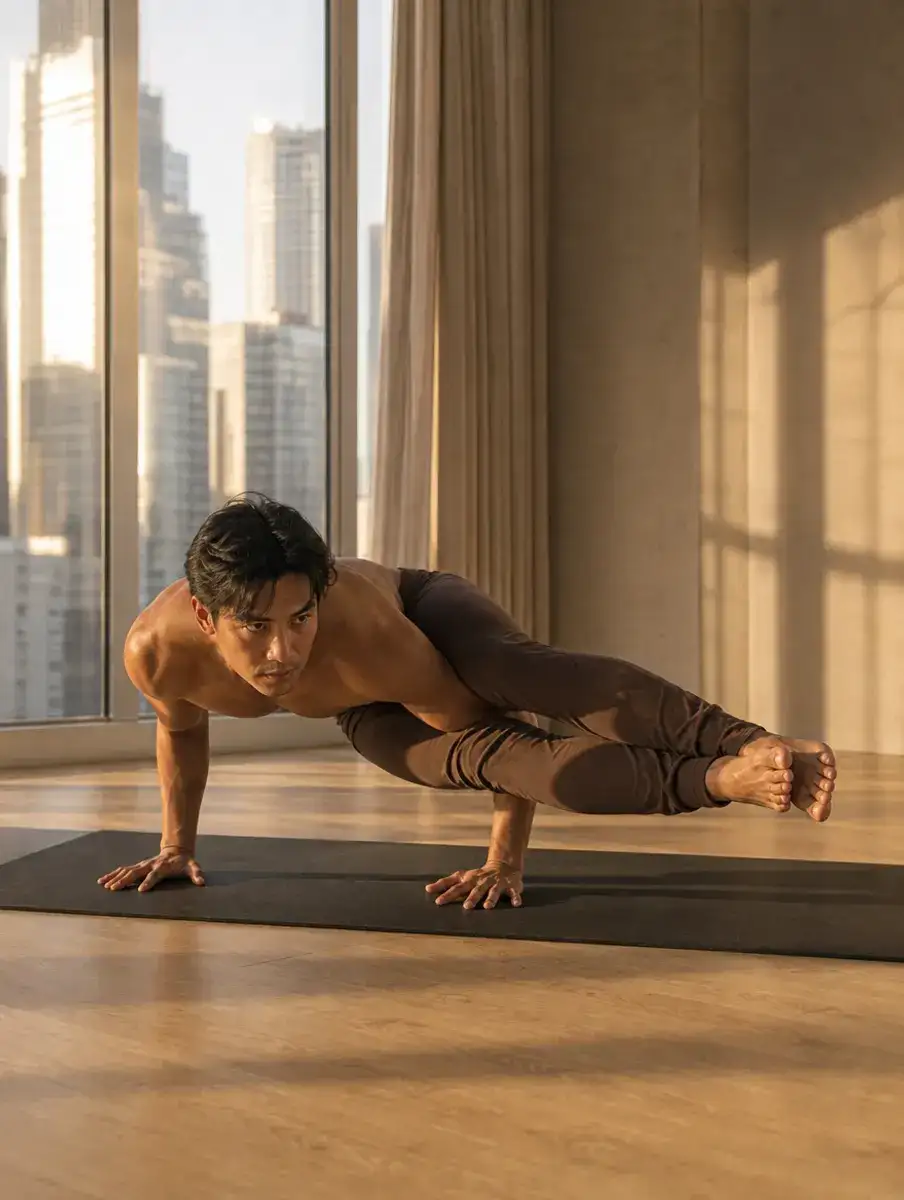
The pose is named after Ashtavakra, a sage in Indian stories whose body was said to be bent in eight places; ashta means eight and vakra means bent. Balancing on the hands, the legs hook over one arm and cross at the ankles, and the body leans forward and to the side.
Eight Angle Pose (Astavakrasana) is an advanced arm balance that asks a lot of the wrists, shoulders and hips. Learn it with a teacher: hook one knee high over the upper arm, lift the hips, cross the ankles and lean forward as the legs extend to the side. Keep the chest broad and do not bend the elbows too far.
Pronunciation and meaning
Astavakrasana: ahsh-tah-vah-KRAHS-uh-nuh. It is often written Ashtavakrasana, and the stress falls on KRAHS.
The pose is named after Ashtavakra, a sage in Indian stories whose body was said to be bent in eight places; ashta means eight and vakra means bent. Balancing on the hands, the legs hook over one arm and cross at the ankles, and the body leans forward and to the side.
How to do Eight Angle Pose
- Learn this pose with a teacher. Warm up the wrists, shoulders and hips, and be comfortable in Crow and Side Plank first.
- Sit with your legs straight. Bend your right knee and lift it over your right upper arm, high toward the shoulder, with the right hand on the floor beside your right hip.
- Place your left hand on the floor beside your left hip, hands shoulder-width apart, fingers spread.
- Press into your hands and lift your hips. Hook your left ankle over your right ankle so the legs squeeze the right arm.
- Bend your elbows toward a low push up position, shift your chest forward and extend the legs out to the right. Stay for two or three breaths.
- Straighten the arms, lower the hips with control, uncross the legs and repeat on the other side.
For other poses that work the core, open the pose finder set to the core.
Make it easier
- Keep the feet on the floor and practise only the leg hook over the arm, a seated stage.
- Lift the hips with the legs bent and crossed, without leaning forward.
- Place blocks under the hands for more height when lifting the hips.
Pregnancy and after birth
Pregnancy. Avoid. The twist, the compression of the belly and the risk of a fall make this unsuited to pregnancy. Check with your OB or midwife about safer strength work.
After birth. Avoid for now. Wait until your doctor or midwife has cleared you and your core and wrists feel strong, then rebuild with a teacher.
Pregnancy and postpartum notes are kept by Joahnna Lee, who is certified in prenatal and postnatal yoga.
Common mistakes
- Setting the leg low on the arm, near the elbow, so it slides off.
- Bending the elbows too far, which loads the shoulders heavily.
- Collapsing the chest toward the floor instead of keeping it broad.
Eight Angle Pose is an advanced arm balance that combines a twist, a forward lean and a strong squeeze of the legs. It usually appears in advanced Vinyasa classes or arm balance workshops.
It is a pose to learn with a teacher, in stages. Each stage, the leg hook, the lift and the lean, is useful practice on its own.
How do you prepare for eight angle pose?
Practise Crow Pose for confidence on the hands and Side Plank (Vasisthasana) for strength along the side of the body. Seated Twist helps the spine turn. The shoulder stretches routine prepares the shoulders for the low push up position.
Who should skip it?
Anyone with a wrist, elbow, shoulder or back injury, or high blood pressure. Use the seated stages instead, or choose another arm balance.
Prep poses for Eight Angle Pose
Poses that warm up the same body areas at a lower intensity, so Eight Angle Pose feels steadier when you get there.
- Crow Pose (Bakasana) a direct preparation, advanced
- Side Plank (Vasisthasana) a direct preparation, intermediate
- Plank Pose (Phalakasana) gentler work for the same area, beginner plus
- Four-Limbed Staff Pose (Chaturanga Dandasana) gentler work for the same area, intermediate
Counter-poses for Eight Angle Pose
Shapes that move the body the other way or let it rest straight after Eight Angle Pose.
- Balasana (Child's Pose) beginner
Props that help in Eight Angle Pose
- Block: sits under the hips or supports a hand or knee that does not reach the floor.
Sources: Mayo Clinic, Fitness program: 5 steps to get started; NCCIH (US National Institutes of Health), Yoga: Effectiveness and Safety. Last reviewed 2 October 2026.
Eight Angle Pose questions
Why is it called eight angle pose?
It is named after Ashtavakra, a sage in Indian stories whose body was described as bent in eight places. The name honours the character rather than counting eight angles in the shape.
Is eight angle pose harder than crow pose?
Most people find it harder. It adds a twist, a leg hook and a forward lean, and the weight sits more on one arm. Learn Crow first.
What helps the legs stay on the arm in eight angle pose?
Hook the knee as high on the upper arm as you can, close to the shoulder, and squeeze the ankles together firmly. The squeeze is what keeps the legs in place.
Is Eight Angle Pose the same as eight-point pose?
No. Eight-point pose, Ashtanga Namaskara, is a low shape in the Sun Salutation where the chin, chest, both hands, both knees and both feet touch the floor. Eight Angle Pose, Astavakrasana, is an advanced arm balance with the legs hooked over one arm, named after the sage Ashtavakra rather than eight points of contact.
Updated