Pose library · Ardha Matsyendrasana · reviewed by a teacher
Seated Twist (Ardha Matsyendrasana)
A seated twist turns the chest and shoulders to one side while the hips stay grounded. Ardha Matsyendrasana means half lord of the fishes: ardha is half, and Matsyendra is a figure from yoga stories. You lengthen the spine first and then rotate gently from the ribs, never from the neck.
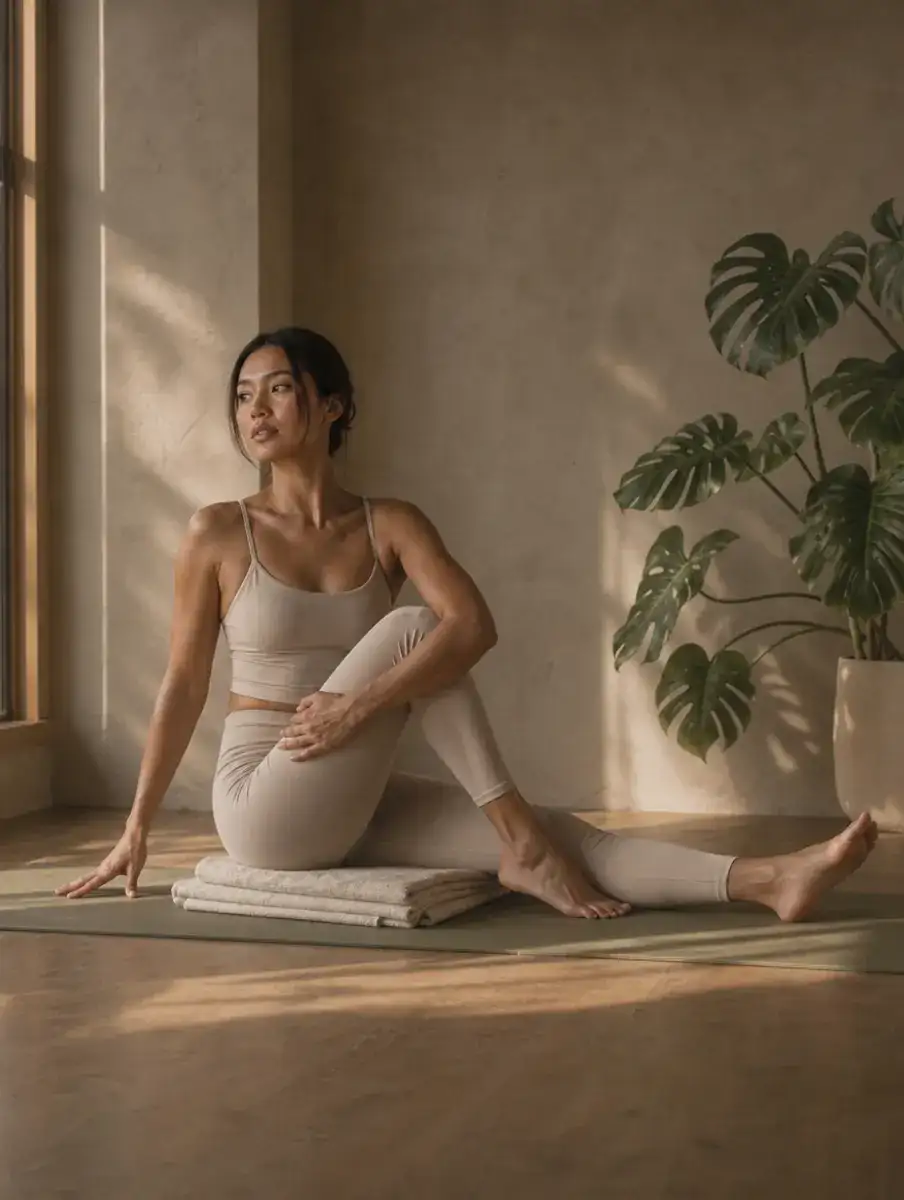
Seated Twist (Ardha Matsyendrasana) turns the chest and shoulders to one side while the hips stay grounded. Sit on a blanket, place one foot outside the opposite thigh, lengthen on each in-breath and turn a little on each out-breath for five breaths. Let the head turn last, and never crank the neck or pull hard with the arm.
Pronunciation and meaning
Ardha Matsyendrasana: AR-duh mut-see-en-DRAHS-uh-nuh. Ardha has two syllables; the long word leans on DRAHS.
A seated twist turns the chest and shoulders to one side while the hips stay grounded. Ardha Matsyendrasana means half lord of the fishes: ardha is half, and Matsyendra is a figure from yoga stories. You lengthen the spine first and then rotate gently from the ribs, never from the neck.
How to do Seated Twist
- Sit on a folded blanket with both legs straight out in front of you.
- Bend your right knee and place the right foot on the floor outside the left thigh. Keep the left leg straight, or bend it and tuck the left heel by the right hip.
- Place your right hand on the floor behind you, close to the hip, fingertips down.
- Breathe in and sit tall. Breathe out and turn your chest to the right, hugging the right knee with the left arm or hooking the left elbow outside it.
- With each in-breath lengthen a little; with each out-breath turn only as far as is easy. Let the head follow last.
- Stay for five breaths, unwind slowly on an in-breath and repeat on the other side.
Seated Twist appears in the Bikram 26 poses sequence, which is printable with holds and cues. For other poses that work the glutes, open the pose finder set to the glutes.
Teacher's note from Joahnna Lee
“Height first, twist second. If you are slumping to turn further, stop and sit taller.”
“Keep both sit bones heavy on the blanket, so the turn happens in the ribs, not the hips.”
Make it easier
- Sit higher, on a block or two blankets, so the spine can lift without effort.
- Keep the bottom leg straight if folding it bothers the knee.
- Do it on a chair: sit sideways or forward, feet flat, and turn with one hand on the backrest.
Pregnancy and after birth
Pregnancy. Adapt. Twist only gently and only in the open direction, turning away from the bent knee so the belly is never squeezed. Keep the legs wide, sit high and stay well short of your end range. Check with your OB or midwife before you start.
After birth. Adapt. Once your doctor or midwife has cleared you, keep twists small and open at first, and wait longer after a caesarean birth. Ease off if you feel pulling along the scar or the middle of the belly.
Before adapting a pose, read is yoga safe during pregnancy on joahnnalee.com.
Common mistakes
- Rounding the back and pulling with the arm to get further. The turn should come from length, not leverage.
- Cranking the neck round to look behind you before the chest has turned.
- Letting one sit bone lift off the floor.
A seated twist is one of the plainest ways to move the spine in a direction most people rarely use. It needs no strength and very little flexibility, only patience to sit tall before you turn.
It is a common early pose in yoga for new students, often straight after sitting cross-legged in Sukhasana, because it takes a minute to learn and works on any floor or chair.
If you spend the day at a desk, the chair version is worth knowing on its own. Lying down, the same turn becomes the twist lying on your back, which lets gravity do the work. Adding a side bend over one straight leg to the turn of the chest gives you Revolved Head to Knee Pose.
The twist learned here is part of Eight Angle Pose, an arm balance with crossed legs.
Prep poses for Seated Twist
Poses that warm up the same body areas at a lower intensity, so Seated Twist feels steadier when you get there.
- Easy Pose (Sukhasana) gentler work for the same area, beginner
- Supine Twist (Supta Matsyendrasana) gentler work for the same area, beginner
Props that help in Seated Twist
- Blanket: lifts the hips a little so the spine can stay tall.
- Block: sits under the hips or supports a hand or knee that does not reach the floor.
- Chair: brings the floor closer, or gives a seat or a hand rest for a gentler version.
Programs and sessions that use Seated Twist
- The 14-day flexibility plan 2 of its 14 sessions
- The one-month challenge 1 of its 30 sessions
- The 4-week beginner program 1 of its 12 sessions
- The 7-day desk reset 1 of its 7 sessions
- Sequences: 26-posture sequence
Sources: Mayo Clinic, Fitness program: 5 steps to get started; NCCIH (US National Institutes of Health), Yoga: Effectiveness and Safety; NHS, Exercise in pregnancy; CDC, Pregnant & Postpartum Activity: An Overview; Canadian Family Physician (Chan et al., 2014), via PubMed Central, Hot yoga and pregnancy: Fitness and hyperthermia. Last reviewed 2 October 2026.
Seated Twist questions
Which way should I twist first?
Either is fine. Many teachers twist to the right first, but there is no rule you need to follow. What matters is doing both sides, for about the same number of breaths.
Can I do a seated twist with back pain?
Ask your doctor or physiotherapist first. If they are happy for you to twist, keep it small, sit high and come out at the first sharp or shooting feeling.
What is a seated twist good for?
A seated twist moves the spine in a direction most people rarely use, turning the chest and shoulders while the hips stay grounded. It needs no strength and little flexibility, so it suits beginners. Many people like the chair version as a break from desk work, and it pairs well after forward folds.
When should you avoid a seated twist?
Skip it or keep it very small if you have a back or spine injury, recent surgery on the back or belly, or a sharp or shooting feeling as you turn. If folding the bottom leg bothers a knee, keep that leg straight. Check with your doctor or physio first if you are unsure.
Pairs well with
Updated