Pose library · Sukhasana · reviewed by a teacher
Easy Pose (Sukhasana)
Sukha means ease or comfort, and asana means posture, so Sukhasana is the comfortable seat. It is a simple cross-legged position used for breathing practice, meditation and the start and end of a class.
Easy Pose (Sukhasana) is a simple cross-legged seat used for breathing practice, meditation and the start and end of a class. Sit on the edge of a folded blanket, cross the shins, let the knees drop below the hips and grow tall. Sit higher if the knees rise above the hips, and switch which shin is in front.
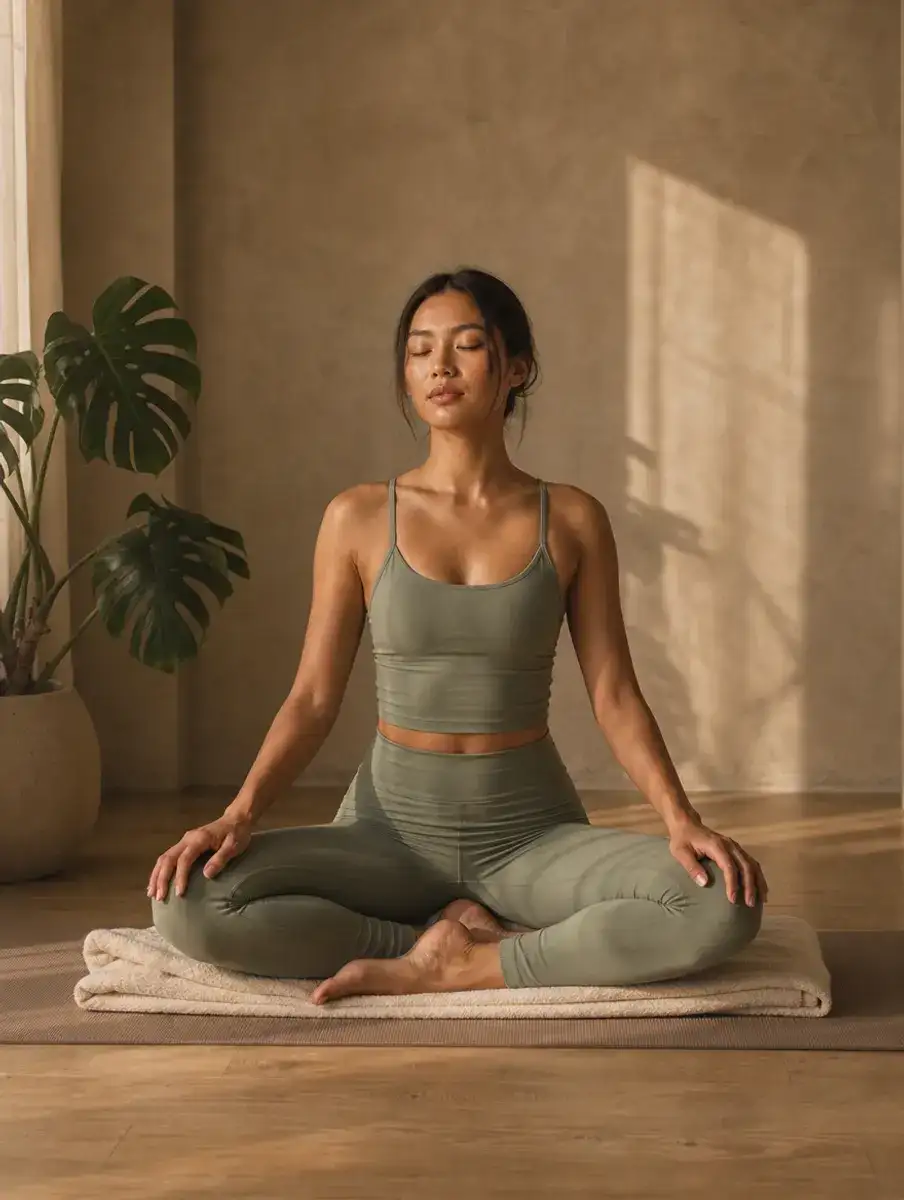
Pronunciation and meaning
Sukhasana: soo-KAHS-uh-nuh. The kh is a breathy k, and the emphasis goes on KAHS.
Sukha means ease or comfort, and asana means posture, so Sukhasana is the comfortable seat. It is a simple cross-legged position used for breathing practice, meditation and the start and end of a class.
How to do Easy Pose
- Sit on the front edge of a folded blanket or cushion with your legs straight out in front of you.
- Bend your knees and cross your shins, sliding each foot under the opposite knee or shin.
- Let your knees drop toward the floor, and check that they are level with or lower than your hips.
- Rest your hands on your thighs or knees, palms up or down, and let the shoulders settle.
- Grow tall from the base of your spine to the crown of your head, chin level.
- Stay for as long as is comfortable, then change the cross of your legs so the other shin is in front.
Easy Pose step by step
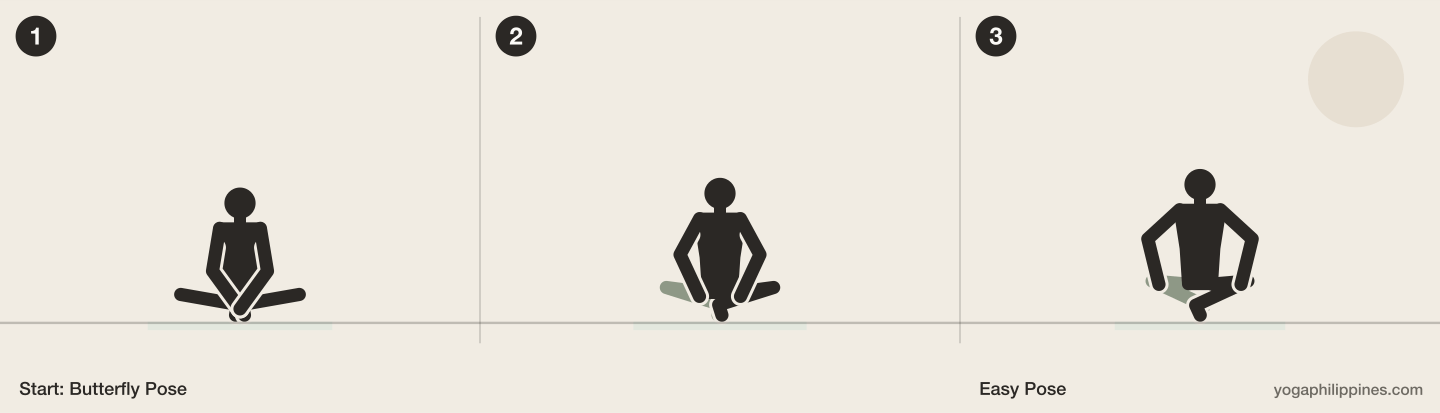
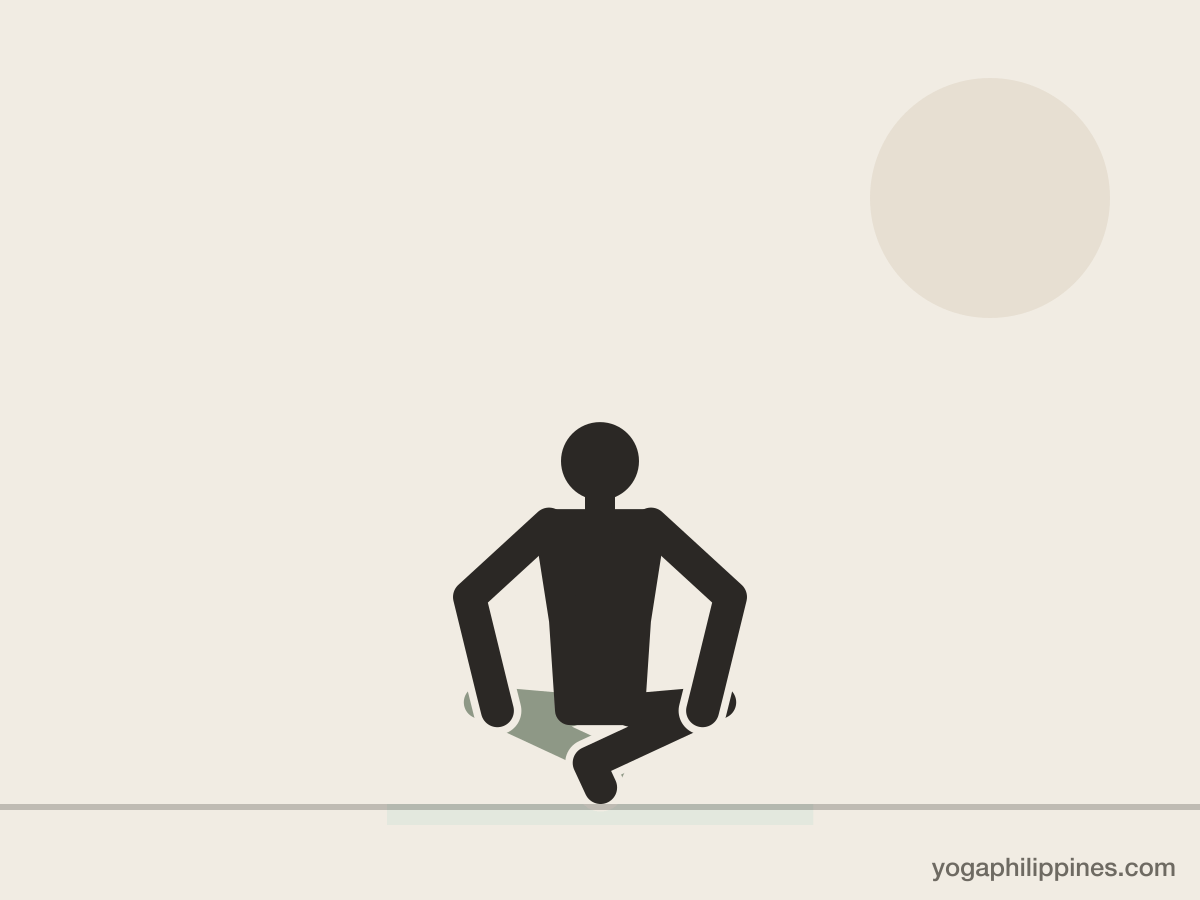
Drawings and video by YogaPhilippines.com, free to reuse under CC BY 4.0 with credit and a link: see the image licence for how to credit.
Easy Pose appears in the 20-minute beginner yoga sequence, which is printable with holds and cues. For other poses that work the hips, open the pose finder set to the hips.
Teacher's note from Joahnna Lee
“Sit on your sit bones, not behind them. Rock gently side to side and forward and back until you find the top of them.”
“The cushion is not a cheat. I raise the hips until the lower back stops working to hold you up.”
“Soften the face and the jaw. Easy Pose should look like its name.”
Make it easier
- Sit higher on a block, a bolster or two folded blankets if your knees are above your hips.
- Put a block or rolled blanket under each knee if the knees float.
- Sit with your back to a wall and a small cushion behind the lower back.
- If crossing the legs does not suit your knees, sit on a chair with both feet flat on the floor.
Pregnancy and after birth
Pregnancy. Adapt. Sit higher, on a cushion or bolster, with the knees wide and supported, and lean your back against a wall if that helps. Change position whenever your legs or back feel tired, and check with your OB or midwife before starting yoga in pregnancy.
After birth. Adapt. When your OB or midwife says you are ready to exercise, sit higher and well supported, especially if sitting is still tender after birth. A soft cushion or a chair is a fine seat for breathing practice.
For more on practising through pregnancy, see Joahnna Lee Yoga.
Common mistakes
- Sitting flat on the floor with the knees higher than the hips, which rounds the lower back.
- Tucking the feet tightly under the thighs so the knees and ankles twist.
- Always crossing the same leg in front.
- Sitting stiffly with the chest pushed forward. Let the ribs soften over the hips.
Easy Pose is the seat most people take without thinking. Done well, it lets you sit for several minutes of breathing practice without fidgeting. The difference usually comes down to the height of what you sit on.
It is often the first seat in yoga for beginners, and a folded blanket usually does more for it than effort does. When it feels settled, the next seats to explore are Siddhasana, with one heel in front of the other and Half Lotus, with one foot on the thigh. If you are heading to a class soon, your first yoga class explains what to bring.
From this seat, a gentle Seated Twist, turning from the ribs is a common first movement to add. It also opens the page of seated yoga poses, from Easy Pose to Boat, and sits among the easy yoga poses for slow days.
When the legs straighten out in front, the seat becomes Staff Pose, Dandasana. From a cross-legged seat or a kneel, a few rounds of Lion Pose, the roaring breath loosen the face and jaw. If you are curious about the crossed-leg seats beyond this one, Half Lotus and full Lotus compared explains what each asks of the hips.
Poses that lead into Easy Pose
In a sequence, Easy Pose often follows these poses as their counter-pose or rest.
Where to go next after Easy Pose
These poses list Easy Pose as a preparation, so they are a natural next step once it feels comfortable.
- Accomplished Pose (Siddhasana) intermediate
- Half Lotus Pose (Ardha Padmasana) intermediate
- Fire Log Pose (Agnistambhasana) intermediate
Props that help in Easy Pose
- Blanket: lifts the hips a little so the spine can stay tall.
- Block: sits under the hips or supports a hand or knee that does not reach the floor.
- Bolster: supports the body so you can stay longer with less effort.
- Wall: gives a steady point to lean on or press into for balance and alignment.
- Chair: brings the floor closer, or gives a seat or a hand rest for a gentler version.
Programs and sessions that use Easy Pose
- The one-month challenge 1 of its 30 sessions
- The 4-week beginner program 1 of its 12 sessions
- Sequences: short 10-minute practice, 30-minute yoga flow, 45-minute slow practice, beginner routine and wrist-free flow
- Practice app sessions: 10-minute reset, 20-minute flow, 30-minute practice, morning wake-up, evening wind-down and hip opener
- Generated example flows: 10-minute beginner flow and 45-minute yin-style wind-down
Sources: Mayo Clinic, Fitness program: 5 steps to get started; NCCIH (US National Institutes of Health), Yoga: Effectiveness and Safety; NHS, Exercise in pregnancy; CDC, Pregnant & Postpartum Activity: An Overview; Canadian Family Physician (Chan et al., 2014), via PubMed Central, Hot yoga and pregnancy: Fitness and hyperthermia. Last reviewed 2 October 2026.
Easy Pose questions
Is Easy Pose the same as sitting cross-legged?
Very nearly. Easy Pose is sitting cross-legged with attention: the hips raised enough, the spine long and the shoulders soft. It is the seat many teachers use for breathing practice.
What is the difference between Easy Pose and Lotus?
In Easy Pose the feet rest under the opposite shins. In Lotus, each foot sits on top of the opposite thigh, which asks for much more rotation from the hips. Easy Pose is where to start.
What is another name for Easy Pose?
Easy Pose is Sukhasana in Sanskrit. Sukha means ease or comfort and asana means posture, so the name means the comfortable seat. In English it is also called the cross-legged pose or simply a cross-legged seat. It is the seat many teachers use for breathing practice, meditation and the start and end of a class.
Who should not sit in Sukhasana?
If crossing the legs strains your knees, ankles or hips, or you have a recent injury there, sit on a chair with both feet flat instead. Sitting higher on a block or folded blankets, with support under the knees, helps many people. If pain lasts or you have a joint condition, check with your doctor or physio first.
What is the difference between Siddhasana and Sukhasana?
In Sukhasana, Easy Pose, the shins cross and each foot rests under the opposite knee or shin. In Siddhasana, the legs do not cross: one heel sits close to the body and the other heel rests in front of it. Siddhasana asks for a little more opening in the hips, so Easy Pose is the usual place to start.
Updated