Pose library · Garudasana · reviewed by a teacher
Eagle Pose (Garudasana)
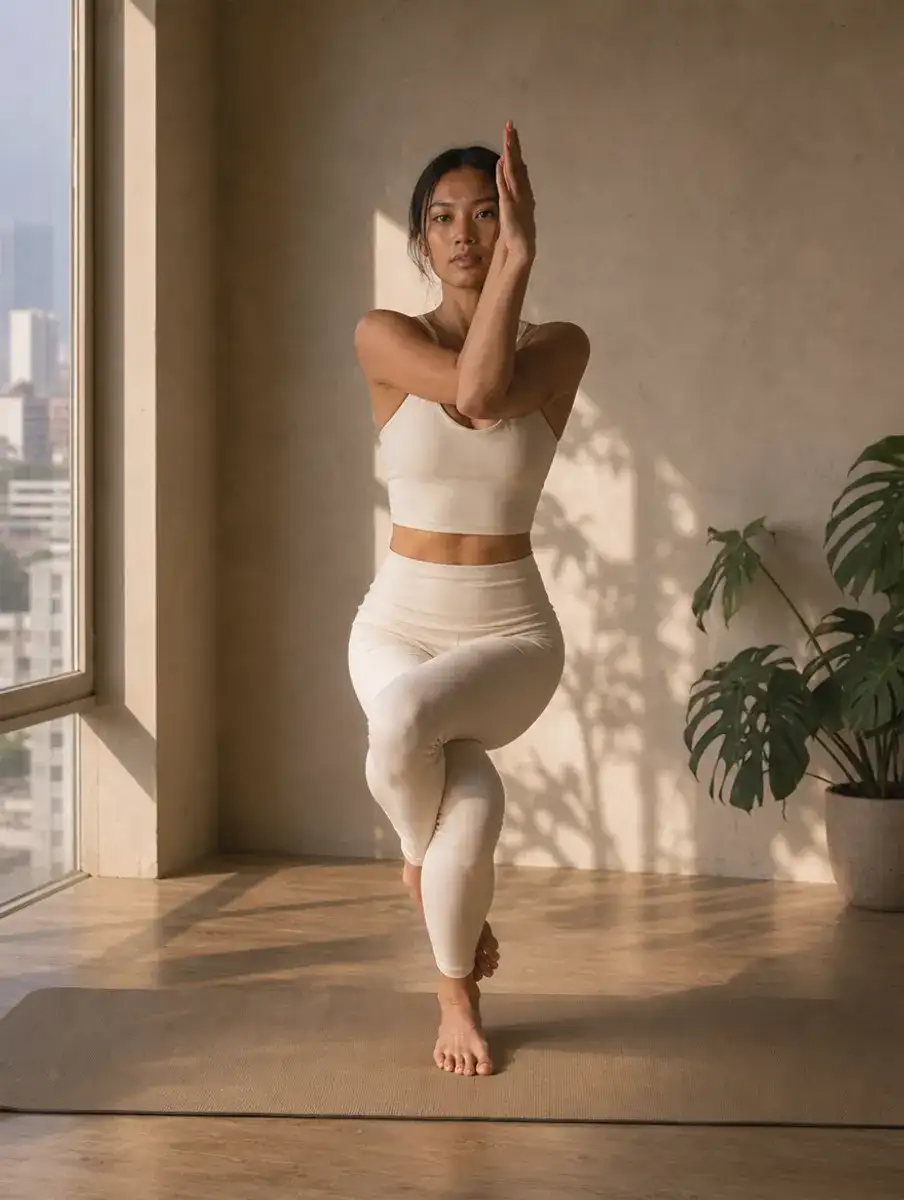
Eagle Pose is a standing balance where one leg wraps around the other and one arm wraps around the other, while you sit low on the standing leg. Garuda is the great eagle of Indian stories and asana means posture. It asks for balance and focus, and the arm wrap stretches the space between the shoulder blades.
Eagle Pose (Garudasana) is a standing balance with the legs and arms wrapped, stretching the space between the shoulder blades. Bend the knees, cross one thigh high over the other, wrap the arms with the elbows at shoulder height and sit lower for five breaths. Rest the toes on the floor rather than forcing the foot to hook.
Pronunciation and meaning
Garudasana: gah-roo-DAHS-uh-nuh. Four short syllables, with the weight on DAHS.
Eagle Pose is a standing balance where one leg wraps around the other and one arm wraps around the other, while you sit low on the standing leg. Garuda is the great eagle of Indian stories and asana means posture. It asks for balance and focus, and the arm wrap stretches the space between the shoulder blades.
How to do Eagle Pose
- Stand tall and bend both knees a little, as if beginning to sit in a chair.
- Shift your weight onto the left foot. Lift the right leg and cross the right thigh over the left, as high up the thigh as it goes.
- Point the right toes down. If they reach, hook the right foot behind the left calf; if not, rest the toes on the floor beside the left foot.
- Reach the arms forward, cross the left arm over the right at the elbows, bend both elbows and bring the palms toward each other.
- Lift the elbows to shoulder height and draw them a little away from your face. Sit lower and stay for five breaths.
- Unwind slowly, stand on both feet and repeat on the other side, with the opposite leg and arm on top.
Eagle Pose step by step

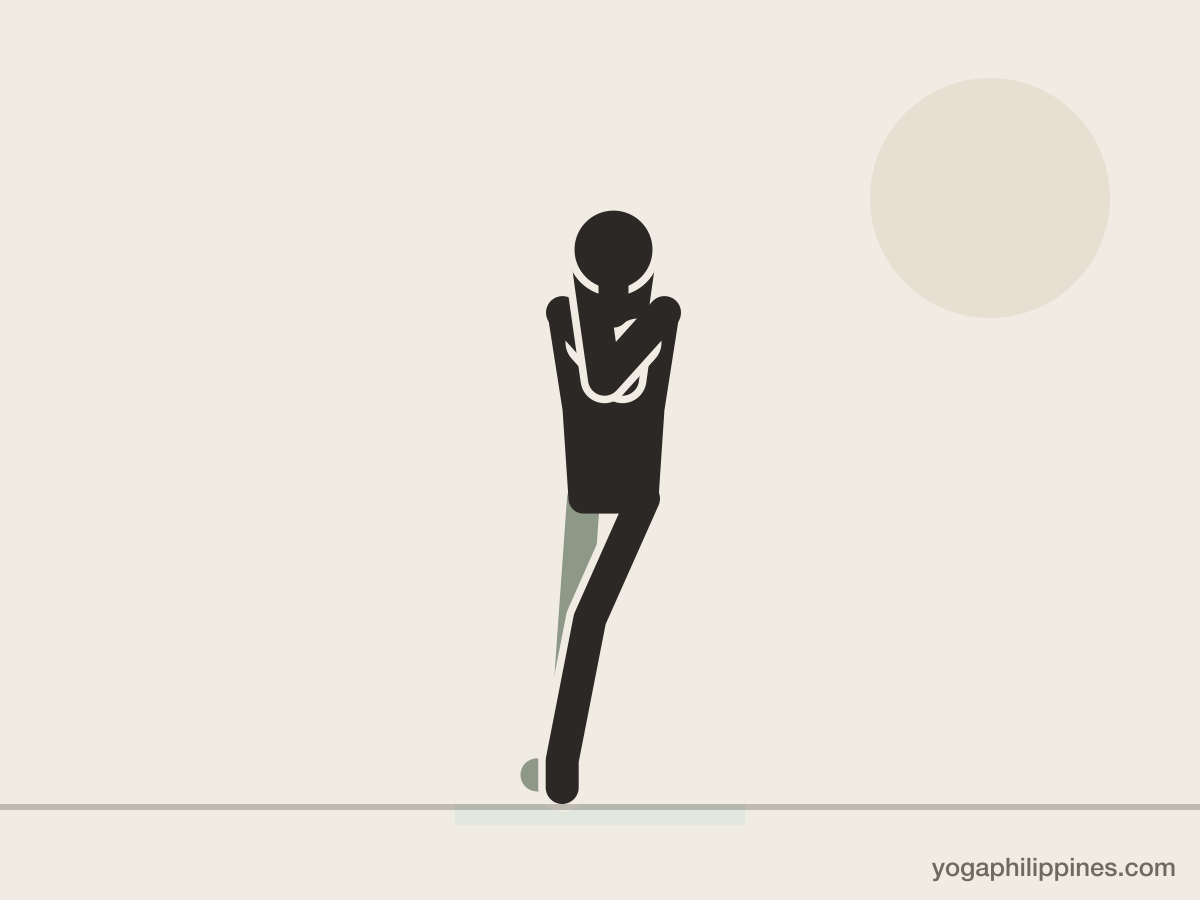
Drawings and video by YogaPhilippines.com, free to reuse under CC BY 4.0 with credit and a link: see the image licence for how to credit.
Eagle Pose appears in the Bikram 26 poses sequence and the 15-minute standing balance sequence, both printable with holds and cues. For other poses that work the shoulders, open the pose finder set to the shoulders.
Teacher's note from Joahnna Lee
“Sit as if into a low chair. The lower you sit, the steadier the balance.”
“Squeeze the legs toward the midline, as if they were one leg.”
“Breathe into the back between the shoulder blades, where the arm wrap opens most.”
Make it easier
- Kickstand foot: rest the toes of the crossed leg on the floor instead of hooking the calf.
- Arms only: if the legs or balance are not happy, sit on a chair and do just the arm wrap, or hold opposite shoulders in a hug.
- Stand with your back near a wall in case you wobble.
Pregnancy and after birth
Pregnancy. Adapt. Skip the leg wrap and the deep knee bend as balance shifts, and keep the arm wrap, seated or standing beside a wall. Check with your OB or midwife before you start.
After birth. Adapt. After your doctor or midwife clears you, start with the arms only or the kickstand foot near a wall. The arm wrap is a welcome stretch after hours of carrying and feeding.
Prenatal and postpartum guides live on joahnnalee.com.
Common mistakes
- Standing tall with straight legs, which makes the balance much harder. Sit lower.
- Forcing the foot to hook behind the calf and twisting the knee to get it there.
- Letting the shoulders hunch up toward the ears in the arm wrap.
Eagle Pose ties you in a knot and then asks you to stand still. It is one of the best balances for a busy mind, because there is no room to think about anything else.
In a Vinyasa class with balance work, it often comes straight after Utkatasana, the chair shape, since the low seat is the same.
The arm wrap on its own is a useful stretch for the upper back, and it works at a desk. You will find the leg version among the standing balances, one card each.
Before wrapping the legs, a lifted knee in Flamingo Pose, a simple one-legged balance is a good test of the standing foot.
If Eagle wobbles, short balance drills on one leg help the standing ankle get used to the work.
Prep poses for Eagle Pose
Poses that warm up the same body areas at a lower intensity, so Eagle Pose feels steadier when you get there.
- Chair Pose (Utkatasana) a direct preparation, beginner plus
- Tree Pose (Vrksasana) a direct preparation, beginner
- Star Pose (Utthita Tadasana) gentler work for the same area, beginner
Counter-poses for Eagle Pose
Shapes that move the body the other way or let it rest straight after Eagle Pose.
- Mountain Pose (Tadasana) beginner
Easier and harder variations of Eagle Pose
Related poses from the same family that start from the same position and do a similar kind of work; Eagle Pose itself is intermediate.
- Easier: Flamingo balance beginner plus
Props that help in Eagle Pose
- Wall: gives a steady point to lean on or press into for balance and alignment.
- Chair: brings the floor closer, or gives a seat or a hand rest for a gentler version.
Programs and sessions that use Eagle Pose
- The one-month challenge 2 of its 30 sessions
- The 7-day desk reset 1 of its 7 sessions
- Sequences: 30-minute yoga flow, 26-posture sequence and balance routine
- Practice app sessions: 30-minute practice and balance
Sources: Mayo Clinic, Fitness program: 5 steps to get started; NCCIH (US National Institutes of Health), Yoga: Effectiveness and Safety; NHS, Exercise in pregnancy; CDC, Pregnant & Postpartum Activity: An Overview; Canadian Family Physician (Chan et al., 2014), via PubMed Central, Hot yoga and pregnancy: Fitness and hyperthermia. Last reviewed 2 October 2026.
Eagle Pose questions
Why can't I wrap my foot behind my calf in Eagle Pose?
The length of your legs and the shape of your hips decide that more than effort does. Rest the toes on the floor instead. The kickstand version is a complete pose, not a lesser one.
Is Eagle Pose hard on the knees?
It can be if the knee is twisted to make the foot hook. Keep the wrap where it falls easily and sit evenly over both knees. If a knee hurts, use the kickstand version or skip the legs and keep the arms.
What is Eagle Pose good for?
Eagle Pose, or Garudasana, asks for balance and focus while you sit low on one leg, so it works the standing leg, ankle and hip. The arm wrap stretches the space between the shoulder blades, and squeezing the legs toward the midline works the inner thighs. Many people find it steadies a busy mind.
Is Eagle Pose a beginner pose?
It suits many beginners with a few changes. Rest the toes of the crossed leg on the floor as a kickstand instead of hooking the calf, stand near a wall, and sit lower for balance. If the legs are not ready, do just the arm wrap on a chair. The full wrap can come later.
What are eagle arms good for?
Eagle arms stretch the upper back, especially the space between the shoulder blades, and the back of the shoulders. You can do them standing, seated on a chair or at a desk, without the leg wrap. Lift the elbows to shoulder height, draw them a little away from your face and breathe into the back.
Why can't you bring the palms together in eagle arms?
Tight shoulders and upper back, or simply the length of your arms, can keep the palms apart. Let the backs of the hands touch instead, or hold opposite shoulders in a hug. Keep the shoulders away from the ears and the elbows at shoulder height. The stretch between the shoulder blades still works.
Pairs well with
Updated