Pose library · Viparita Karani · reviewed by a teacher
Legs Up the Wall (Viparita Karani)
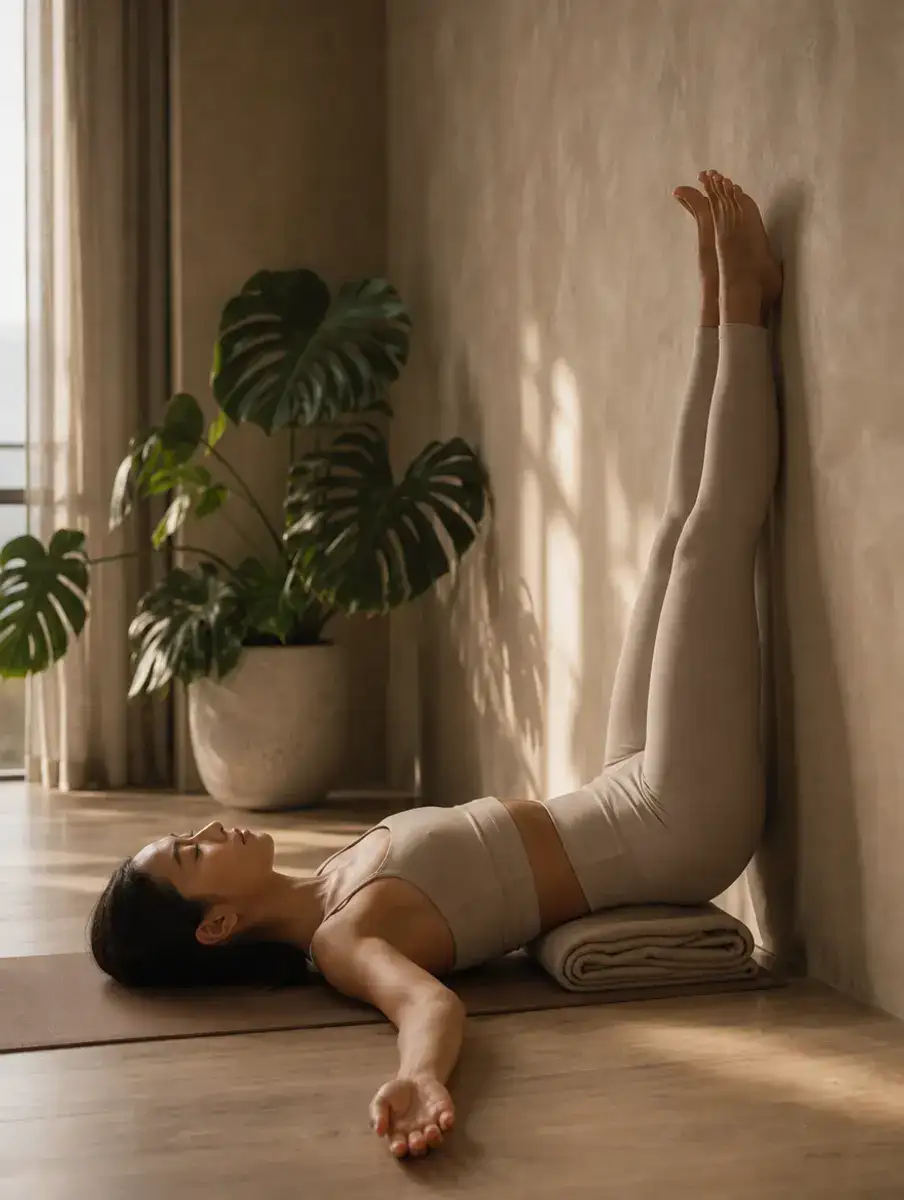
Viparita means turned around or inverted, and karani means doing, so the name is roughly an inverted action. You lie on your back with your legs resting up a wall, and let the floor and the wall hold you.
Legs Up the Wall (Viparita Karani) is a restful inversion lying on your back with the legs up a wall. Sit side-on to the wall, swing the legs up as you lower your back and rest five to ten minutes. If the backs of the legs pull, move away from the wall. Roll onto your side to come out.
Pronunciation and meaning
Viparita Karani: vip-uh-REE-tuh kuh-RAH-nee. Both words carry the stress on the second syllable from the end.
Viparita means turned around or inverted, and karani means doing, so the name is roughly an inverted action. You lie on your back with your legs resting up a wall, and let the floor and the wall hold you.
How to do Legs Up the Wall
- Sit sideways on the floor with one hip touching the wall and your knees bent, with a folded blanket or a low bolster within reach.
- Lean back onto one forearm, then swing your legs up the wall as you lower your back to the floor, turning your whole body in one move.
- Shuffle your seat as close to the wall as feels easy. If the backs of your legs pull, slide a hand's width or two away; the legs do not need to be straight.
- Rest your arms out to the sides with the palms up, or lay your hands on your belly. Let the feet go loose, soles facing the ceiling.
- Stay for five to ten minutes, breathing slowly through the nose.
- To come out, bend your knees toward your chest, roll onto your side and pause there for a few breaths before you push yourself up to sitting.
Legs Up the Wall step by step
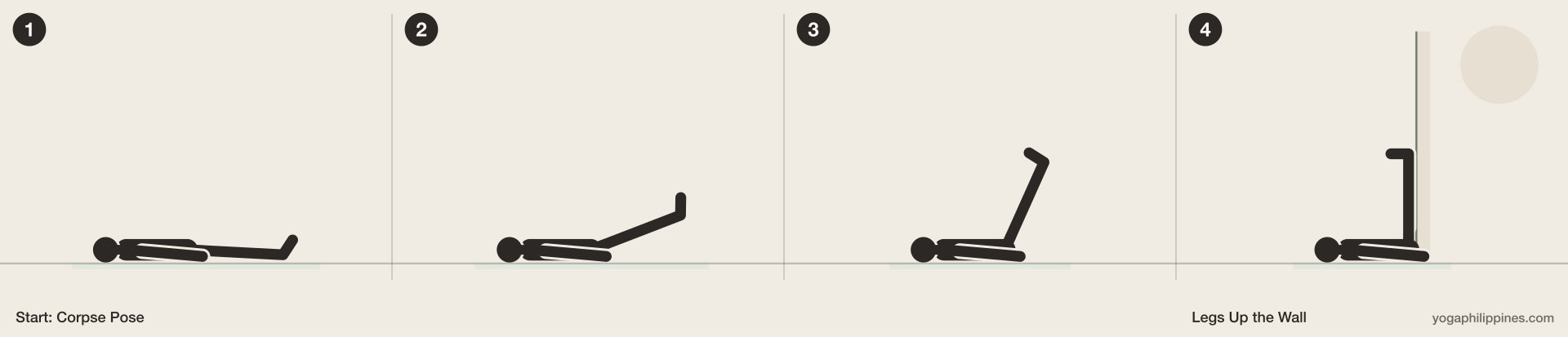
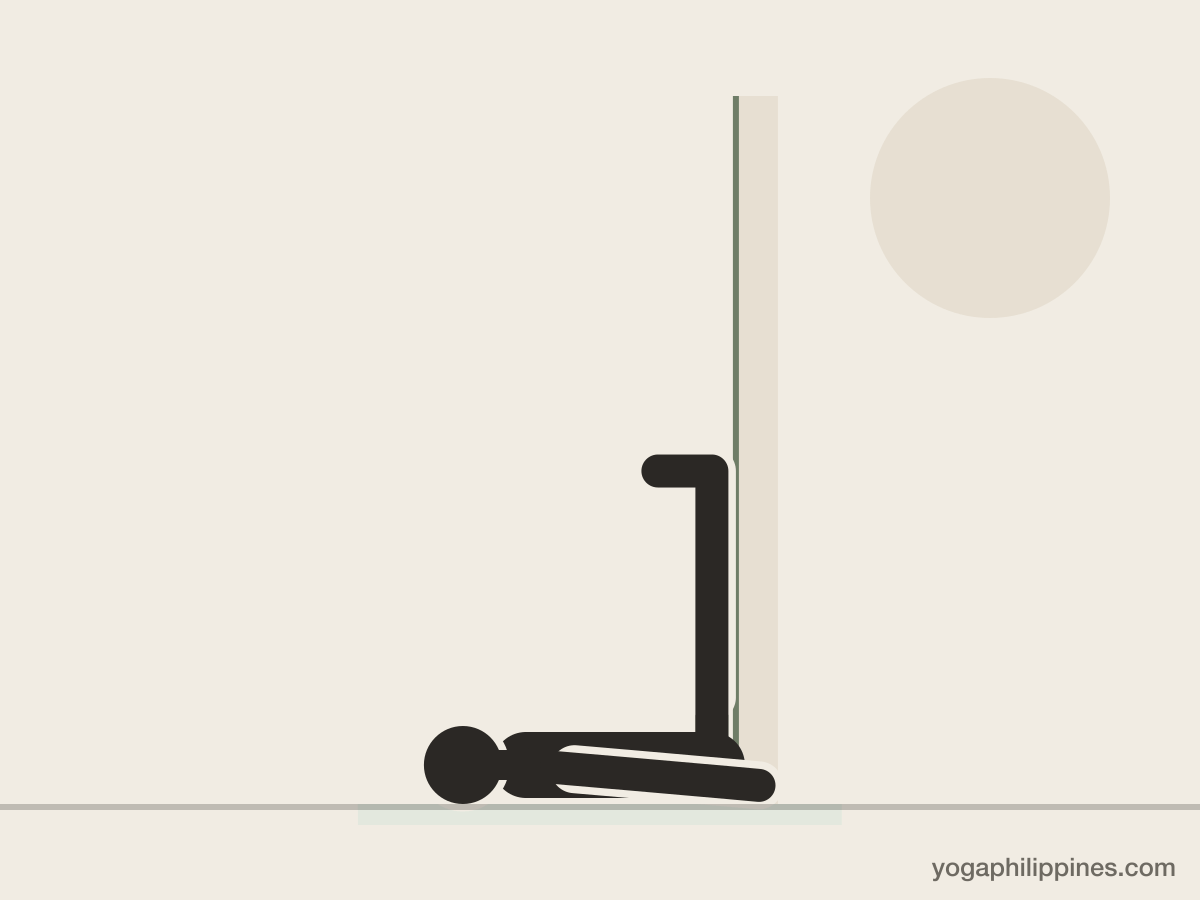
Drawings and video by YogaPhilippines.com, free to reuse under CC BY 4.0 with credit and a link: see the image licence for how to credit.
Legs Up the Wall appears in the 15-minute runner's recovery sequence and the 10-minute bedtime wind-down sequence, both printable with holds and cues. For other poses that work the hamstrings, open the pose finder set to the hamstrings.
Teacher's note from Joahnna Lee
“I would rather you were a little farther from the wall and completely at ease than pressed against it and holding on. Distance is not a score.”
“Let the thighs grow heavy, as if they were sinking down into the hip sockets. The wall carries your legs so you do not have to.”
“Once you are settled, stop adjusting. Find the spot, then leave it alone.”
Make it easier
- Slide a folded blanket or a low bolster under your hips so the pelvis is slightly raised, with the tailbone dropping over the far edge toward the floor.
- No clear wall? Rest your calves on the seat of a chair instead, knees bent at a right angle.
Pregnancy and after birth
Pregnancy. Adapt. Lying flat on your back tends to become uncomfortable as pregnancy goes on, and it is usually best avoided later in pregnancy. Prop your upper back on a bolster so you rest on an incline, or lie on your left side with a pillow between the knees instead, and come out straight away if you feel dizzy, breathless or unwell. Check with your OB or midwife before you start.
After birth. Adapt. Wait until your OB or midwife has said gentle movement is fine. After a caesarean birth, keep the knees bent against the wall at first and always roll onto your side to come in and out, so the belly does not have to do the lifting.
Prenatal and postpartum guides live on joahnnalee.com.
Common mistakes
- Sitting down facing the wall and trying to climb the legs up. Start side-on to the wall and swing round; it is far easier on the lower back.
- Forcing the hamstrings straight. If the backs of the legs are working hard, move back from the wall until they soften.
Legs Up the Wall is one of the simplest restorative shapes, and it often comes just before the final rest of a practice. There is nothing to achieve in it: set it up well, then stay.
In a restorative yoga practice it is usually set up with a bolster or a folded blanket under the hips, and held for as long as it stays comfortable. It is also one of the shapes in a short evening practice for sleep.
Before you rest here, a soft supine twist with pillows under the knees is a kind way to unwind the back.
It is the gentle alternative many teachers offer to Shoulder Stand, the classic inversion on blankets.
Counter-poses for Legs Up the Wall
Shapes that move the body the other way or let it rest straight after Legs Up the Wall.
- Balasana (Child's Pose) beginner
Where to go next after Legs Up the Wall
These poses list Legs Up the Wall as a preparation, so they are a natural next step once it feels comfortable.
- Plow Pose (Halasana) advanced
- Shoulder Stand (Salamba Sarvangasana) advanced
Props that help in Legs Up the Wall
- Wall: gives a steady point to lean on or press into for balance and alignment.
- Blanket: supports the head or the back so the neck stays relaxed.
- Bolster: supports the body so you can stay longer with less effort.
- Chair: brings the floor closer, or gives a seat or a hand rest for a gentler version.
Programs and sessions that use Legs Up the Wall
- The one-month challenge 3 of its 30 sessions
- The 14-day flexibility plan 1 of its 14 sessions
- The 7-day desk reset 1 of its 7 sessions
- Sequences: bedtime routine and post-run routine
- Practice app sessions: evening wind-down
- Generated example flows: 30-minute back-friendly session, no weight on the wrists and 45-minute yin-style wind-down
Sources: Mayo Clinic, Fitness program: 5 steps to get started; NCCIH (US National Institutes of Health), Yoga: Effectiveness and Safety; NHS, Exercise in pregnancy; CDC, Pregnant & Postpartum Activity: An Overview; Canadian Family Physician (Chan et al., 2014), via PubMed Central, Hot yoga and pregnancy: Fitness and hyperthermia; PLoS One (Cramer et al., 2013), via PubMed Central, Adverse Events Associated with Yoga: A Systematic Review of Published Case Reports and Case Series. Last reviewed 2 October 2026.
Legs Up the Wall questions
How long should I stay in Legs Up the Wall?
Five to ten minutes is a good place to start. Come down sooner if your feet tingle or go numb.
Is Legs Up the Wall an inversion?
Only a gentle one. Your legs are higher than your hips, but your head and shoulders stay on the floor and nothing presses on the neck, so it is very different from a headstand or a shoulderstand.
What is Legs Up the Wall good for?
Legs Up the Wall is a restful shape: the floor and the wall hold you while the legs rest above the hips and the backs of the legs lengthen gently. Many people find it a calm way to wind down near the end of a practice, and it is the gentle alternative many teachers offer to Shoulder Stand.
Can you stay in Legs Up the Wall for 20 minutes?
Five to ten minutes is a good start, and longer holds are fine in a restorative class if you stay comfortable. Nothing special happens at twenty minutes. Come down sooner if your feet tingle or go numb, or the backs of the legs pull. Bend the knees and roll onto your side to come out slowly.
Is Legs Up the Wall good before bed?
Many people like it in the evening, and it is one of the shapes in a short practice for sleep. It asks nothing of you: set it up near a wall, rest your arms out to the sides, breathe slowly through the nose for five to ten minutes, then roll onto your side to come out.
Who should avoid Legs Up the Wall?
It is gentle, but check with your doctor or physio first if you have a recent back, hip or neck injury, or if lying flat with the legs raised feels uncomfortable for you. Come out if you feel dizzy, if your feet tingle or go numb, or if the lower back aches. Moving away from the wall often helps.
Pairs well with
Updated