Pose library · Supta Matsyendrasana · reviewed by a teacher
Supine Twist (Supta Matsyendrasana)
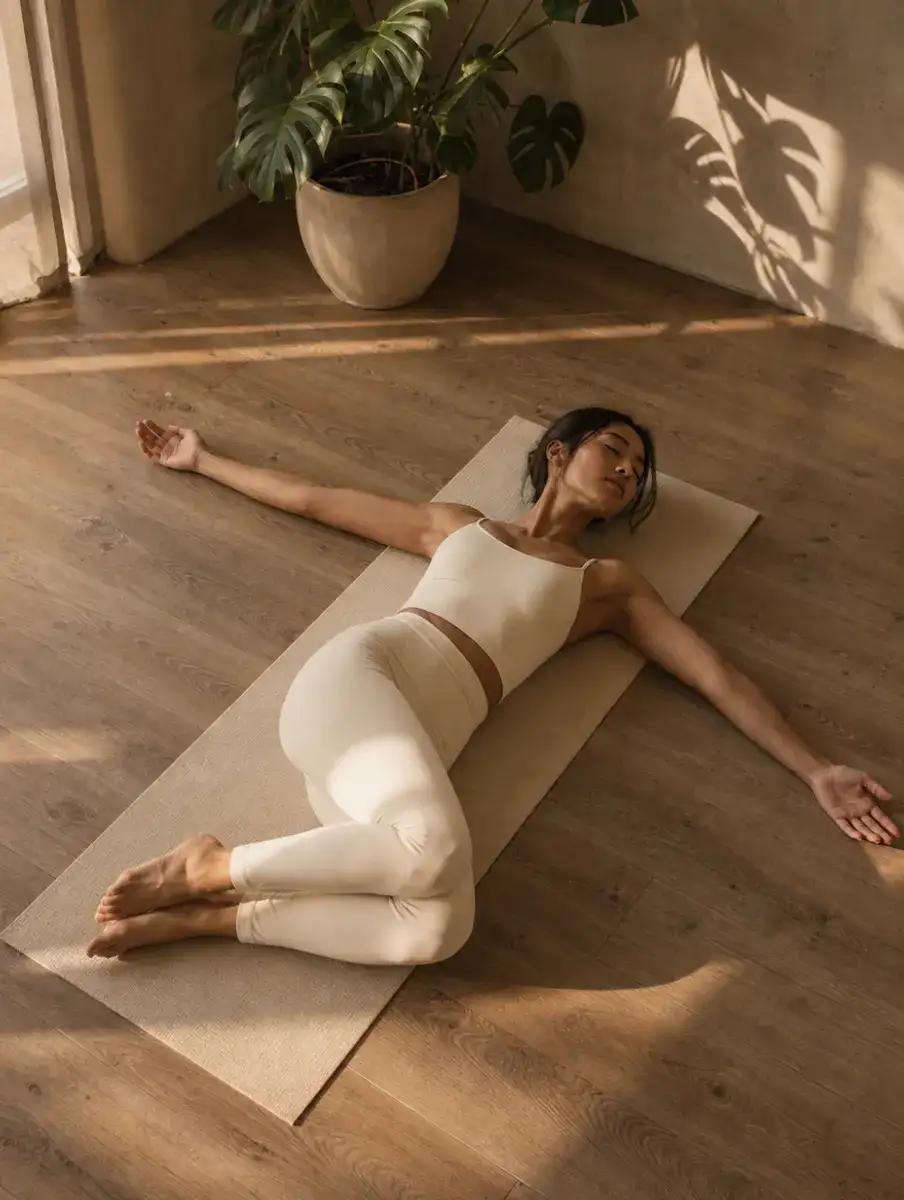
A supine twist is a gentle twist lying on your back: the knees fall to one side while the shoulders stay heavy on the floor and the head turns the other way, or rests in the middle. Supta means reclined, and Matsyendrasana names the seated twist it mirrors. Gravity does the work, so it suits the end of a practice.
Supine Twist (Supta Matsyendrasana) is a gentle twist lying on your back, letting gravity do the work. Shift the hips slightly to one side, hug the knees in, lower them the other way onto a pillow if needed, open the arms and stay one to three minutes each side. Never force the knees down while the opposite shoulder lifts.
Pronunciation and meaning
Supta Matsyendrasana: SOOP-tuh mut-see-en-DRAHS-uh-nuh. Supta is two syllables and rhymes loosely with tuppa.
A supine twist is a gentle twist lying on your back: the knees fall to one side while the shoulders stay heavy on the floor and the head turns the other way, or rests in the middle. Supta means reclined, and Matsyendrasana names the seated twist it mirrors. Gravity does the work, so it suits the end of a practice.
How to do Supine Twist
- Lie on your back with your knees bent and your feet flat on the floor.
- Shift your hips a few centimetres to the right, so the spine stays in a straight line when you turn.
- Hug your knees toward your chest, then let them lower slowly to the left, resting on a pillow or a bolster if they do not reach the floor.
- Open your arms wide at shoulder height, palms up, and let the right shoulder grow heavy.
- Turn your head to the right if your neck likes it, or keep it centred. Stay for one to three minutes, breathing into the side of the ribs.
- Bring the knees back to the middle with an in-breath and repeat on the other side.
Supine Twist appears in the beginner yoga sequence card and the bedtime wind-down sequence card, both printable with holds and cues. For other poses that work the lower back, open the pose finder set to the lower back.
Teacher's note from Joahnna Lee
“Let the knees be heavy and the shoulders be heavier. The twist happens between the two.”
“If the top shoulder lifts a long way off the floor, put more height under the knees.”
“Breathe out slowly and notice the twist soften a little more on each breath.”
Make it easier
- Keep the knees closer to the chest for a twist into the upper back, lower toward the hips for the lower back.
- Rest a block or a stack of cushions under the knees so nothing hangs.
- Straighten the bottom leg and cross only the top knee over, for a longer stretch along the outer hip.
Pregnancy and after birth
Pregnancy. Adapt. From the second trimester, lying flat on your back for long is usually avoided, so take the twist lying on your side or seated instead, turning gently and only in the open direction. Check with your OB or midwife before you start.
After birth. Adapt. After your doctor or midwife has cleared you, start with a small twist with pillows under the knees. After a caesarean birth, wait longer and leave it out if it pulls on the scar.
Expecting? Joahnna Lee Yoga has notes on adapting each trimester.
Common mistakes
- Forcing the knees to the floor while the opposite shoulder lifts off it.
- Twisting with the hips still in the middle of the mat, so the spine bends to the side as it turns.
- Holding the breath. A twist should leave the breath easy.
The supine twist is the quietest twist in the practice. It needs no effort and no balance, only the floor and a pillow, which is why it so often comes near the end of a class.
In restorative yoga, propped and slow, the knees rest on a bolster and you can stay long enough for the breath to settle by itself.
Sitting up, the same turn becomes Ardha Matsyendrasana, the seated version, which asks a little more of the back.
A common partner just before it is Reclined Hand to Big Toe Pose, Supta Padangusthasana, which stretches the hamstrings while you stay lying down.
Poses that lead into Supine Twist
In a sequence, Supine Twist often follows these poses as their counter-pose or rest.
- Boat Pose (Navasana) intermediate
- Bow Pose (Dhanurasana) intermediate
- Bridge Pose (Setu Bandha Sarvangasana) beginner plus
Props that help in Supine Twist
- Bolster: supports the body so you can stay longer with less effort.
- Blanket: supports the head or the back so the neck stays relaxed.
- Block: goes under the sacrum, the head or a knee for support.
Programs and sessions that use Supine Twist
- The 30-day challenge 5 of its 30 sessions
- The 14-day flexibility plan 4 of its 14 sessions
- The 4-week beginner program 3 of its 12 sessions
- The 7-day desk reset 1 of its 7 sessions
- Sequences: 10-minute routine, half-hour flow, back-friendly yoga sequence, sequence before bed, sequence for beginners, after-run sequence and wrist-free yoga flow
- Practice app sessions: 10-minute reset, 20-minute flow, 30-minute practice, evening wind-down, back-friendly and balance
Sources: Mayo Clinic, Fitness program: 5 steps to get started; NCCIH (US National Institutes of Health), Yoga: Effectiveness and Safety; NHS, Exercise in pregnancy; CDC, Pregnant & Postpartum Activity: An Overview; Canadian Family Physician (Chan et al., 2014), via PubMed Central, Hot yoga and pregnancy: Fitness and hyperthermia. Last reviewed 2 October 2026.
Supine Twist questions
How long should I hold a supine twist?
One to three minutes on each side is plenty. In a restorative class, propped well, some students stay longer. Come out when the breath stops feeling easy.
Is a supine twist good before sleep?
Many people like a soft twist in bed or on the floor before sleep, because it is slow and needs no effort. Keep it gentle and stop if anything pinches in the lower back.
What is a supine twist good for?
A supine twist gently rotates the spine while you lie on your back, stretching the outer hip, the side of the ribs and the chest as the shoulders stay heavy. It needs no effort, so many people find it a calming way to close a practice. Keeping the knees higher works the upper back, lower works the lower back.
What does supine mean in yoga?
Supine means lying on your back, face up. In yoga, supine poses include the supine twist, Happy Baby Pose, Reclined Hand to Big Toe Pose, Bridge and final rest in Savasana. The Sanskrit word supta, reclined, often marks them in a pose name. The floor supports the spine, so they suit the slower end of a class.
Pairs well with
Updated