Pose library · Modern variation
Flamingo Pose: a standing balance
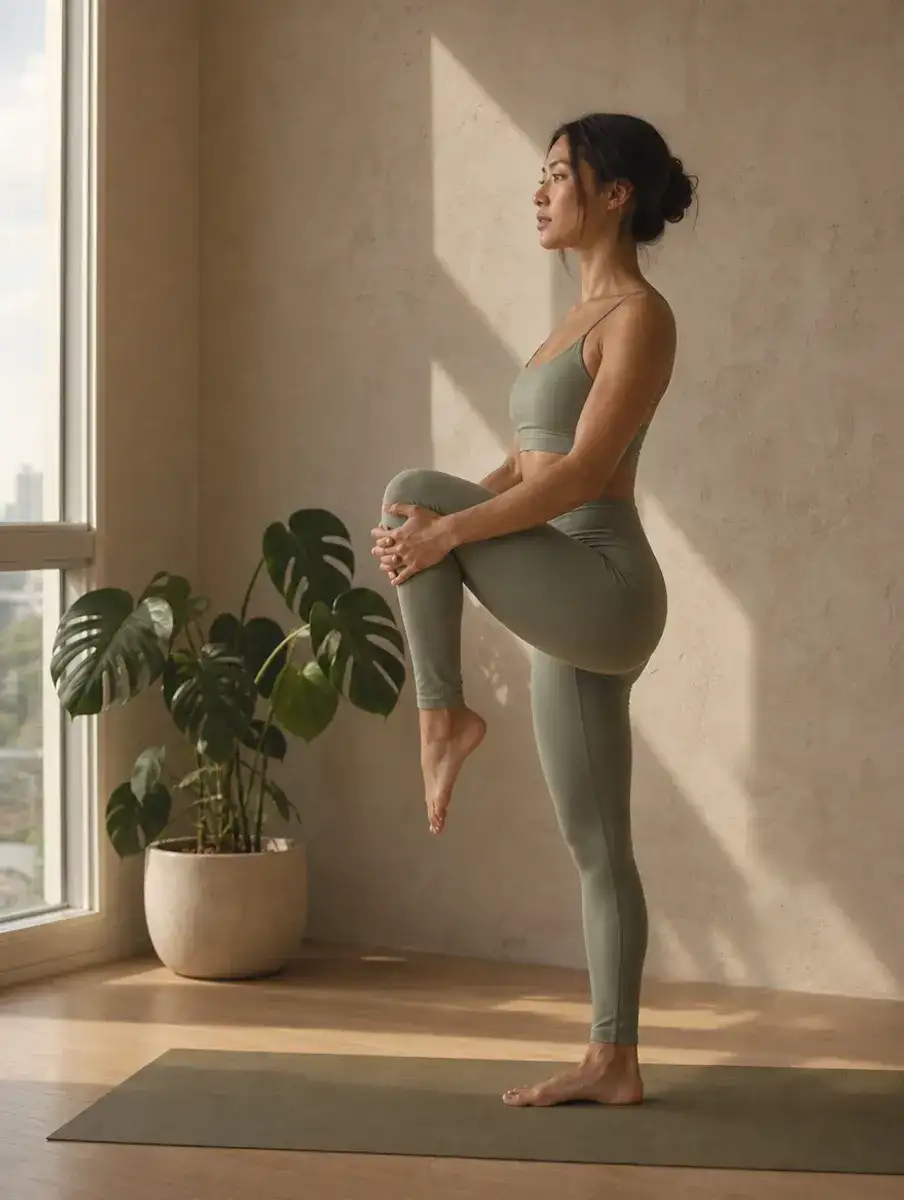
Flamingo Pose is a modern standing balance variation rather than a classical posture. You stand on one leg and lift the other knee or foot, the way a flamingo rests on one leg. Teachers use the name for a few related shapes, all built on a steady standing foot.
Flamingo Pose is a modern standing balance rather than a classical posture, working the standing leg. Rest your gaze on one still point, shift onto one foot and lift the other knee to hip height for five breaths. Keep the standing knee soft, and rest a hand on a wall or chair if you wobble.
Pronunciation and meaning
Modern variation: FLUH-ming-oh. Flamingo Pose has no established Sanskrit name, so classes use the English name.
Flamingo Pose is a modern standing balance variation rather than a classical posture. You stand on one leg and lift the other knee or foot, the way a flamingo rests on one leg. Teachers use the name for a few related shapes, all built on a steady standing foot.
How to do Flamingo Pose
- Stand in Mountain Pose with your feet hip-width apart and your weight spread across both feet. Fix your gaze on one point that does not move.
- Shift your weight into your left foot, keeping a soft bend in the knee. Press down through the big toe, little toe and heel.
- Inhale and lift your right knee to hip height, holding the shin or knee with your hands, or resting the hands on your hips.
- Stand tall through the crown of the head and keep both hip points facing forward. Stay for five breaths.
- If that is steady, extend the right leg forward, holding the big toe with your right hand or a strap, and keep the chest lifted. Stay for three to five breaths.
- Lower the foot with control and repeat on the other side.
Flamingo Pose step by step

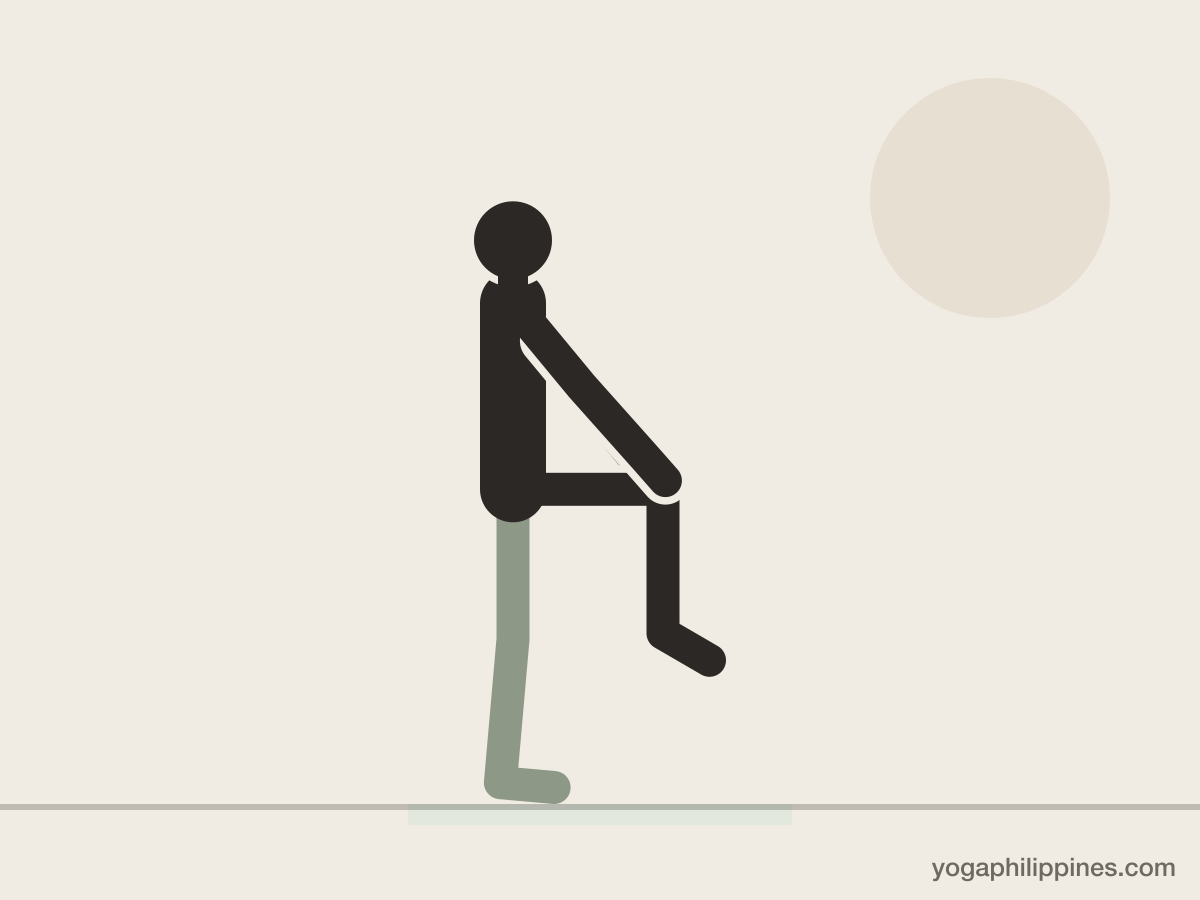
Drawings and video by YogaPhilippines.com, free to reuse under CC BY 4.0 with credit and a link: see the image licence for how to credit.
For other poses that work the hamstrings, open the pose finder set to the hamstrings.
Make it easier
- Keep one hand on a wall or the back of a chair.
- Lift the knee only a little, or keep the toes lightly touching the floor.
- Loop a strap around the ball of the foot instead of reaching for the toe.
Pregnancy and after birth
Pregnancy. Adapt. Balance changes as the belly grows, so practise next to a wall, keep the knee low, and skip the extended leg version. Check with your OB or midwife.
After birth. Adapt. After your doctor or midwife has cleared you, start with a hand on the wall and a small lift. Balance and core strength take time to return, and that is normal.
Expecting? Joahnna Lee Yoga has notes on adapting each trimester.
Common mistakes
- Locking the standing knee, which makes the balance stiff and loads the joint.
- Hitching the lifted hip up toward the ribs.
- Looking around the room instead of resting the gaze on one point.
Flamingo Pose is a name you will hear in some modern classes, children’s classes and fitness programmes for a simple one-legged balance. It is not a traditional posture with a fixed form, so teachers may show slightly different versions.
What they share is a steady standing foot, a tall spine and a quiet gaze. It is an easy way to practise balance in a few spare minutes.
How does flamingo pose relate to tree pose?
Both are standing balances on one foot. In Tree, the classic one-legged balance, the lifted foot rests on the inner leg. In Flamingo the knee lifts in front, which asks more of the hip and core. Eagle Pose, the wrapped balance, and Dancer, the reaching backbend balance, are natural next steps.
Who is it for?
Almost anyone with a wall nearby. It sits well in gentle yoga for older adults, with a chair to hold, and in short balance work for runners.
Prep poses for Flamingo Pose
Poses that warm up the same body areas at a lower intensity, so Flamingo Pose feels steadier when you get there.
- Tree Pose (Vrksasana) a direct preparation, beginner
- Wide Legged Forward Bend (Prasarita Padottanasana) gentler work for the same area, beginner plus
- Standing Forward Bend (Uttanasana) gentler work for the same area, beginner
Counter-poses for Flamingo Pose
Shapes that move the body the other way or let it rest straight after Flamingo Pose.
- Mountain Pose (Tadasana) beginner
Easier and harder variations of Flamingo Pose
Related poses from the same family that start from the same position and do a similar kind of work; Flamingo Pose itself is beginner plus.
- Harder: Half Moon Pose (Ardha Chandrasana) intermediate
- Harder: Eagle Pose (Garudasana) intermediate
Props that help in Flamingo Pose
- Strap: extends the arms when the hands do not reach the feet or each other yet.
- Wall: gives a steady point to lean on or press into for balance and alignment.
- Chair: brings the floor closer, or gives a seat or a hand rest for a gentler version.
Programs and sessions that use Flamingo Pose
- Sequences: 45-minute slow yoga
- Generated example flows: 20-minute hip flow and 30-minute back-friendly session, no weight on the wrists
Sources: Mayo Clinic, Fitness program: 5 steps to get started; NCCIH (US National Institutes of Health), Yoga: Effectiveness and Safety. Last reviewed 2 October 2026.
Flamingo Pose questions
Does flamingo pose have a Sanskrit name?
Not an established one. It is a modern variation. The extended leg version is close to Utthita Hasta Padangusthasana, the extended hand to big toe posture, which some classes teach in its place.
Why is one leg wobblier than the other in flamingo pose?
Almost everyone has a steadier side. Practise both, start with the less steady leg, and use a wall. The gap often narrows with regular practice.
Is flamingo pose good for balance?
Many people find that one-legged standing poses help them feel more steady and aware of their feet. Practise it near a wall, and keep the breath slow.
What is the purpose of flamingo pose?
Flamingo Pose is a simple way to practise standing on one leg. It works the standing leg and foot, asks the hip and core to keep the body upright, and trains a quiet, steady gaze. It fits into a few spare minutes, a warm up before Tree or Eagle, or gentle balance work with a wall nearby.
Updated