Pose library · Chaturanga Dandasana
Four-Limbed Staff Pose (Chaturanga Dandasana)
Chatur means four, anga means limb, danda means staff and asana means posture. It is a low plank: the body stays straight as a staff while the hands and feet, the four limbs, hold it just above the floor.
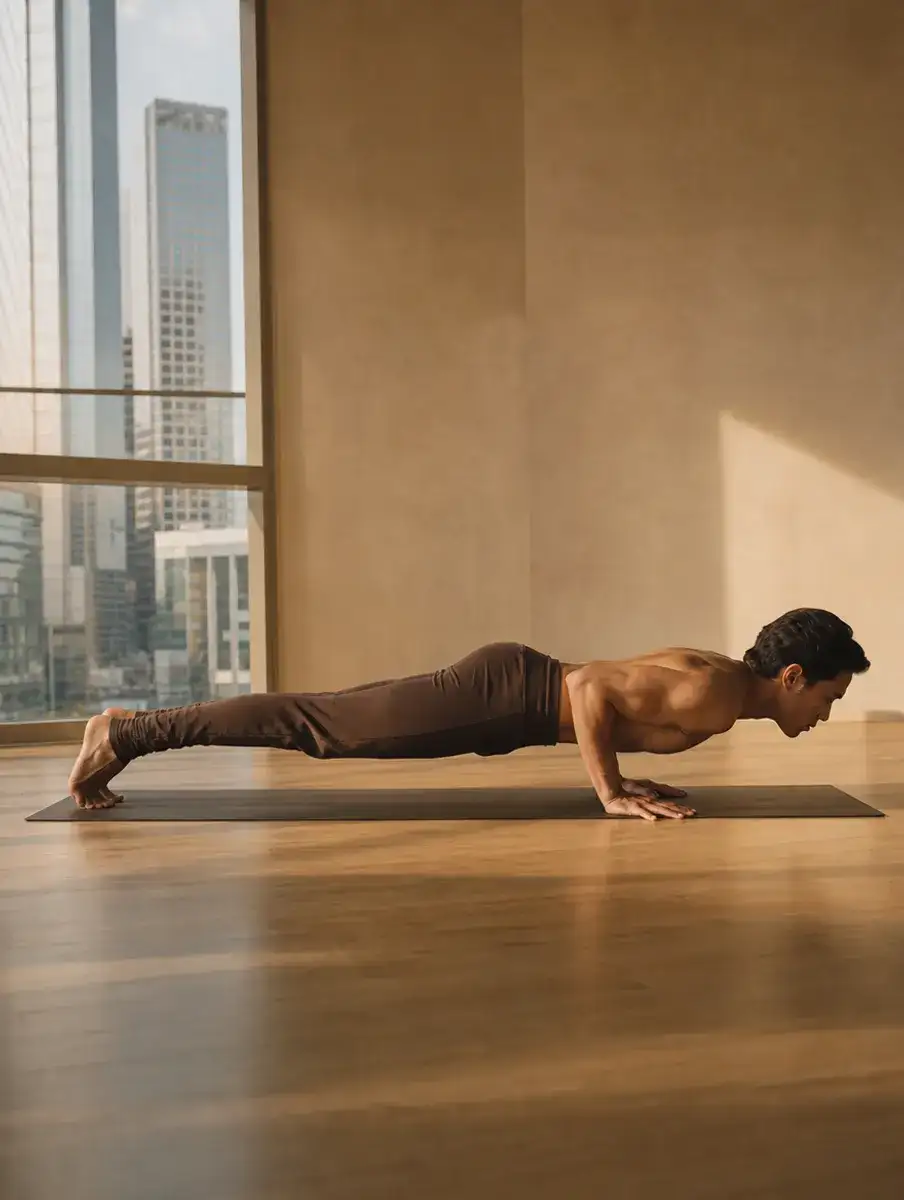
Four-Limbed Staff Pose (Chaturanga Dandasana) is a low plank that works the arms, shoulders and belly. From Plank, shift forward, bend the elbows straight back beside the ribs and lower as one piece until the elbows reach about ninety degrees. Never dip the shoulders below the elbows; lowering the knees first is a full version.
Pronunciation and meaning
Chaturanga Dandasana: chuh-tur-UNG-uh dun-DAHS-uh-nuh. Chaturanga has four syllables with the stress on the third, and Dandasana stresses DAHS.
Chatur means four, anga means limb, danda means staff and asana means posture. It is a low plank: the body stays straight as a staff while the hands and feet, the four limbs, hold it just above the floor.
How to do Four-Limbed Staff Pose
- Start in Plank Pose with your wrists under your shoulders, fingers spread, and one straight line from the crown of your head to your heels.
- Rock forward onto the balls of your feet so your shoulders move a little ahead of your wrists. Draw the belly in gently and press the floor away.
- As you exhale, bend both elbows straight back, keeping them close to your ribs, and lower the whole body as one piece.
- Stop when your elbows are bent to about ninety degrees and your shoulders are level with them. Staying higher is fine; dipping lower is not.
- Hold for one breath at first, chest broad, gaze on the floor just ahead of your hands.
- On the next inhale, move into Upward-Facing Dog or Cobra, or lower all the way to the floor and rest.
Four-Limbed Staff Pose step by step

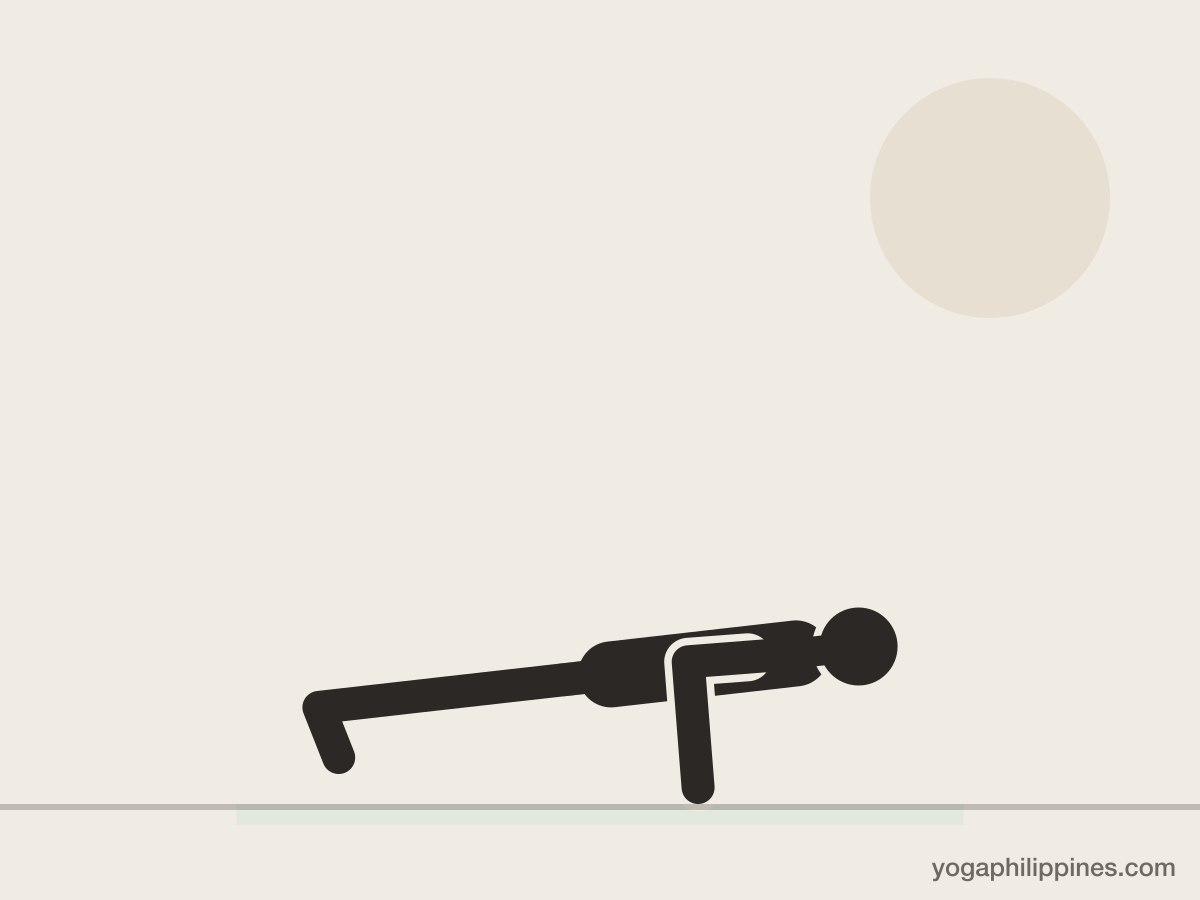
Drawings and video by YogaPhilippines.com, free to reuse under CC BY 4.0 with credit and a link: see the image licence for how to credit.
For other poses that work the shoulders, open the pose finder set to the shoulders.
Make it easier
- Lower your knees to the mat before you bend the elbows, keeping a straight line from the knees to the head. This is a full version of the pose, not a lesser one.
- Set a block lengthwise under your chest as a target, and stop when the chest touches it.
- Lower slowly all the way to your belly instead of holding halfway, then press back up to hands and knees.
Pregnancy and after birth
Pregnancy. Adapt. Chaturanga works the belly hard, so many teachers suggest the knees down version or moving through hands and knees instead as the pregnancy progresses. Check with your OB or midwife.
After birth. Adapt. After your doctor or midwife has cleared you, begin with the knees down and a short range. If you see a ridge or doming along the middle of the belly, go back to an easier version and mention it to a pelvic floor physiotherapist.
Pregnancy and postpartum notes are kept by Joahnna Lee, who is certified in prenatal and postnatal yoga.
Common mistakes
- Dipping the shoulders below the elbows, which puts a heavy load on the front of the shoulder.
- Letting the elbows flare out to the sides like a wide push up.
- Sagging through the hips or piking them up, so the body stops moving as one line.
Chaturanga is the low plank that links one pose to the next in a flowing class. It shows up in every round of Sun Salutation A, between Plank and Upward-Facing Dog, so it is repeated far more often than most poses.
That repetition is the reason to learn it slowly, since small habits add up. Building the shape from a steady Plank Pose with the body in one line is the surest start.
What does chaturanga mean?
The full name is Chaturanga Dandasana. Chatur means four, anga means limb, danda means staff or stick and asana means pose, so the English name is Four-Limbed Staff Pose: the body held straight as a staff on the hands and feet. Many classes simply call it low plank.
The same word chaturanga, four parts, is also the name of an early Indian board game whose pieces stood for the four divisions of an army. It is widely regarded as an ancestor of chess, which is why a search for the word brings up both. The yoga pose itself is relatively modern: it does not appear in the medieval hatha yoga texts and became widespread through the twentieth century teaching of T. Krishnamacharya in Mysore and his students.
How do you build strength for chaturanga?
A simple four-week plan, two or three times a week, after a short warm-up:
| Week | Practice | Dose |
|---|---|---|
| 1 | Plank holds on the hands | 3 rounds of 5 breaths |
| 2 | Knees-down chaturanga, lowering slowly all the way to the belly | 2 rounds of 5 |
| 3 | Knees-down chaturanga holds at the halfway point | 3 rounds of 2 breaths |
| 4 | Full chaturanga lowering slowly to the belly, then knees-down holds | 2 rounds of 3, then 3 holds |
Forearm plank and Dolphin Pose on the other days build the shoulders without loading the wrists. If the shoulders ache at the front at any stage, go back a week.
How long does it take to get chaturanga?
It varies with how much upper body strength you start with. Many people can hold a well-aligned knees-down version within a few weeks of regular practice, and a full version with the knees lifted after a few months. There is no prize for rushing; a hundred careful knees-down chaturangas are better for the shoulders than ten collapsed full ones.
Keeping the hands from sliding
In a hot room, sweaty palms can slip forward as you lower, which pulls the shoulders ahead of the wrists. Wipe the hands between rounds, spread the fingers wide and press through the base of the index finger. A towel over the top of the mat helps in very humid classes.
Who should take the knees down version?
Anyone who is new to it, coming back after a break, or noticing the front of the shoulders after class. Knees down keeps the same alignment with less load. Many experienced students still use it in a long Vinyasa style class.
What helps after a lot of chaturangas?
Gentle work for the chest and the front of the shoulders feels good to many people. A few minutes from the shoulder stretches routine or a slow Child’s Pose after class is a kind way to finish.
Four-Limbed Staff Pose or Plank Pose?
Chaturanga starts in Plank and lowers halfway. The two use the same straight line from head to heels; the difference is the bend in the elbows.
| Compare | Four-Limbed Staff Pose | Plank Pose |
|---|---|---|
| Position | Hands and knees or hands and feet | Hands and knees or hands and feet |
| What it works | arms, shoulders and core | core, arms and shoulders |
| Level | Intermediate | Beginner plus |
| Key difference | Elbows bend straight back beside the ribs and stop at shoulder height, the body lowering as one line. | Arms stay straight, wrists under the shoulders, hips level with the shoulders. |
Prep poses for Four-Limbed Staff Pose
Poses that warm up the same body areas at a lower intensity, so Four-Limbed Staff Pose feels steadier when you get there.
- Plank Pose (Phalakasana) a direct preparation, beginner plus
- Downward-Facing Dog (Adho Mukha Svanasana) gentler work for the same area, beginner plus
Counter-poses for Four-Limbed Staff Pose
Shapes that move the body the other way or let it rest straight after Four-Limbed Staff Pose.
- Balasana (Child's Pose) beginner
Easier and harder variations of Four-Limbed Staff Pose
Related poses from the same family that start from the same position and do a similar kind of work; Four-Limbed Staff Pose itself is intermediate.
- Harder: Crow Pose (Bakasana) advanced
- Harder: Firefly Pose (Tittibhasana) advanced plus
Props that help in Four-Limbed Staff Pose
- Block: brings the floor closer under the hands.
Put it into practice with the timer for Sun Salutation rounds, the pose of the day and the quiz on pose names, built on pages like this one.
Sources: Mayo Clinic, Fitness program: 5 steps to get started; NCCIH (US National Institutes of Health), Yoga: Effectiveness and Safety. Last reviewed 2 October 2026.
Four-Limbed Staff Pose questions
Why do the shoulders hurt in chaturanga?
Most often the shoulders are sinking lower than the elbows, or the elbows are flaring out. Lower less far, keep the elbows by your ribs, and use the knees down version for a while. If the pain stays after practice, see a doctor or physio.
Is chaturanga the same as a push up?
They are close relatives. Chaturanga keeps the elbows tight to the ribs and stops at the halfway point, usually for a breath, before flowing into a backbend. A push up often uses wider elbows and repeats up and down.
How many chaturangas are in a vinyasa class?
It varies a lot. A strong flow class can repeat it many times through sun salutations and vinyasas, which is why learning it carefully matters. You can swap any of them for the knees down version or for lowering to the belly.
Can beginners skip chaturanga?
Yes. You can lower your knees first and then the chest, lower all the way to your belly from plank, or simply hold plank and move to Downward Dog. Many teachers offer these options in every class. Build strength with the knees down version until the full pose feels steady.
How low should you go in chaturanga?
Stop when your upper arms are about parallel to the floor, with the elbows in line with your shoulders and the shoulders no lower than the elbows. Going lower loads the front of the shoulder. If you cannot hold that height, stay higher or lower your knees.
What is the difference between chaturanga and a vinyasa?
Chaturanga is a single pose, the low plank. A vinyasa is the short linking sequence it sits in, usually Plank, Chaturanga, Upward-Facing Dog and Downward Dog, and Vinyasa is also the name of the flowing class style built around that breath-linked movement. So chaturanga is one part of a vinyasa, not another name for it.
Pairs well with
Updated