Pose library · Tittibhasana
Firefly Pose (Tittibhasana)
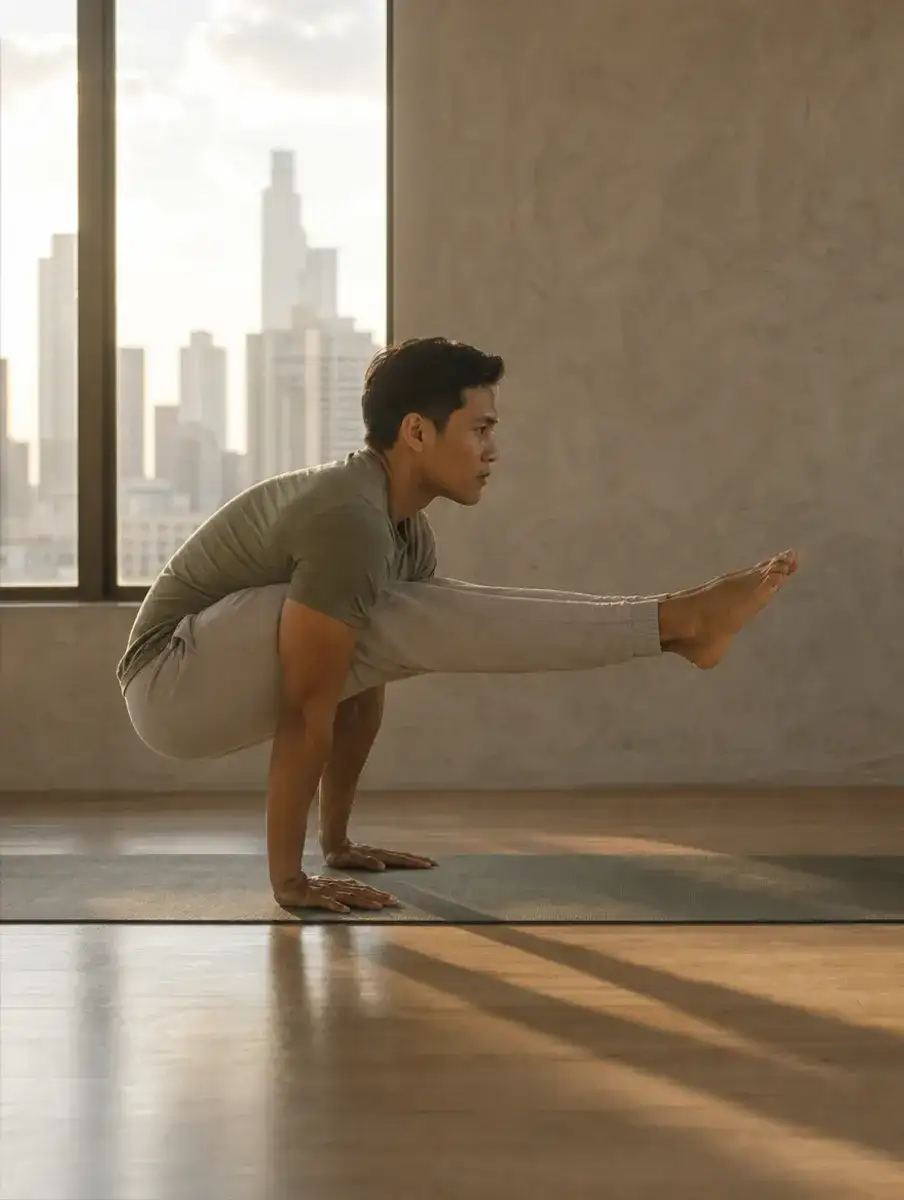
Tittibha is usually translated as firefly, though it may also name a small insect or bird, and asana means posture. Balancing on the hands, the legs rest over the upper arms and stretch out straight to the sides and forward, like wings.
Firefly Pose (Tittibhasana) is an advanced arm balance that asks for strong wrists and open hamstrings and inner thighs. Learn it with a teacher: thread the arms behind the legs, hands behind the heels, sit onto the upper arms and lift the feet, straightening the legs if steady. Keep the elbows slightly bent, never locked.
Pronunciation and meaning
Tittibhasana: tit-tee-BAHS-uh-nuh. The double t is held a moment, and the stress falls on BAHS.
Tittibha is usually translated as firefly, though it may also name a small insect or bird, and asana means posture. Balancing on the hands, the legs rest over the upper arms and stretch out straight to the sides and forward, like wings.
How to do Firefly Pose
- Learn this pose with a teacher. Warm up the wrists, hamstrings and inner thighs first, and be comfortable in Crow Pose.
- Stand with the feet a little wider than the hips, fold forward and bend the knees. Thread your arms between your legs and place your hands flat on the floor behind your heels, fingers pointing forward.
- Work your shoulders as far behind your knees as you can, so the backs of the thighs rest high on the upper arms.
- Bend your elbows slightly, shift your weight back into the hands and sit onto the upper arms. Lift one foot and then the other, keeping the knees bent.
- If the balance is steady, straighten the legs out in front and to the sides. Press the floor away and keep the gaze forward. Stay for two or three breaths.
- Bend the knees, lower the feet to the floor with control, and rest with the wrists shaken out.
For other poses that work the wrists, open the pose finder set to the wrists.
Make it easier
- Sit on a block placed behind the hands and lift the feet from there, so the arms carry less weight.
- Keep the knees bent and the feet low, the shape before the legs straighten.
- Work on the parts separately: Garland Pose for the hips, Crow for the balance, and wide folds for the hamstrings.
Pregnancy and after birth
Pregnancy. Avoid. Arm balances that compress the belly and risk a fall are not suited to pregnancy. Check with your OB or midwife about safer strength work.
After birth. Avoid for now. Wait until your doctor or midwife has cleared you and the core and wrists feel strong, then rebuild with Crow and a teacher's help.
Pregnancy and postpartum notes are kept by Joahnna Lee, who is certified in prenatal and postnatal yoga.
Common mistakes
- Placing the hands too far forward, so the arms cannot reach behind the legs.
- Locking the elbows straight, which loads the joints. Keep them slightly bent.
- Dropping onto the tailbone when coming out instead of lowering the feet with control.
Firefly Pose is an advanced arm balance seen in strong Vinyasa classes and arm balance workshops. It asks for open hamstrings and hips, strong wrists and a steady core all at once.
It is a pose to learn in stages with a teacher. The parts, a squat with the arms inside the legs, a lift onto the hands and a wide forward fold, are useful on their own.
How do you prepare for firefly pose?
Start with Crow Pose to learn to trust the hands. Garland Pose, the deep squat, gets the hips and arms into the right position, and the V-shaped Boat Pose builds the core lift. The hamstring stretches routine helps the legs straighten over time.
Who should skip firefly pose?
Anyone with a wrist, elbow or shoulder injury, high blood pressure, or a recent back injury. Leave it for another time and work on the stages instead.
Prep poses for Firefly Pose
Poses that warm up the same body areas at a lower intensity, so Firefly Pose feels steadier when you get there.
- Crow Pose (Bakasana) a direct preparation, advanced
- Garland Pose (Malasana) a direct preparation, beginner plus
- Side Plank (Vasisthasana) gentler work for the same area, intermediate
- Plank Pose (Phalakasana) gentler work for the same area, beginner plus
Counter-poses for Firefly Pose
Shapes that move the body the other way or let it rest straight after Firefly Pose.
- Balasana (Child's Pose) beginner
Easier and harder variations of Firefly Pose
Related poses from the same family that start from the same position and do a similar kind of work; Firefly Pose itself is advanced plus.
- Easier: Four-Limbed Staff Pose (Chaturanga Dandasana) intermediate
Props that help in Firefly Pose
- Block: brings the floor closer under the hands.
Sources: Mayo Clinic, Fitness program: 5 steps to get started; NCCIH (US National Institutes of Health), Yoga: Effectiveness and Safety. Last reviewed 2 October 2026.
Firefly Pose questions
Why is it hard to straighten the legs in firefly pose?
Straight legs need open hamstrings and the thighs set high on the arms. Work on wide forward folds, and practise with the knees bent until the legs are ready.
Is firefly pose bad for the wrists?
It puts the full body weight on the hands, so it is demanding. Warm up the wrists, spread the fingers and press through the whole hand. Skip it with any wrist injury, and see a doctor or physio if pain stays after practice.
Which poses prepare you for firefly pose?
Crow Pose for the balance, Garland Pose for squatting with the arms inside the legs, and Wide Legged Forward Bend for the hamstrings. Boat Pose builds the core.
Is Firefly Pose difficult?
Yes. Firefly Pose is an advanced arm balance that asks for strong wrists, open hamstrings and inner thighs, and a steady core all at once. Most people build it in stages with a teacher: Crow Pose for the balance, Garland Pose for the hips and wide forward folds for the hamstrings, keeping the knees bent until the legs are ready.
What is Firefly Pose good for?
Firefly Pose builds strength in the wrists, arms, shoulders and core, and stretches the hamstrings and inner thighs as the legs straighten. It also asks for balance and patience. Its parts are useful on their own: the deep squat, the lift onto the hands and the wide forward fold all have a place in a strong Vinyasa practice.
Pairs well with
Updated