Pose library · Setu Bandha Sarvangasana · reviewed by a teacher
Bridge exercise: Bridge Pose (Setu Bandha Sarvangasana)
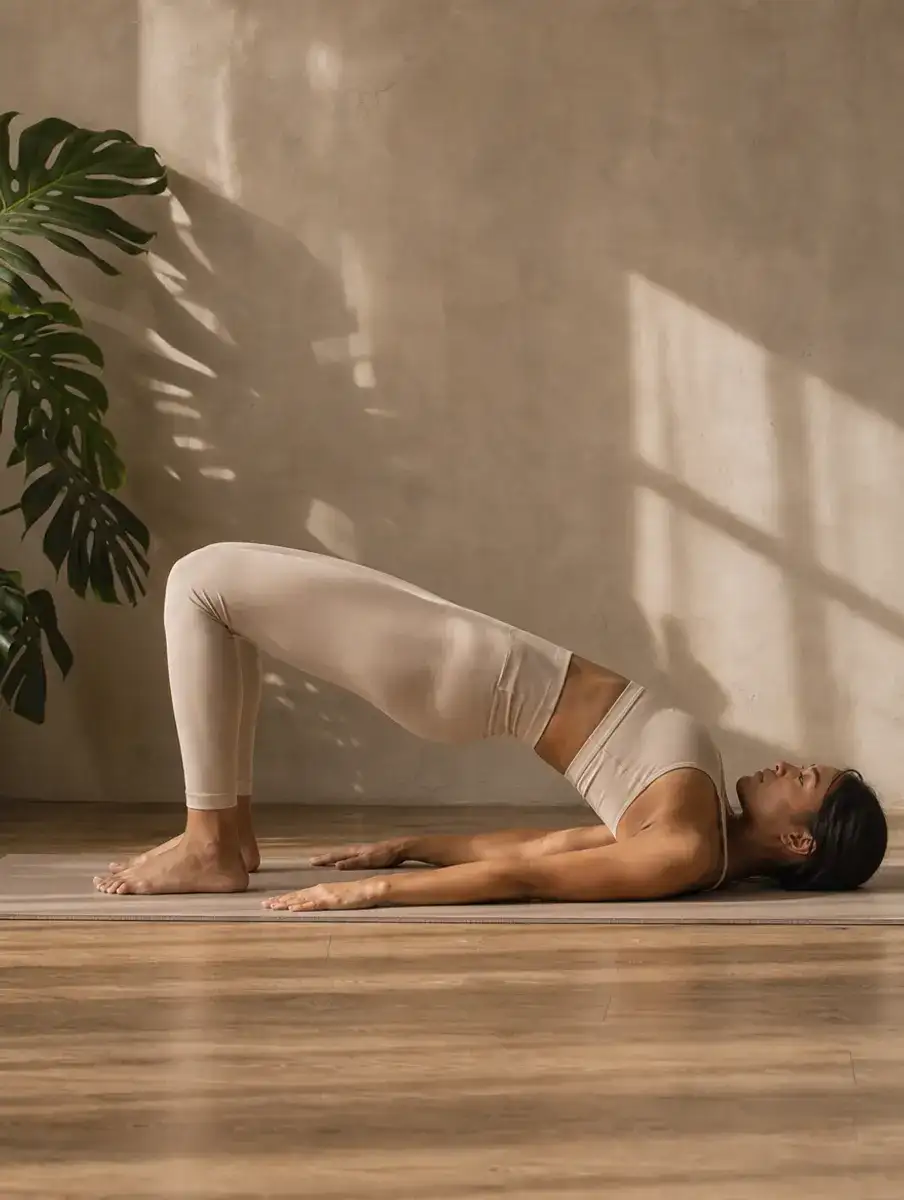
The bridge exercise lifts the hips from the floor while you lie on your back, so the body forms an arch like a bridge between the shoulders and the feet. In yoga it is Setu Bandha Sarvangasana. Setu means bridge, bandha means lock or binding, sarvanga means the whole body and asana means posture.
Bridge Pose (Setu Bandha Sarvangasana) lifts the hips while you lie on your back, working the legs and buttocks and opening the chest. With the knees bent and feet hip-width, press through the feet to lift the hips and hold five breaths. If the lower back is sensitive, lift only a little or rest on a block.
Pronunciation and meaning
Setu Bandha Sarvangasana: SAY-too BUN-duh sar-vahn-GAHS-uh-nuh. The long last word is stressed on GAHS.
The bridge exercise lifts the hips from the floor while you lie on your back, so the body forms an arch like a bridge between the shoulders and the feet. In yoga it is Setu Bandha Sarvangasana. Setu means bridge, bandha means lock or binding, sarvanga means the whole body and asana means posture.
How to do Bridge Pose
- Lie on your back with the knees bent and the feet flat on the mat, hip-width apart and parallel, heels about a hand's length from the buttocks.
- Rest the arms by your sides, palms down, and check that your fingertips can just brush your heels.
- Press through the feet, especially the inner edges and the heels, and on an inhale lift the hips off the floor.
- Keep the knees pointing straight ahead over the ankles, and let the chest lift toward the chin without pushing the chin down into the chest.
- Press the upper arms into the mat, or interlace the hands underneath you and roll the shoulders in, whichever lets the chest open.
- Hold for five breaths, then lower down slowly on an exhale, one section of the spine at a time.
Bridge Pose step by step

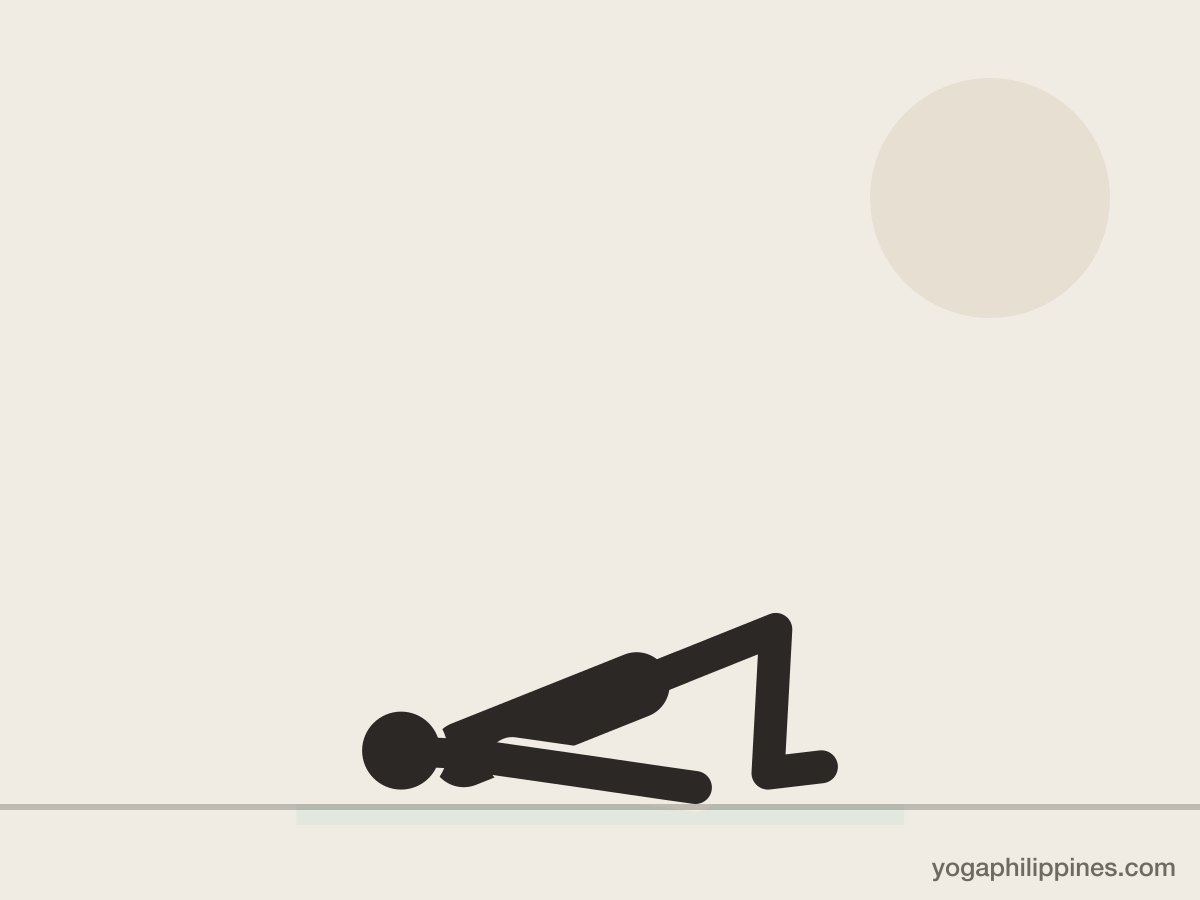
Drawings and video by YogaPhilippines.com, free to reuse under CC BY 4.0 with credit and a link: see the image licence for how to credit.
Bridge Pose appears in the 10-pose beginner yoga sequence and the core strength sequence, both printable with holds and cues. For other poses that work the glutes, open the pose finder set to the glutes.
Teacher's note from Joahnna Lee
“Keep your head still once you lift. Turning to look around puts the neck at risk while the weight is on the shoulders.”
“Imagine pulling your heels toward your shoulders without moving them. The backs of the legs switch on and the lower back gets lighter.”
“Let the height come from the legs, not from pushing the belly up.”
Make it easier
- Supported Bridge: slide a block under the sacrum, the flat bony part at the back of the pelvis, and rest there with the arms relaxed.
- Squeeze a block between the thighs so the knees do not drift apart.
- Keep the hips low and lift only a few centimetres if the lower back is sensitive.
- Put a folded blanket under the shoulders, with the head off it, if the neck feels compressed.
Pregnancy and after birth
Pregnancy. Adapt. Short holds may be fine early in pregnancy. Later on, lying flat on the back can make some people feel dizzy or unwell, so keep it brief, or skip it for a pose on hands and knees. Check with your OB or midwife before you start.
After birth. Adapt. Once your doctor or midwife has cleared you to exercise, begin with small lifts, rolling up and down with the breath. After a caesarean birth, wait for their advice on when to start, and stop if you feel pulling across the scar or pressure in the pelvic floor.
Expecting or postpartum? See joahnnalee.com for the stage-by-stage guides.
Common mistakes
- Letting the knees splay outward, which shifts the weight onto the outer feet.
- Turning the head to the side while the hips are lifted.
- Squeezing the buttocks so hard that the lower back pinches.
- Placing the feet too far away, so the hamstrings cramp and the hips cannot rise.
The bridge exercise turns up in gym warm-ups, physio sessions and yoga classes alike, and the yoga version is Bridge Pose. Bridge is a gentle backbend that begins lying down, which makes it approachable for people who find standing backbends daunting. It works the backs of the legs as much as the spine.
Because the floor holds you, it suits yoga for beginners, where there is time to learn where the work belongs before the hips lift any higher. If you are new to classes, what to expect in your first yoga class covers the basics.
Bridge is also the preparation for Wheel Pose, the full backbend from the floor, which is best left until Bridge feels easy for several breaths.
Lifting the hips further with the weight on the shoulders leads toward Shoulder Stand, which needs a careful blanket set up. Sitting rather than lying, the same lift of the hips is reverse table top, on the table top pose page.
How do you progress the bridge exercise?
Move to the next step only when the current one feels steady for all its repetitions, with the knees pointing forward and no pinch in the lower back.
| Step | Version | How to do it | Dose |
|---|---|---|---|
| 1 | Small lifts | Lift the hips a few centimetres and lower slowly | 8 lifts |
| 2 | Full bridge reps | Lift to a straight line from shoulders to knees | 2 rounds of 8 to 10 |
| 3 | Bridge hold | Lift and stay | 3 rounds of 5 breaths |
| 4 | Marching bridge | At the top, lift one foot a little, then the other, keeping the hips level | 2 rounds of 6 per side |
| 5 | Single-leg bridge | Straighten one leg in line with the other thigh, then lift on the standing leg | 2 rounds of 5 per side |
| 6 | Feet raised | Heels on a low, stable step or sofa edge | 2 rounds of 8 |
A resistance band just above the knees adds work for the sides of the hips at any step.
Reps or holds?
Lifting and lowering with the breath trains the glutes and hamstrings to switch on smoothly, which is why gyms and physios favour it. Holding builds endurance and lets you notice the chest and the front of the hips opening, which is the yoga emphasis. A balanced week can include both: reps on two days, a few long holds on another.
How long until you notice a difference?
With bridges two or three times a week, many people find the movement feels steadier and less effortful within a few weeks, mainly as coordination improves. Building noticeably stronger glutes usually takes longer, often a couple of months of consistent work, with the dose rising gradually.
A note on damp floors
In humid weather, feet can slide forward on a sweaty mat as you lift, which pulls the hips down and tires the hamstrings. Practise barefoot on a dry, grippy mat, wipe the feet before you start, and if you are on tile, rest the toes against a wall or a heavy book so the feet cannot creep away.
Bridge Pose or Wheel Pose?
Bridge is the preparation for Wheel. Both lift the hips from the same start on the back; in Wheel the hands push the upper body up as well.
| Compare | Bridge Pose | Wheel Pose |
|---|---|---|
| Position | Lying on your back | Lying on your back |
| What it works | glutes, chest and spine | chest, shoulders and spine |
| Level | Beginner plus | Advanced |
| Key difference | Feet press and the hips lift while the shoulders, arms and head stay on the mat. | Hands press beside the ears and the arms straighten, lifting the head and shoulders off the mat. |
Prep poses for Bridge Pose
Poses that warm up the same body areas at a lower intensity, so Bridge Pose feels steadier when you get there.
- Supine Twist (Supta Matsyendrasana) gentler work for the same area, beginner
Counter-poses for Bridge Pose
Shapes that move the body the other way or let it rest straight after Bridge Pose.
- Happy Baby Pose (Ananda Balasana) beginner
Poses that lead into Bridge Pose
In a sequence, Bridge Pose often follows these poses as their counter-pose or rest.
- Boat Pose (Navasana) intermediate
- Seated Forward Bend (Paschimottanasana) beginner plus
Where to go next after Bridge Pose
These poses list Bridge Pose as a preparation, so they are a natural next step once it feels comfortable.
- Fish Pose (Matsyasana) beginner plus
- Camel Pose (Ustrasana) intermediate
- Plow Pose (Halasana) advanced
- Shoulder Stand (Salamba Sarvangasana) advanced
Easier and harder variations of Bridge Pose
Related poses from the same family that start from the same position and do a similar kind of work; Bridge Pose itself is beginner plus.
- Harder: Wheel Pose (Urdhva Dhanurasana) advanced
Props that help in Bridge Pose
- Block: goes under the sacrum, the head or a knee for support.
- Blanket: supports the head or the back so the neck stays relaxed.
Programs and sessions that use Bridge Pose
- The 30-day yoga challenge 3 of its 30 sessions
- The 4-week beginner program 3 of its 12 sessions
- The 14-day flexibility plan 2 of its 14 sessions
- Sequences: 30-minute home flow, 45-minute slow yoga, beginner yoga sequence, core practice and flow that spares the wrists
- Practice app sessions: 20-minute flow and 30-minute practice
- Generated example flows: 20-minute hip flow and 30-minute back-friendly session, no weight on the wrists
This page feeds the sequence builder and the random flow generator.
Sources: Mayo Clinic, Fitness program: 5 steps to get started; NCCIH (US National Institutes of Health), Yoga: Effectiveness and Safety; NHS, Exercise in pregnancy; CDC, Pregnant & Postpartum Activity: An Overview; Canadian Family Physician (Chan et al., 2014), via PubMed Central, Hot yoga and pregnancy: Fitness and hyperthermia. Last reviewed 2 October 2026.
Bridge Pose questions
Is the bridge exercise the same as a glute bridge?
They are close relatives. A gym glute bridge usually lifts and lowers the hips in repetitions, with the focus on the buttocks, while Bridge Pose holds the lift for several breaths and works the backs of the legs and the spine together. The setup of the feet and knees is the same.
How many bridge exercise repetitions should a beginner do?
Try five to eight slow lifts, rising on an inhale and lowering on an exhale, then one hold of three to five breaths. Stop sooner if the lower back or the neck complains.
Is bridge pose safe for your neck?
It can be, if the head stays still and there is a small natural gap between the back of the neck and the floor. Do not press the neck into the mat or turn the head. A folded blanket under the shoulders gives the neck more space.
What is supported bridge pose?
It is a restful version with a yoga block placed under the sacrum, so the hips stay lifted without effort. It is common in gentle and restorative classes, and the block can be set low, medium or high.
What muscles does the bridge exercise work?
Bridge mainly works the glutes and hamstrings, which lift the hips, along with the muscles along the spine and the deep trunk muscles that keep the pelvis steady. It also gives a gentle stretch to the front of the hips and the chest as you lift.
Should you squeeze your glutes in bridge pose?
Firm them, but do not clench so hard that the knees splay out or the lower back pinches. Press evenly through both feet, keep the knees about hip-width apart, and let the lift come from the legs and buttocks working together.
Updated