Stretches
Upper back stretches for the space between the shoulder blades
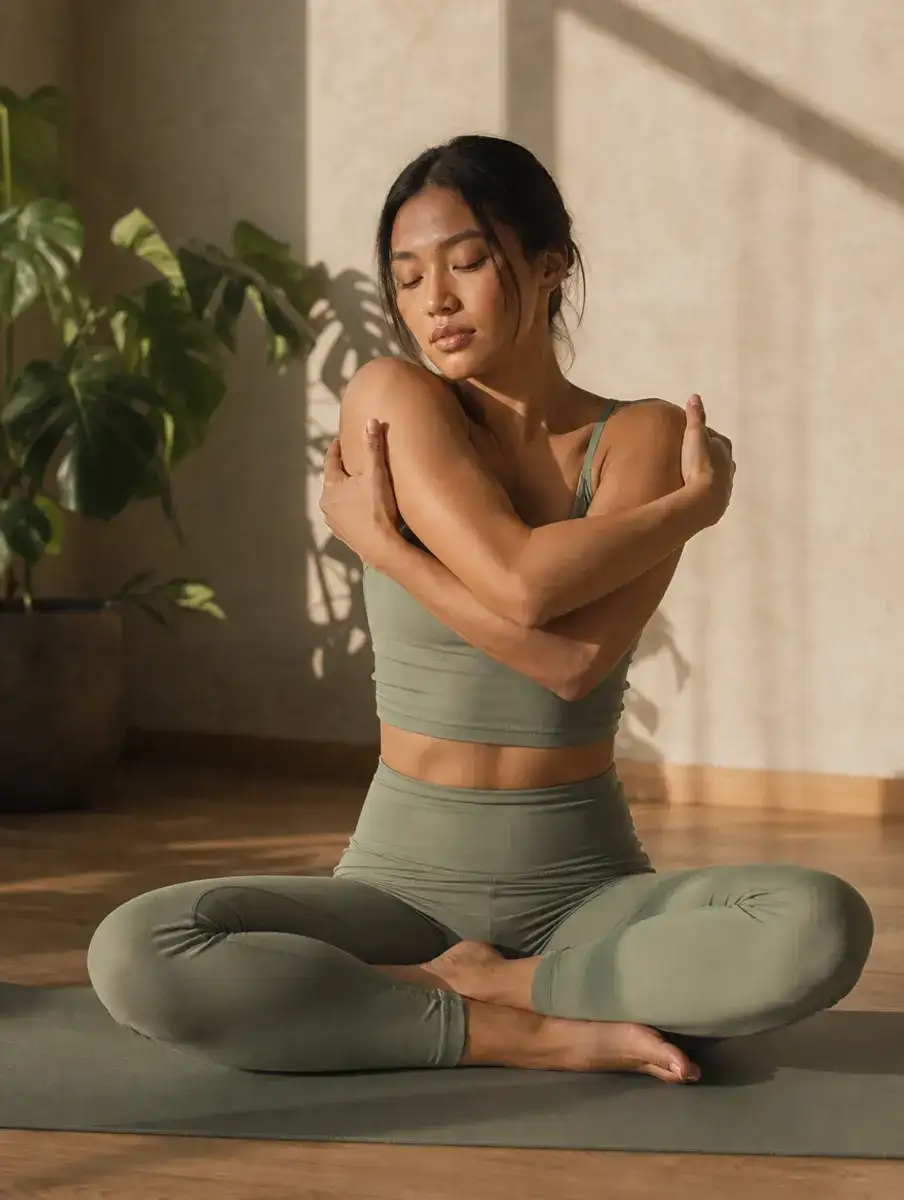
A good upper back stretch moves the middle of the spine both ways: rounding forward, as when you hug yourself and spread the shoulder blades, and opening back over a rolled towel or in Cat-Cow. Add thread the needle and an open book twist for rotation, and hold each for five to eight slow breaths.
The upper back, the thoracic spine, runs from the base of the neck to the bottom of the ribs, with the shoulder blades resting on top of it. It is built to round, arch a little and twist. Screens and phones ask it to round forward and stay there, while the muscles between the shoulder blades hold the head and shoulders up for hours.
The seven stretches below move the upper back in all three directions, in about ten minutes. Several overlap with the shoulder stretches for laptop days, because the shoulder blades move with the upper back.
When should you see a doctor or physio?
Check with a doctor or physiotherapist before stretching if you have:
- sudden or severe pain between the shoulder blades, especially with chest pain, breathlessness or sweating (get urgent help);
- pain after a fall or an accident;
- pain, numbness or tingling in the arms;
- pain that wakes you at night or keeps getting worse;
- osteoporosis, or a recent rib or spine injury (ask which movements suit you).
How do you do an upper back stretch?
Hold each for five to eight slow breaths, about 30 seconds, unless noted. Breathe into the back of the ribs.
- Self hug. Sit tall and wrap the arms around yourself, hands reaching towards the opposite shoulder blades. Breathe into the back of the ribs and let the shoulder blades spread apart. Switch which arm is on top.
- Cat-Cow. On a chair with the hands on the knees, or on hands and knees: breathing in, lift the chest forward; breathing out, round the upper back. Eight slow rounds. Cat-Cow on hands and knees has the full cues.
- Thread the needle. On hands and knees, slide the right arm under the left, palm up, and rest the right shoulder and the side of the head down. Then switch.
- Open book. Lie on your left side with the knees bent at hip height and the arms straight in front, palms together. Breathing in, lift the right arm up and over to open towards the right, eyes following the hand, knees stacked. Breathe out and return. Five slow rounds each side.
- Towel opener. Lie on your back with the knees bent and a firmly rolled towel across the upper back, just below the shoulder blades. Support the head with the hands, elbows wide, and let the chest open over the towel for five breaths. Move the towel a little higher and repeat.
- Puppy Pose. From hands and knees, keep the hips over the knees and walk the hands forward until the chest sinks towards the floor, forehead on a cushion. The Puppy Pose page has gentler versions.
- Child’s Pose side reach. From Child’s Pose, walk both hands over to the right and breathe into the left side of the back. Five breaths, then the other side.
Should you strengthen the upper back too?
Stretching eases the feeling of stiffness, but the muscles between the shoulder blades also need to be strong enough to hold you upright through a long day. Add these three, two or three times a week:
- Shoulder blade squeeze, 10 reps. Sit or stand tall with the arms by your sides. Breathing out, draw the shoulder blades gently back and down, hold for two breaths, then release. Keep the chin level and the ribs from flaring.
- Wall angels, 8 reps. Stand with the back against a wall, feet a little forward, arms in a goalpost shape. Slide the arms up the wall on an out-breath and down on an in-breath, only as far as the lower back stays near the wall.
- Prone Y raise, 8 reps. Lie on your front, forehead on a folded towel, arms reaching forward in a Y with the thumbs up. Breathing out, lift the arms a few centimetres, then lower slowly.
Moving or holding?
| Type | Examples from this page | When |
|---|---|---|
| Moving (dynamic) | Cat-Cow, open book, wall angels | Before exercise, and every hour at the desk |
| Holding (static) | Puppy Pose, Child’s Pose side reach, towel opener | After exercise, or in the evening |
A desk day plan
Short and often beats one long session. On a laptop-heavy workday, try a minute of upper back movement at three points: mid-morning, after lunch and mid-afternoon. A self hug and five seated Cat-Cows take less than a minute and can be done in an office chair or during a long wait on a jeepney or bus. The 7-day desk reset for office workers builds these into a week of short sessions.
How long until you feel a difference?
The upper back usually feels easier straight after a few minutes of movement. A lasting change in how often it aches by evening tends to take several weeks of regular movement breaks, strength work and small changes to screen height. If the ache is getting worse despite that, see a doctor or physio.
Common mistakes
- Turning from the neck. In the open book and thread the needle, let the turn come from the chest.
- Arching the lower back on the towel. Keep the knees bent and the ribs soft.
- Rushing the rotation. Slow rounds, one breath each way.
- Forcing range. The upper back moves less than the lower back. A small movement is normal.
Make it easier or harder
- Easier: do the self hug and Cat-Cow on a chair; use a thinner towel roll; rest the hands on a chair seat in Puppy Pose.
- Harder: hold the open position of the open book for five breaths; in thread the needle, reach the top arm up towards the ceiling; use a firmer roll under the back.
What pairs with upper back stretches?
The front of the body is the other half: the chest stretches for rounded shoulders open what the upper back has been rounding over, and the overhead tricep stretch and its variations lengthen the sides of the upper back. For the whole spine, the back stretches from neck to tailbone add the lower back, and yoga for posture and screen habits explains why strength matters too. If the mid back feels stuck when you twist or arch, add these thoracic spine mobility drills.
For a full session that keeps the spine comfortable, follow the gentle back-friendly session, about 14 minutes and mostly on the floor.
Best time to do it
5 of the 10 moves are done with the breath rather than held, so this routine suits the start of the day or the few minutes before a walk, a run, a workout or a class.
How long to hold each move
Holds below are for a medium pace; at a slower pace, stay up to the longer time. Moves marked each side are done on both sides.
| Move | Hold | Slower pace |
|---|---|---|
| Self Hug | 30 s | 45 s |
| Cat-Cow | 45 s of slow rounds | 1 min 10 s |
| Thread the Needle | 30 s each side | 45 s |
| Open Book | 40 s of slow rounds each side | 1 min |
| Towel Opener | 1 min | 1 min 30 s |
| Puppy Pose | 30 s | 45 s |
| Child's Pose Side Reach | 30 s each side | 45 s |
| Shoulder Blade Squeeze | 20 s of slow rounds | 30 s |
| Wall Slides | 40 s of slow rounds | 1 min |
| Prone Y Raise | 30 s of slow rounds | 45 s |
Pair it with
Other stretching routines that work the same areas, for a longer session or the next day:
- Shoulder stretches also works the upper back and shoulders
- Mobility exercises for the hips, spine and shoulders also works the upper back and shoulders
- Chest stretches also works the upper back and shoulders
Put it into practice with the pose finder, built on pages like this one.
Browse all stretching routines.
Sources: Mayo Clinic, Fitness program: 5 steps to get started; NCCIH (US National Institutes of Health), Yoga: Effectiveness and Safety; NHS, Back pain; Cochrane, Yoga for chronic non-specific low back pain; NHS, Neck pain; PLoS One (Cramer et al., 2013), via PubMed Central, Adverse Events Associated with Yoga: A Systematic Review of Published Case Reports and Case Series. Last reviewed 2 October 2026.
Questions
What is the thoracic spine?
It is the middle section of the spine, the twelve vertebrae between the neck and the lower back, each connected to a pair of ribs. Because of the ribs it moves less than the neck or the lower back, and it is the part that rounds forward over a laptop or phone.
Why does the area between the shoulder blades ache at a computer?
When the head and shoulders drift forward towards a screen, the muscles between the shoulder blades work for hours to hold them up, and many people feel that as an ache by mid-afternoon. Raising the screen and standing up every half hour or so matter as much as any stretch.
Is it fine if the upper back pops during a stretch?
A quiet pop during a twist or Cat-Cow is common, and on its own is not usually a concern. Avoid forcing the spine to crack, or asking someone to push on your back to make it happen, and see a doctor if a pop comes with pain.
Pairs well with
Your yoga calendar
We track every yoga event, workshop and pop-up class so you don't have to.
Updated