Pose library · Parivrtta Surya Yantrasana
Compass Pose (Parivrtta Surya Yantrasana)
Parivrtta means revolved, surya means sun, yantra means instrument and asana means posture, so the name is often given as revolved sundial posture. Seated, you lift one leg over the shoulder and straighten it toward the ceiling while the body turns and leans away, like the arm of a compass.
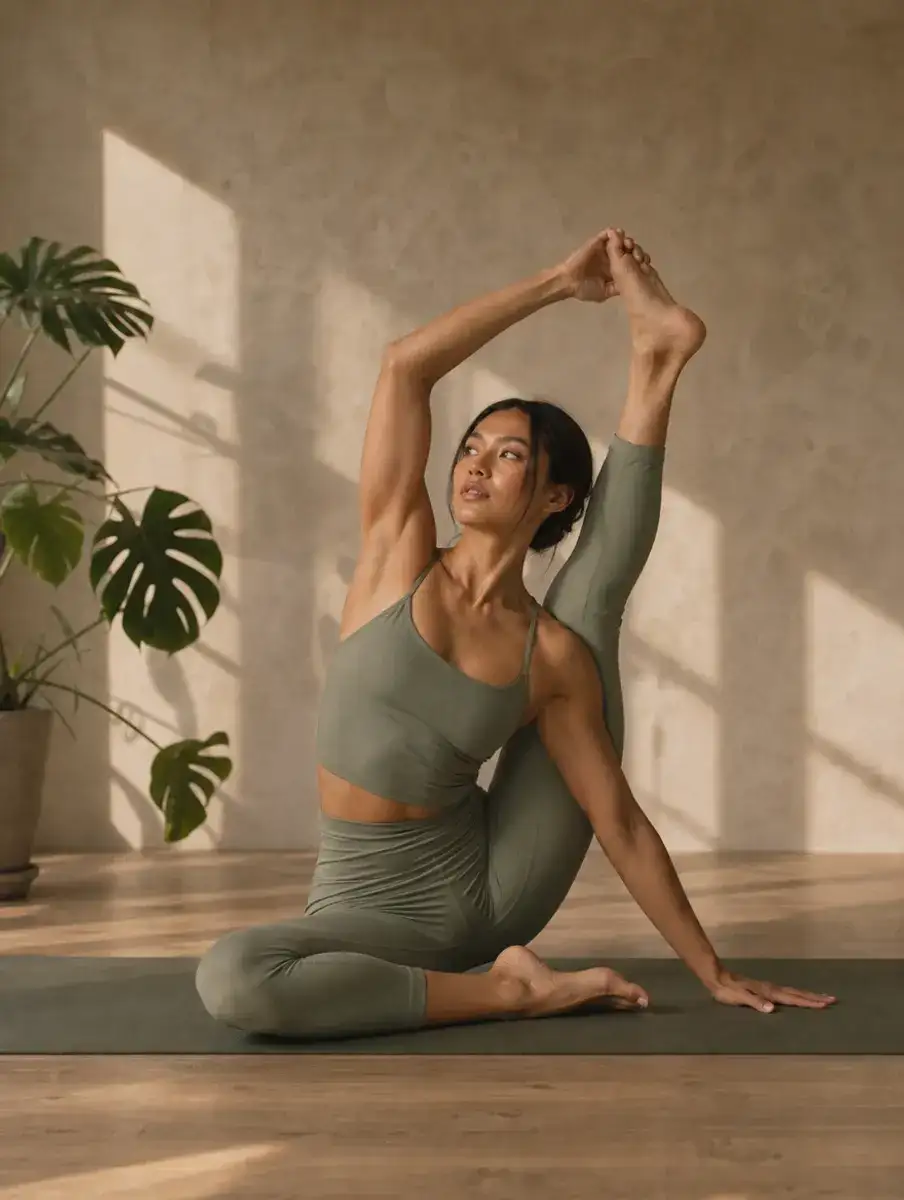
Compass Pose (Parivrtta Surya Yantrasana) is an advanced seated shape that asks for open hips and hamstrings. After warming up, thread one arm under the lifted leg, hold the foot, turn the chest away and straighten the leg toward the ceiling for three to five breaths. Use a strap, and never force the leg behind the shoulder.
Pronunciation and meaning
Parivrtta Surya Yantrasana: pah-ri-VRIT-tuh SOOR-yuh yun-TRAHS-uh-nuh. Each word has its own stress, with Yantrasana stressed on TRAHS.
Parivrtta means revolved, surya means sun, yantra means instrument and asana means posture, so the name is often given as revolved sundial posture. Seated, you lift one leg over the shoulder and straighten it toward the ceiling while the body turns and leans away, like the arm of a compass.
How to do Compass Pose
- Warm up the hips and hamstrings first. Sit in a cross-legged seat with the left leg folded in front.
- Hold your right foot with the left hand and lift the right knee, threading your right arm under the right leg so the back of the knee rests high on the right shoulder.
- Place the right hand on the floor beside the right hip, fingers pointing out.
- Turn the chest up and to the left, and begin to straighten the right leg toward the ceiling, still holding the foot with the left hand.
- Keep lifting the chest and look up under the left arm only if the neck is comfortable. Stay for three to five breaths.
- Bend the knee, release the foot slowly, lower the leg and repeat on the other side.
For other poses that work the hamstrings, open the pose finder set to the hamstrings.
Make it easier
- Loop a strap around the lifted foot instead of holding it.
- Keep the lifted knee bent and rest the leg on the upper arm, without straightening it.
- Sit on a folded blanket to help the pelvis tip forward.
Pregnancy and after birth
Pregnancy. Avoid. The deep hip stretch and side bend press on the belly and stretch loosened joints. A gentle seated side bend is a safer choice. Check with your OB or midwife.
After birth. Avoid for now. Joints can stay loose for months after birth. Wait until your doctor or midwife has cleared you and return with gentle hip openers first.
Expecting? Joahnna Lee Yoga has notes on adapting each trimester.
Common mistakes
- Forcing the leg behind the shoulder before the hip is ready, which strains the knee and lower back.
- Collapsing the chest and rounding the back.
- Twisting the neck sharply to look up.
Compass Pose, also called Sundial, is an advanced seated stretch that combines a deep hip and hamstring opening with a side bend and a twist. It appears in strong Vinyasa classes, usually near the end, once the body is warm.
It is a pose to approach slowly, often with a strap. Most of the benefit comes from the earlier stages, which are still a big stretch.
How do you build toward compass pose?
Open the outer hips with the stacked knees of Cow Face Pose and Happy Baby, holding the feet, and practise sitting easily in a cross-legged seat or Lotus Pose. The hamstring stretches routine helps the lifted leg straighten.
What should compass pose feel like?
A strong stretch along the back of the lifted leg and the side of the body, with the chest open. A sharp feeling in the knee or lower back means stop, bend the knee, and use the strap.
Prep poses for Compass Pose
Poses that warm up the same body areas at a lower intensity, so Compass Pose feels steadier when you get there.
- Head to Knee Pose (Janu Sirsasana) a direct preparation, beginner plus
- Cow Face Pose (Gomukhasana) a direct preparation, beginner plus
- Revolved Head to Knee Pose (Parivrtta Janu Sirsasana) gentler work for the same area, intermediate
- Caterpillar Pose (Yin) gentler work for the same area, beginner
Counter-poses for Compass Pose
Shapes that move the body the other way or let it rest straight after Compass Pose.
- Easy Pose (Sukhasana) beginner
Easier and harder variations of Compass Pose
Related poses from the same family that start from the same position and do a similar kind of work; Compass Pose itself is advanced.
- Easier: Accomplished Pose (Siddhasana) intermediate
Props that help in Compass Pose
- Strap: extends the arms when the hands do not reach the feet or each other yet.
- Blanket: lifts the hips a little so the spine can stay tall.
Sources: Mayo Clinic, Fitness program: 5 steps to get started; NCCIH (US National Institutes of Health), Yoga: Effectiveness and Safety. Last reviewed 2 October 2026.
Compass Pose questions
Why is it called compass pose?
The straight leg reaching up and the body leaning the other way look like the two arms of a drawing compass. Its Sanskrit name refers to a sundial, so it is also called Sundial Pose.
Is compass pose hard?
Yes. It needs open hamstrings, open hips and comfort in a twist all at once. Most people use a strap and a bent knee for a long time, and that is a full practice.
Which poses prepare you for compass pose?
Happy Baby and Cow Face Pose open the hips, the hamstring stretches lengthen the backs of the legs, and seated side bends prepare the side of the body.
What is Surya Yantrasana?
Surya Yantrasana means sundial posture, and it is another name for Compass Pose. Sitting, you thread one arm under the lifted leg, hold the foot with the other hand, turn the chest away and straighten the leg toward the ceiling. Parivrtta, revolved, is added to the full name because the chest turns.
Updated