Pose library · Parivrtta Janu Sirsasana
Revolved Head to Knee Pose (Parivrtta Janu Sirsasana)
Parivrtta means revolved or turned, janu means knee, sirsa means head and asana means posture. It is a side bend over one straight leg with the chest turning toward the ceiling.
Revolved Head to Knee Pose (Parivrtta Janu Sirsasana) is a seated side bend over one straight leg that stretches the side of the body. Sit with the legs wide, bend one knee, rest the lower forearm inside the straight leg, reach the top arm over the ear and turn the chest up for five breaths. Keep both sit bones down.
Pronunciation and meaning
Parivrtta Janu Sirsasana: pah-ree-VRIT-tuh JAH-noo sheer-SHAHS-uh-nuh. Parivrtta stresses VRIT, Janu the first syllable, and Sirsasana stresses SHAHS.
Parivrtta means revolved or turned, janu means knee, sirsa means head and asana means posture. It is a side bend over one straight leg with the chest turning toward the ceiling.
How to do Revolved Head to Knee Pose
- Sit on a folded blanket with your legs wide in a comfortable V. Bend your right knee and bring the right heel in toward the groin, knee out to the side.
- Turn your chest a little toward the bent right knee. Slide your left forearm along the inside of the left leg, resting it on the floor, a block or the shin.
- Inhale and reach the right arm up. Exhale and lean to the left over the left leg, drawing the right arm over your ear.
- Turn the chest up toward the ceiling, rolling the right shoulder back. Hold the left foot with the right hand or with a strap, only if it comes easily.
- Stay for five breaths, breathing into the right ribs. Keep both sit bones on the blanket.
- Inhale to sit up slowly, and repeat on the other side.
Revolved Head to Knee Pose step by step
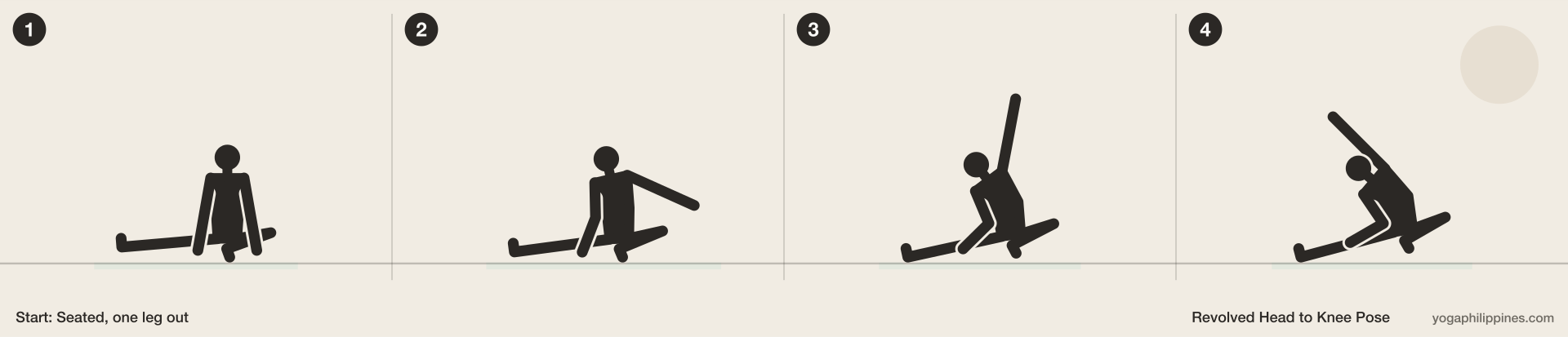
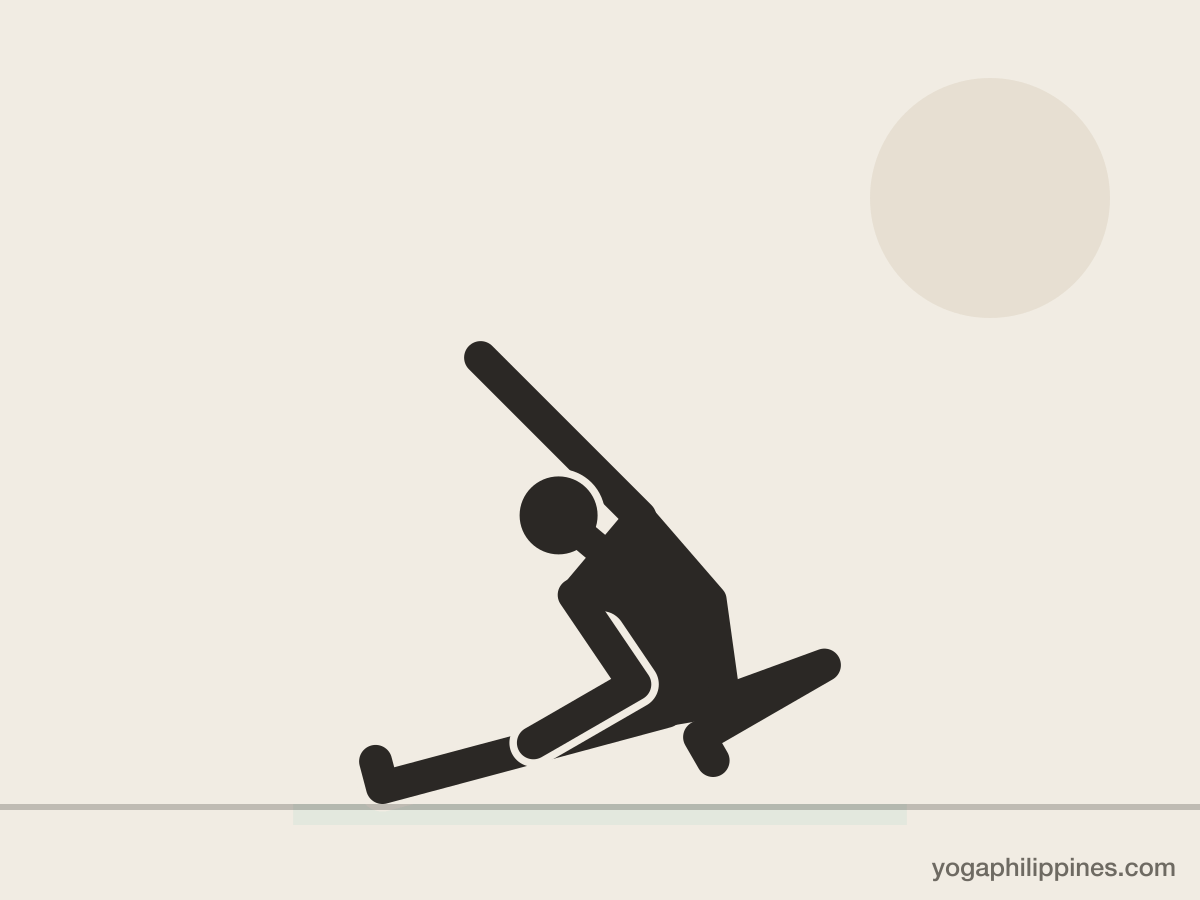
Drawings and video by YogaPhilippines.com, free to reuse under CC BY 4.0 with credit and a link: see the image licence for how to credit.
For other poses that work the hamstrings, open the pose finder set to the hamstrings.
Make it easier
- Keep the lower forearm on a block and the top hand on the back of the head, elbow pointing up.
- Bend the knee of the straight leg and rest a rolled blanket under it.
- Sit with the back of the hips near a wall for steady support.
Pregnancy and after birth
Pregnancy. Adapt. Keep the side bend shallow with the lower arm on a block, and leave plenty of room for the belly between the legs. Avoid twisting deeply across it. Check with your OB or midwife.
After birth. Adapt. Once your doctor or midwife has cleared you, start with a gentle side bend and the top hand behind the head. Ease off if a caesarean scar or the belly pulls.
Before adapting a pose, read is yoga safe during pregnancy on joahnnalee.com.
Common mistakes
- Collapsing the chest toward the floor, so the side bend turns into a forward fold.
- Lifting the opposite sit bone off the blanket to reach further.
Revolved Head to Knee Pose is the side-bending sibling of Head to Knee Pose, Janu Sirsasana. Both fold over one straight leg, but here you bend to the side and turn the chest up, so the stretch runs along the ribs and waist rather than down the back.
It tends to come in the seated part of a class, after the forward folds, and it suits anyone who can sit comfortably with the legs wide on a blanket. Tight hamstrings make it harder, so a soft bend in the straight leg is always fine.
How does it relate to other side bends?
The kneeling side bend Gate Pose, Parighasana is a gentler way to feel the same long side body. When the turn of the chest is the part you want, a plain Seated Twist, turning from the ribs is a calmer place to start.
The hamstring stretches routine prepares the straight leg. Stop if you feel a pinch in the lower back or the bent knee.
Prep poses for Revolved Head to Knee Pose
Poses that warm up the same body areas at a lower intensity, so Revolved Head to Knee Pose feels steadier when you get there.
- Head to Knee Pose (Janu Sirsasana) a direct preparation, beginner plus
- Gate Pose (Parighasana) a direct preparation, beginner plus
- Caterpillar Pose (Yin) gentler work for the same area, beginner
- Seated Forward Bend (Paschimottanasana) gentler work for the same area, beginner plus
Easier and harder variations of Revolved Head to Knee Pose
Related poses from the same family that start from the same position and do a similar kind of work; Revolved Head to Knee Pose itself is intermediate.
- Harder: Compass Pose (Parivrtta Surya Yantrasana) advanced
Props that help in Revolved Head to Knee Pose
- Block: sits under the hips or supports a hand or knee that does not reach the floor.
- Strap: extends the arms when the hands do not reach the feet or each other yet.
- Blanket: lifts the hips a little so the spine can stay tall.
- Wall: gives a steady point to lean on or press into for balance and alignment.
Sources: Mayo Clinic, Fitness program: 5 steps to get started; NCCIH (US National Institutes of Health), Yoga: Effectiveness and Safety; NHS, Knee pain. Last reviewed 2 October 2026.
Revolved Head to Knee Pose questions
Is Parivrtta Janu Sirsasana a twist or a side bend?
Both, in a sense. The trunk bends sideways over the straight leg while the chest turns toward the ceiling. Most teachers teach it as a side bend first, so lengthen the side waist before you turn.
Which side of the body does revolved head to knee pose stretch?
Mainly the side facing the ceiling, from the hip of the bent leg up through the ribs to the top arm. The hamstrings of the straight leg stretch too.
What if you cannot reach the foot in revolved head to knee pose?
Do not reach for it. Rest the top hand on the back of the head, or hold a strap looped around the foot. The long side waist and the turn of the chest matter more than the bind.
What is Revolved Head to Knee Pose good for?
Parivrtta Janu Sirsasana gives a long stretch along the side of the body, from the hip through the ribs to the top arm, with some stretch in the hamstrings of the straight leg. It usually comes in the seated part of a class, after the forward folds, as a change of direction for the spine.
Updated