Pose library · Purvottanasana
Reverse Plank (Purvottanasana)
Purva means east, and by tradition the front of the body; uttana means intense stretch and asana means posture. It is a plank turned face up, stretching the whole front of the body from the ankles to the throat.
Reverse Plank (Purvottanasana) is a plank turned face up that stretches the whole front of the body. Sit in Staff Pose, place the hands behind the hips, press through the heels and lift the hips until the body makes one line, for three to five breaths. Bend the knees into reverse table top if the shoulders tire.
Pronunciation and meaning
Purvottanasana: poor-voh-tahn-AHS-uh-nuh. The stress falls on AHS, near the end.
Purva means east, and by tradition the front of the body; uttana means intense stretch and asana means posture. It is a plank turned face up, stretching the whole front of the body from the ankles to the throat.
How to do Reverse Plank
- Sit in Staff Pose with your legs long. Place your hands on the mat a hand's length behind your hips, shoulder-width apart, fingers pointing toward your feet or out to the sides.
- Bend your elbows slightly, then press into your hands and roll the shoulders back so the chest lifts.
- Inhale and press through your heels to lift the hips, until the body makes one line from the shoulders to the ankles. Point the toes toward the floor if you can.
- Keep your chin gently tucked, or let the head release back only if the neck feels comfortable.
- Stay for three to five breaths, pressing the floor away and keeping the hips lifted.
- Exhale and lower the hips slowly back to the mat, then shake out the wrists.
Reverse Plank step by step

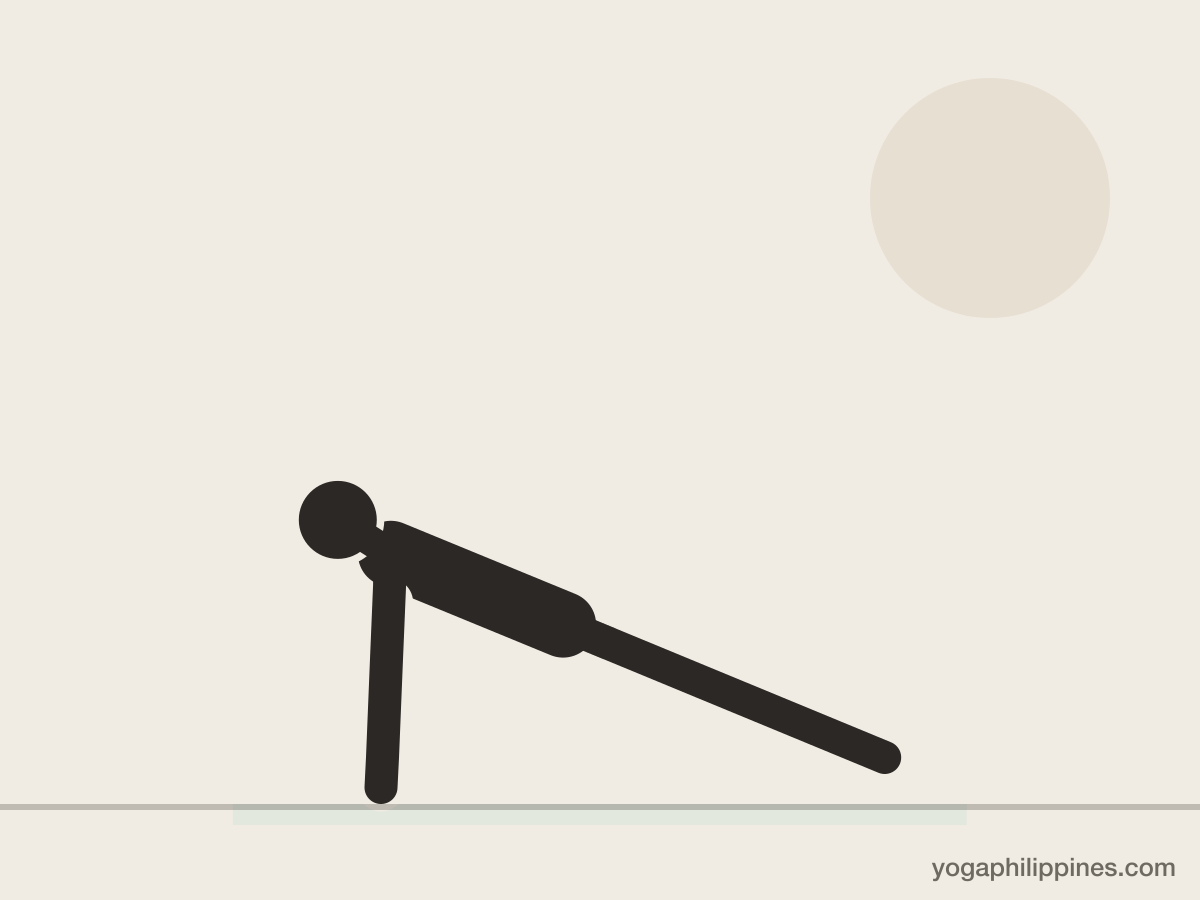
Drawings and video by YogaPhilippines.com, free to reuse under CC BY 4.0 with credit and a link: see the image licence for how to credit.
For other poses that work the shoulders, open the pose finder set to the shoulders.
Make it easier
- Bend your knees with the feet flat for reverse table top, which keeps the same lift with less load on the shoulders.
- Turn the fingers out to the sides, or rest on the forearms, if the wrists complain.
- Lift the hips only partway and keep the chin tucked.
Pregnancy and after birth
Pregnancy. Adapt. Many teachers suggest the bent-knee table version, held briefly, and leaving out the straight-legged lift later in pregnancy. Check with your OB or midwife.
After birth. Adapt. Once your doctor or midwife has cleared you, begin with reverse table top and short holds. Ease off if the belly domes or a caesarean scar pulls.
For more on practising through pregnancy, see Joahnna Lee Yoga.
Common mistakes
- Letting the hips sag so the weight hangs in the shoulders.
- Dropping the head back hard and squeezing the back of the neck.
- Placing the hands too close to the hips, which crowds the shoulders.
Reverse Plank turns a familiar strength shape face up. It often comes near the end of a seated sequence, as a counterpose to forward folds, and it appears in the Ashtanga seated series straight after the long folds.
It suits anyone who already holds a steady Plank Pose, the body in one line, and wants to work the back of the body in the same way. The front of the shoulders gets a strong stretch, which many people need after long days of sitting and typing.
How is reverse plank different from reverse table top?
In Table Top Pose and its reverse version, the knees are bent and the feet are flat, so the body makes a table shape. In Reverse Plank the legs are straight, which makes the lever longer and the work stronger. Start with the table version until the hips lift easily.
It begins from Staff Pose, sitting tall with straight legs, and it pairs well with the core exercises built on yoga holds. Stop at any sharp pain in the shoulders, wrists or neck.
Prep poses for Reverse Plank
Poses that warm up the same body areas at a lower intensity, so Reverse Plank feels steadier when you get there.
- Staff Pose (Dandasana) a direct preparation, beginner
- Table Top Pose (Bharmanasana) a direct preparation, beginner
- Upward-Facing Dog (Urdhva Mukha Svanasana) gentler work for the same area, intermediate
- Cow Face Pose (Gomukhasana) gentler work for the same area, beginner plus
Counter-poses for Reverse Plank
Shapes that move the body the other way or let it rest straight after Reverse Plank.
- Seated Forward Bend (Paschimottanasana) beginner plus
Sources: Mayo Clinic, Fitness program: 5 steps to get started; NCCIH (US National Institutes of Health), Yoga: Effectiveness and Safety. Last reviewed 2 October 2026.
Reverse Plank questions
What does reverse plank work?
It works the backs of the legs, the glutes, the back of the shoulders and the arms, while it stretches the front of the shoulders, chest and ankles. Many people find it a good balance after a run of forward folds and chaturangas.
Why do the wrists hurt in reverse plank?
The wrists bend back under the body's weight. Turn the fingers out to the sides, place the hands a little wider, or rest on the forearms. If wrist pain stays after practice, see a doctor or physio.
Is reverse plank harder than a normal plank?
It feels different rather than simply harder. It asks for open shoulders and strong legs, while a forward plank loads the belly and arms. Many people start with the bent-knee version and build from there.
Does reverse plank work the abs?
Some, but it mostly works the back of the body: the backs of the legs, the glutes, the back of the shoulders and the arms. The trunk works to keep the hips lifted in one line from shoulders to ankles. A forward plank or Boat Pose loads the belly more, so many people practise both for balance.
Updated