Stretches
Hip stretches for the front, back, sides and inner thighs
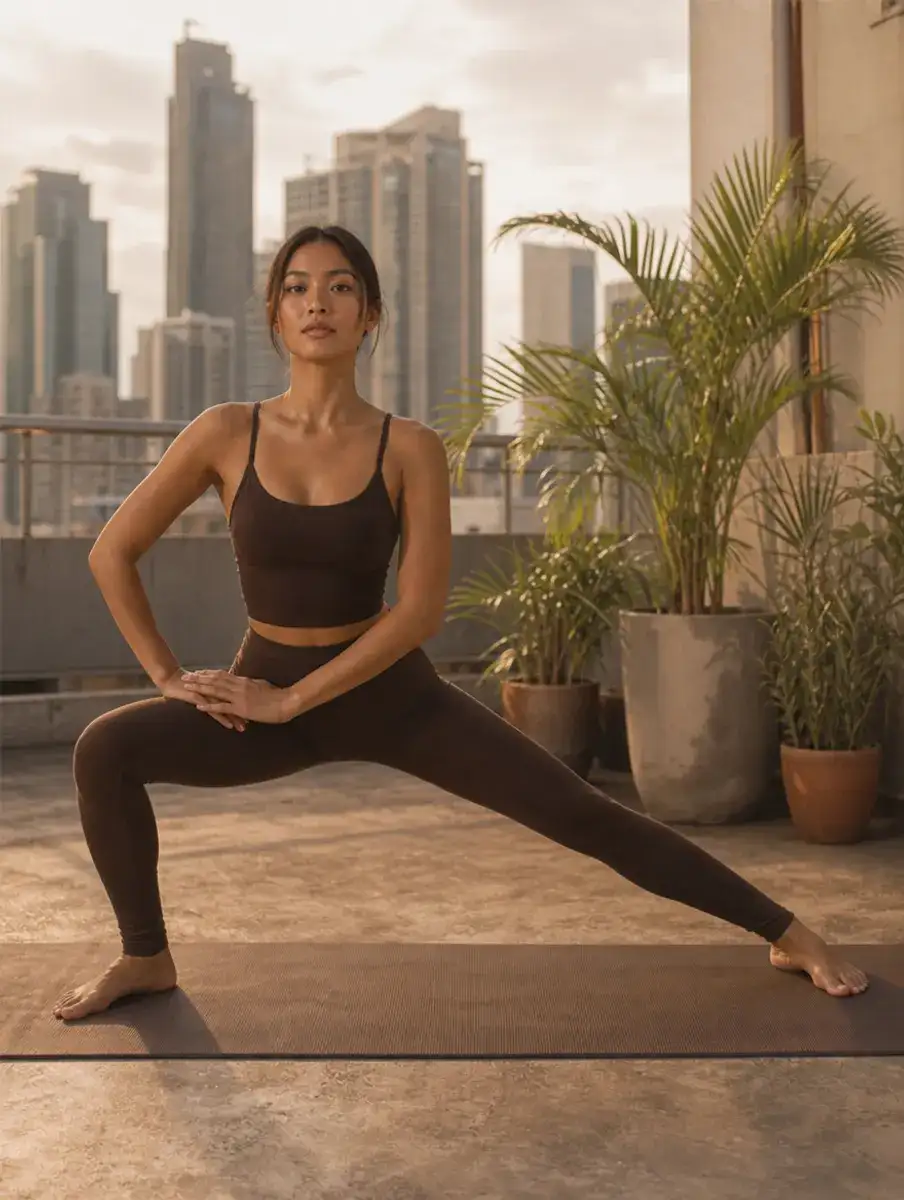
Good hip stretches cover every direction the hip moves: a low lunge for the front, a figure four for the back and outer hip, butterfly and a wide squat for the inner thighs, and gentle windscreen wiper rotations to move the joint. Hold each for five to eight slow breaths, about 30 seconds, on both sides.
The hip is a ball-and-socket joint, and it moves in more directions than almost any other: forward and back, out to the side and in, and turning in and out. Sitting holds it in just one of those positions for hours. Hip stretches take it through the rest.
This page covers the whole hip. If the front of the hips is what feels tight after sitting, the hip flexor stretches for long sitting days go deeper into lunges. Here, the lunge is one shape among seven, about twelve minutes in all.
Before you start: when should you see a doctor?
See a doctor or physiotherapist before stretching if you have:
- pain deep in the hip joint or the groin, especially when walking or putting on socks;
- a pinch at the front of the hip that comes back every time you bend;
- pain, tingling or numbness travelling down the leg;
- a hip replacement, recent hip surgery or a hip that has dislocated (ask which positions are safe for you).
A hip stretch should feel like a broad pull in the muscles around the hip, never a sharp pinch inside the joint.
How do you do these hip stretches?
Hold each for five to eight slow breaths, about 30 seconds, on each side. Breathe out as you settle into each one.
- Windscreen wipers. Sit with the knees bent, feet wider than the hips and hands on the floor behind you. Let both knees drop slowly to the right, then to the left, eight times each way, breathing out as they fall. This turns the hips in and out.
- Low lunge. Step the right foot forward and lower the left knee onto a cushion. Tuck the tailbone a little and ease the hips forward for the front of the hip.
- Side lunge. Stand with the feet wide, bend the right knee and shift the hips to the right, keeping the left leg straight. Hold a chair if you need balance. You feel the inner left thigh.
- Wide squat. Feet wider than the hips, toes turned out, lower the hips onto a block with the elbows inside the knees. Garland Pose on a block has the full set-up.
- Butterfly. Sit on a cushion with the soles of the feet together and the knees falling open, then fold forward from the hips. The Butterfly Pose page explains how to prop the knees.
- Figure four. Lie on your back, cross the right ankle over the left knee and draw the left thigh towards you. This reaches the back and outer hip.
- Supported pigeon. With a folded blanket under the front hip, rest on the forearms. Pigeon Pose with props explains how to keep the front knee comfortable. Finish lying on your back for a minute.
Which direction does each stretch work?
The hip is a ball and socket, so it moves in more directions than most joints. Use this to find the gaps in your own routine.
| Direction | What it means | Stretches above |
|---|---|---|
| Extension | Thigh moving behind you | 2 |
| Flexion | Knee drawing towards the chest | 4, 6 |
| Abduction | Leg moving out to the side | 3, 4, 5 |
| External rotation | Knee turning out | 5, 6, 7 |
| Internal rotation | Knee turning in | 1 |
What can you add once these feel easy?
Two stronger options, for warm hips only:
- Couch stretch. Kneel with the back of the left foot up against a sofa or wall, toes pointing up, and step the right foot forward into a lunge. Keep the torso upright and the tailbone gently tucked. Five breaths, then switch. You feel this deep in the front of the left hip and thigh, so start with the front knee well forward and the hands on blocks.
- Frog. From hands and knees, slide the knees wide apart on a soft surface, with the shins parallel and the ankles in line with the knees. Lower onto the forearms only as far as the inner thighs allow. Five breaths, then walk the knees back in slowly.
A two-minute set for desk days
- Seated figure four on the chair, five breaths each side.
- Stand and take a low lunge with the back knee on a folded jacket or cushion, five breaths each side.
- Side lunge holding the desk, three breaths each side.
How long until the hips feel more open?
The hips often move more freely straight after a routine, especially after a long sit. Lasting change, such as sitting cross-legged more comfortably or a deeper squat, usually takes several weeks of stretching most days. The shape of the hip socket sets some limits that no stretching changes, so compare yourself only with your own starting point.
Common mistakes
- Pressing the knees down in butterfly. Let them open with their own weight.
- Knees falling in during the squat. Keep them pointing the same way as the toes.
- Weight on the front knee in pigeon. Add height under the hip until the knee feels nothing.
- Only stretching what feels easy. Spend a little more time, gently, on the directions you find hardest.
Make it easier or harder
- Easier: sit higher in butterfly with blocks under the knees; put a rolled blanket under the heels in the squat; swap pigeon for the figure four lying down.
- Harder: lower the props over several weeks, stay longer on rest days, or walk the front foot wider in the lunge for a deeper lizard shape.
If you like a slower warm-up first, a few minutes of foam roller exercises for the glutes and thighs can come before the stretches.
How do hip stretches fit with the rest?
The deep rotators under the buttock have their own page in the piriformis stretch, with its safety notes, and the larger buttock muscles are covered in the glute stretches lying down and seated. The front of the thigh is the next layer down from the front of the hip, so the quad stretch standing, kneeling or lying is a good addition. Stretching works best alongside strength, and the hip exercises with bridges, clamshells and balances give the same muscles some work. For the wide-legged goal, see the middle splits routine, step by step, and for tightness down the side of the thigh, the IT band stretches for the outer hip.
Best time to do it
Of the 9 moves, 4 work as warm-up moves and 5 as slower cool-down holds, so it fits most times of day after a few minutes of walking or easy movement. You can also split it: the gentler moving parts before exercise, the longer holds after.
How long to hold each move
Holds below are for a medium pace; at a slower pace, stay up to the longer time. Moves marked each side are done on both sides.
| Move | Hold | Slower pace |
|---|---|---|
| Windscreen Wipers | 30 s of slow rounds | 45 s |
| Low Lunge | 30 s each side | 45 s |
| Side Lunge | 25 s each side | 40 s |
| Garland Pose | 30 s | 45 s |
| Butterfly Pose | 45 s | 1 min 10 s |
| Figure Four | 45 s each side | 1 min 10 s |
| Pigeon Pose | 1 min each side | 1 min 30 s |
| Couch Stretch | 30 s each side | 45 s |
| Frog Pose | 1 min 30 s | 2 min 15 s |
Pair it with
Other stretching routines that work the same areas, for a longer session or the next day:
- Glute stretches also works the hips and quads
- Working towards the middle splits, without forcing the hips also works the hips and quads
- Piriformis stretch also works the hips and quads
This page feeds the flexibility test and the app's mobility routine.
Browse the stretching library.
Sources: Mayo Clinic, Fitness program: 5 steps to get started; NCCIH (US National Institutes of Health), Yoga: Effectiveness and Safety. Last reviewed 2 October 2026.
Questions
What is the difference between hip stretches and hip flexor stretches?
Hip flexor stretches target only the front of the hip, the muscles that lift the knee. Hip stretches in general also cover the back of the hip, the outer hip, the inner thighs and the turning of the joint, which is why a balanced routine mixes several shapes.
What are internal and external hip rotation?
They describe the thigh turning in its socket. External rotation turns the knee and foot outwards, as in butterfly or a figure four. Internal rotation turns them inwards, as when the knees drop towards each other in the windscreen wiper stretch. Many people have much more of one than the other.
Why do the hips feel stiffer in the morning?
Many people feel stiffest after a night of lying still, and the hips are no exception. A few minutes of walking or the gentle rotations at the start of this routine, before any deeper hold, can make a morning practice feel easier.
How often should you stretch your hips?
Five to ten minutes on most days works well, and at least three times a week is a sensible minimum. Short, regular sessions after sitting or exercise tend to help more than one long session a week. Hold each stretch for about 30 seconds on both sides.
Why do the hips feel tight after sitting all day?
Sitting keeps the front of the hips folded and the buttocks pressed and still for hours, so standing up can feel stiff. Getting up to move every 30 to 45 minutes, plus a low lunge and a figure four at the end of the day, are simple ways to counter long sitting.
What are the signs of tight hips?
Common signs are stiffness when you stand up after sitting, finding it hard to sit cross-legged, a shallow squat, or knees that stay high in butterfly. Many people have much more movement in one direction than another. A sharp pinch inside the joint or pain in the groin is not tightness, so see a doctor or physio for that.
Pairs well with
Your yoga calendar
We track every yoga event, workshop and pop-up class so you don't have to.
Updated