Stretches
Working towards the middle splits, without forcing the hips
To work towards the middle splits, warm up first, then practise wide-legged shapes that open the inner thighs and hips: wide squat, side lunge, frog, a wide forward fold and a supported straddle slide. Hold each for five to eight slow breaths, three or four times a week, and let the shape of your hips set the final limit.
The middle splits, also called the side splits or straddle splits, is a seated shape with both legs reaching out wide to the sides and the pelvis lowering towards the floor between them. It is a different stretch from the front splits. Instead of one leg forward and one back, it asks the inner thighs and the hip joints themselves to open sideways.
The inner thigh muscles respond to steady, patient work. The bones of the hip do not, and the shape of the hip socket means some people will never sit flat in the middle splits. That is normal, not a failure.
For the front splits, see the eight-week plan for the front splits.
When should you stop, and when should you see a doctor?
Stop and see a doctor or physiotherapist before going on if:
- you feel a sharp pain in the groin, or a pop with bruising high on the inner thigh;
- the hip joint pinches, clicks painfully or catches deep in the front;
- pain sits inside the knee rather than in the muscle;
- you have had hip, knee or groin surgery, or have been told you have a hip joint condition.
A pinch in the front of the hip or any pain at the knee means come out.
How do you work towards the middle splits?
Warm up first with five minutes of brisk walking or a few slow Sun Salutations. Breathe slowly and never bounce.
- Wide squat. Stand with the feet wider than the hips, toes turned out. Lower the hips into a squat, heels on a folded towel if they lift, and press the elbows gently into the inner knees. Garland Pose on a block is the yoga version. Five to eight breaths.
- Side lunge. Step the feet wide, toes forward. Bend the right knee and shift the hips over the right foot, keeping the left leg straight and the left toes pointing up. Hands on blocks or the floor. Five breaths each side.
- Frog. On hands and knees with blankets under the knees, slide the knees apart and keep the ankles in line with the knees, shins parallel. Lower onto the forearms only as far as the inner thighs allow. Frog Pose with padded knees has gentler versions. Five to eight breaths.
- Wide-legged forward fold. Stand with the feet about a leg’s length apart, toes forward. Fold from the hips with a long back, hands on blocks under the shoulders. The Wide-Legged Forward Bend steps show how to keep the knees safe. Five to eight breaths.
- Seated straddle on a cushion. Sit on a firm cushion or folded blanket with the legs wide, knees and toes pointing up. Sit tall, hands on the floor or a block in front, and tip forward from the hips only while the back stays long. Eight breaths.
- Supported straddle slide. Stand with the feet wide, hands on two tall blocks in front, a bolster or stack of firm cushions under the pelvis. Slide the feet slowly apart until the hips rest on the support, knees and toes facing the same way. Five breaths, then walk the feet in with the hands still on the blocks.
How long does it take to do the middle splits?
There is no fair number. Some people see steady change over a few months; others settle well short of the floor. Measure progress by how easily you breathe near your edge, not by the distance to the mat.
Common mistakes
- Sliding the feet wider than the hips can follow. The knees take the strain. Widen only as far as the inner thighs, not the joints, are working.
- Rolling the knees in or out. Keep the knees and toes pointing the same way in every shape.
- Rounding the back to get lower. It moves the stretch out of the hips. Sit on a cushion and fold from the hips.
Make it easier or harder
Easier: keep a slight bend in the knees, sit higher on a firmer cushion, or lie with the legs up a wall and let them open into a wide V.
Harder: lower the support in the straddle slide one step at a time, but only once the current height feels easy for a full week. Stay longer rather than going wider. The guide to yoga blocks and straps covers what to look for.
Which stretches support the middle splits?
The inner thigh stretches from side lunge to butterfly build the same muscles more gently, and the hip stretches for the front, back and sides of the hip cover the outer hip, which also has to let go for the legs to open wide.
Best time to do it
Of the 6 moves, 1 work as warm-up moves and 3 as slower cool-down holds, so it fits most times of day after a few minutes of walking or easy movement. You can also split it: the gentler moving parts before exercise, the longer holds after.
How long to hold each move
Holds below are for a medium pace; at a slower pace, stay up to the longer time. Moves marked each side are done on both sides.
| Move | Hold | Slower pace |
|---|---|---|
| Garland Pose | 30 s | 45 s |
| Side Lunge | 25 s each side | 40 s |
| Frog Pose | 1 min 30 s | 2 min 15 s |
| Wide Legged Forward Bend | 40 s | 1 min |
| Seated Straddle | 45 s | 1 min 10 s |
| Supported Straddle Slide | 30 s | 45 s |
Pair it with
Other stretching routines that work the same areas, for a longer session or the next day:
- Static vs dynamic stretching: what is the difference? also works the hips and hamstrings
- Leg stretches for the whole lower body in 12 minutes also works the hips and hamstrings
- Stretching before running: a six minute warm-up also works the hips and hamstrings
Middle Splits step by step
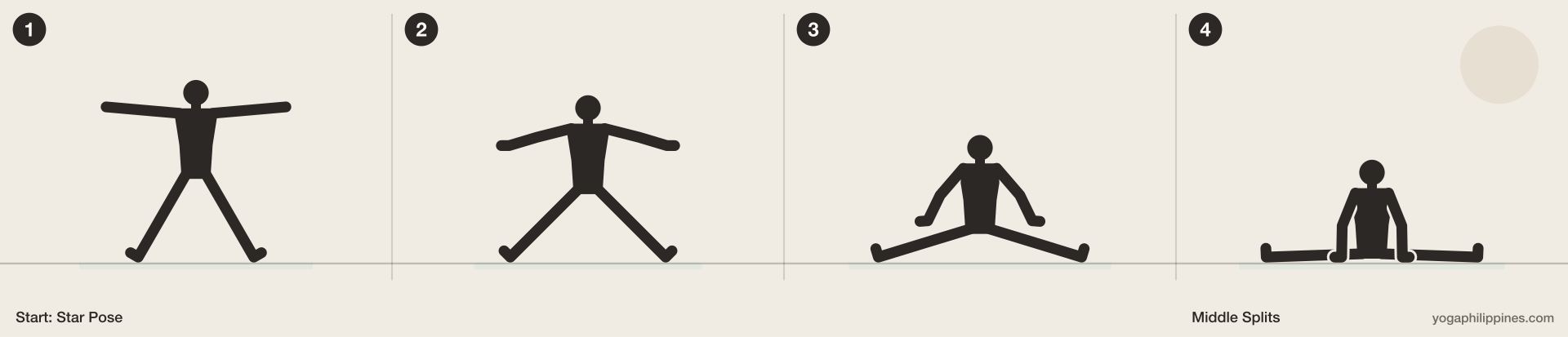
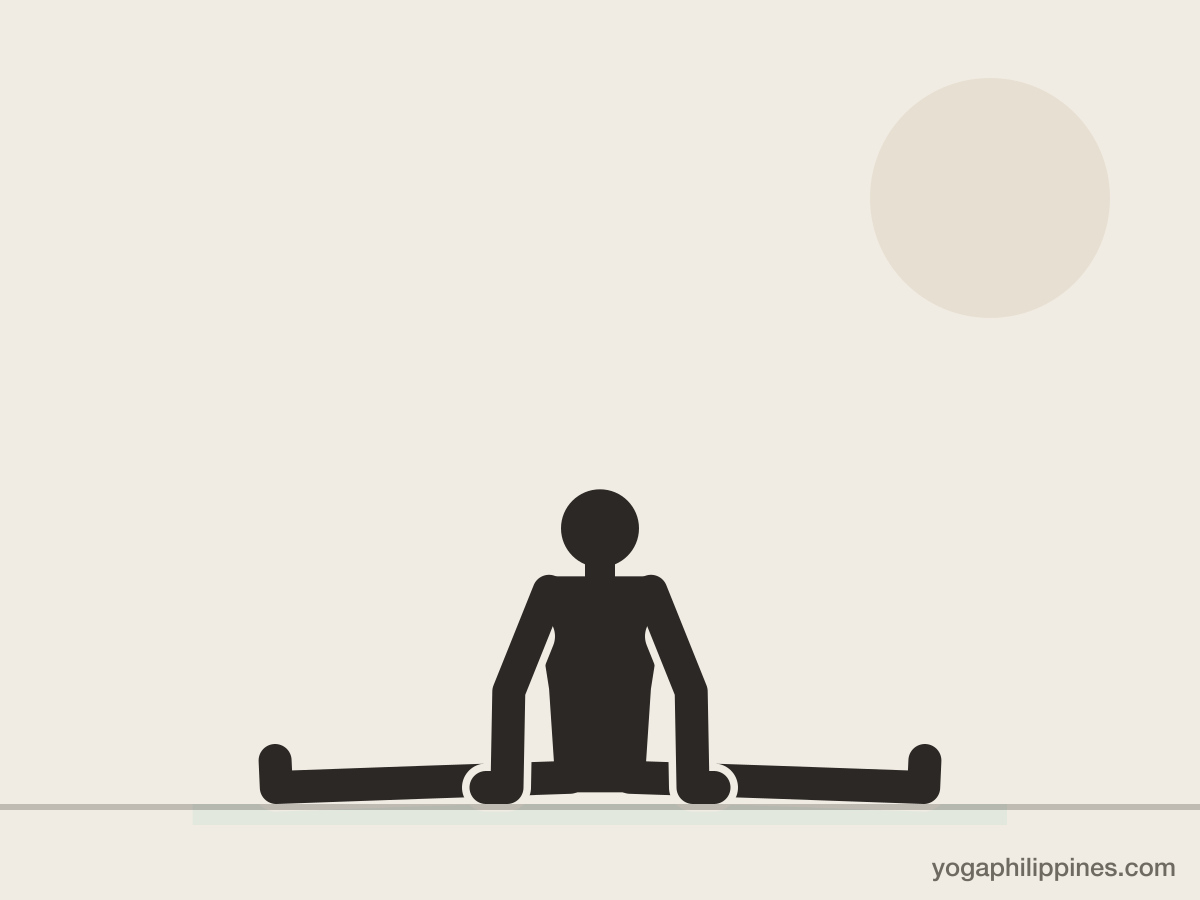
Drawings and video by YogaPhilippines.com, free to reuse under CC BY 4.0 with credit and a link: see the image licence for how to credit.
Put it into practice with the five-part flexibility check, built on pages like this one.
Browse all stretching routines.
Sources: Mayo Clinic, Fitness program: 5 steps to get started; NCCIH (US National Institutes of Health), Yoga: Effectiveness and Safety. Last reviewed 2 October 2026.
Questions
Are the middle splits harder than the front splits?
For many adults, yes. The front splits mostly ask for long hamstrings and open hip flexors, which tend to change with practice. The middle splits ask the hip joints to open wide to the sides, and the shape of the thigh bone and hip socket limits that range for some people however long they stretch.
Should the toes point up or forward in the middle splits?
Most teachers cue the knees and toes to point up while sitting upright, so the knees are not twisted. Wherever they point, the knees and toes should face the same way.
Why do the knees hurt in a straddle stretch?
Usually because the knee is being twisted or pulled sideways, often when the feet slide wider than the hips can follow or the toes turn a different way from the knees. Bring the feet closer, bend the knees a little and line the toes up with the kneecaps. Pain inside the knee joint means stop and see a doctor or physio.
How often should you stretch for the middle splits?
Three or four sessions a week, each around fifteen minutes after a warm-up, suits most people. Long, deep holds at the edge of the range every single day tend to leave the inner thighs sore and guarded, which slows progress rather than speeding it up.
Is the middle splits possible for everyone?
Not always. The inner thigh muscles respond to steady, patient stretching, but the shape of the thigh bone and hip socket sets a limit that no stretching changes, so some people will never sit flat in the middle splits. Measure progress by how easily you breathe near your edge, not by the distance to the floor.
Can you get the middle splits fast?
Rushing is the usual way people strain the groin or knees. Progress comes from three or four sessions a week of about fifteen minutes after a warm-up, holding wide-legged shapes for five to eight slow breaths. Some people see steady change over a few months, others settle short of the floor. Stay longer rather than sliding the feet wider.
Pairs well with
Your yoga calendar
We track every yoga event, workshop and pop-up class so you don't have to.
Updated