Stretches
PNF stretching: how the contract and relax method works
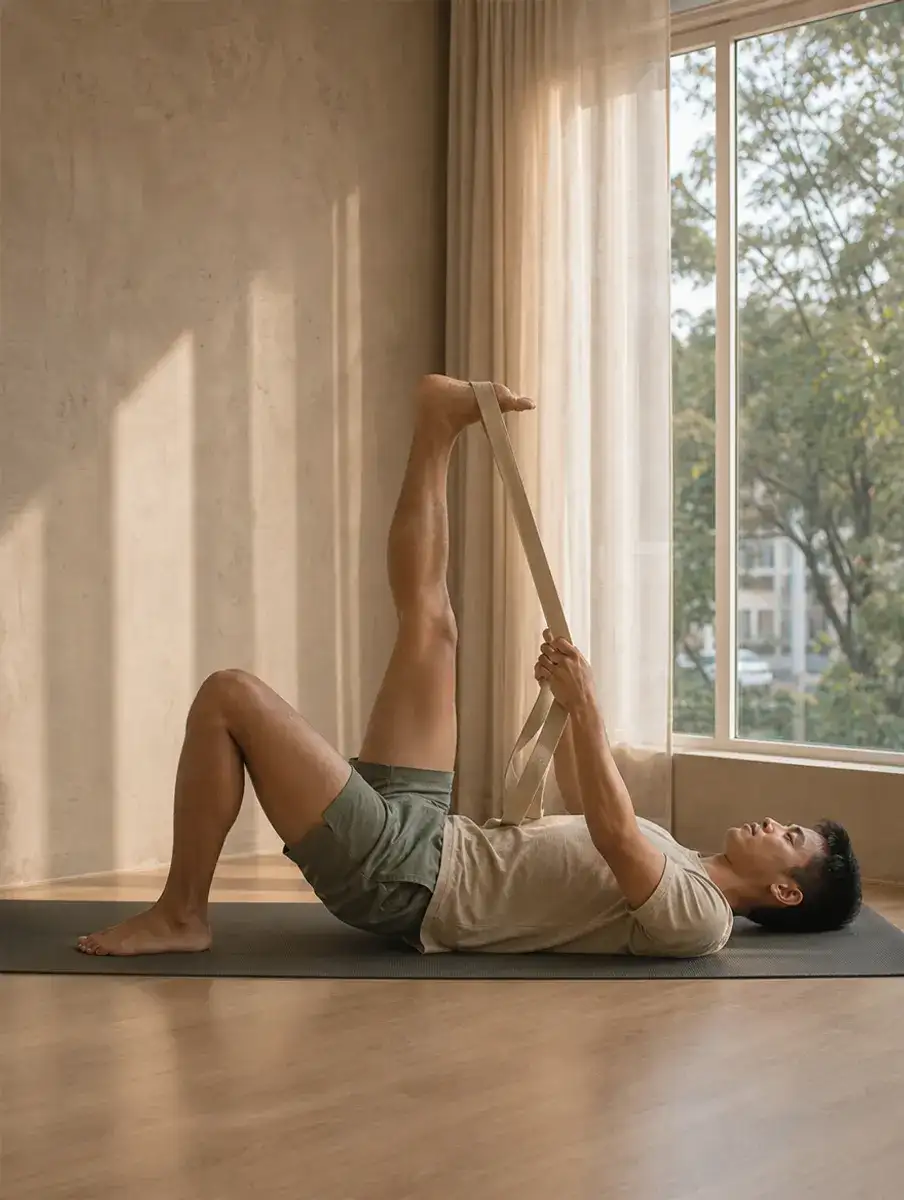
PNF stretching pairs a static stretch with a gentle muscle contraction. You move into a mild stretch, press against resistance for about five seconds without moving, relax, then ease a little deeper on an out-breath and hold. It can be done with a strap or a partner, should always use light effort, and is best kept for warm muscles.
PNF stretching is a way of stretching that adds a short, gentle muscle contraction to an ordinary held stretch. The letters stand for proprioceptive neuromuscular facilitation, a name that comes from the physical therapy methods it grew out of in the United States in the mid twentieth century. Today it shows up in sports warm-downs, physiotherapy clinics and some yoga and mobility classes.
It sounds technical, but the most common version is simple: stretch, press, relax, stretch a little more.
How does PNF stretching work?
The best known method is called hold-relax, or contract-relax. You move into a mild stretch, then press the stretched muscle against something that does not move, a strap, a wall or a partner’s hand, for a few seconds. Nothing changes position. When you relax, many people find they can ease a little further into the stretch. That second, deeper hold is where the stretch happens.
A variation adds a contraction of the opposite muscle, for example squeezing the front of the thigh while stretching the back. It is harder to learn, so start with hold-relax.
Who should not do PNF stretching?
Skip it, and talk to a doctor or physiotherapist first, if:
- the muscle is injured, strained or bruised;
- you have had recent surgery near the area;
- you have high blood pressure or a heart condition (pressing hard can make people hold the breath and strain);
- you feel sharp pain, numbness or tingling at any point.
Never press hard. PNF is about light effort and slow breathing.
The method: PNF hamstring stretch with a strap
- Warm up first. Walk for five minutes or do a few rounds of gentle movement. PNF is for warm muscles.
- Set up. Lie on your back with both knees bent. Loop a strap around the ball of the right foot and straighten the leg towards the ceiling, knee soft, until you feel a mild stretch in the back of the thigh. Hold for three slow breaths.
- Press, gently, for about five seconds. Without moving the leg, press the heel into the strap as if pushing the leg back towards the floor. Use light effort, far below your full strength. Keep breathing; do not hold the breath.
- Relax for one breath. Let the leg go soft in the strap.
- Ease deeper and hold. On an out-breath, draw the leg a little closer, only as far as is comfortable, and hold for five to six slow breaths, about 30 seconds.
- Repeat once or twice, then switch legs. Lower the leg slowly when you finish.
The same pattern works for the front of the hip in a kneeling low lunge for the hip flexors: press the back knee gently down into the floor for five seconds, relax, then ease the hips forward.
What are the main types of PNF stretching?
| Method | What you do | Difficulty |
|---|---|---|
| Hold-relax | Press the stretched muscle against resistance without moving, relax, ease deeper | Easiest, the method above |
| Contract-relax | Press and let the limb move a little against the resistance, relax, ease deeper | Similar, needs a partner or a strap held firmly |
| Hold-relax with opposite muscle contraction | Hold-relax, then gently tighten the muscle on the other side of the joint as you ease deeper | Hardest to coordinate |
Names vary between textbooks and coaches, so the same method may be called by more than one name.
Can you do PNF stretching on your own?
Yes. A strap, a wall, a doorway or a sturdy chair can take the place of a partner. Two more solo versions:
Calf, at a wall. Stand facing a wall and step the right foot back, heel down, until you feel the calf. Hold for three breaths. Press the ball of the right foot gently into the floor, as if starting to rise onto the toes, for five seconds without moving. Relax for a breath, then bend the front knee a little more and hold for five breaths. Switch legs.
Chest, in a doorway. Rest the right forearm on the door frame at shoulder height, elbow bent, and turn the chest slightly away until you feel the front of the shoulder. Press the forearm lightly into the frame for five seconds, relax, then turn a touch further and hold for five breaths. Stop at once if you feel tingling down the arm.
When should you do PNF stretching?
After exercise or at the end of the day, when the muscles are warm. Avoid it right before a run, a game or a strong class, because a hard stretching session just before activity can leave muscles feeling less springy. Before activity, a moving warm-up does more. Many people find two or three short PNF sessions a week for one stubborn area is plenty.
How is PNF different from static stretching?
Static stretching holds still and relaxes the whole time. PNF adds the brief press before the hold. The comparison of static vs dynamic stretching covers the two more common methods, and the hamstring stretches lying down and standing are plain static versions of the stretch above.
Common mistakes
- Pressing too hard. More effort does not mean more stretch. Light pressure is enough.
- Holding the breath. Breathe steadily through the press and the hold.
- Moving during the press. The leg stays still. If it moves, you are pushing too hard.
- Forcing the deeper hold. Ease in only as far as the body allows after relaxing.
- Doing it cold. Always warm up first.
Make it easier or harder
Easier: keep the press to three seconds and the effort very light. Do one round only, and keep the knee well bent.
Harder: add a second or third round, or try the opposite-muscle version, gently tightening the front of the thigh as you ease deeper. With a partner, agree on a word for “stop” before you start.
Where PNF fits in a stretching practice
PNF is one tool, not the whole box. Most people get on well with mostly gentle static stretching and an occasional PNF round for a stubborn area. If your goal is general range, yoga for flexibility explains why regular, patient practice matters more than any single technique. To see how it compares with static, dynamic, active and passive stretching, read the guide to the types of stretching.
Put it into practice with the sit-and-reach scorer, built on pages like this one.
Browse every stretch by body area.
Sources: Mayo Clinic, Fitness program: 5 steps to get started; NCCIH (US National Institutes of Health), Yoga: Effectiveness and Safety. Last reviewed 2 October 2026.
Questions
What does PNF stand for?
PNF stands for proprioceptive neuromuscular facilitation. Proprioception is the body's sense of where its parts are, and neuromuscular refers to the nerves and muscles working together. The name comes from the physical therapy methods the technique grew out of.
Do you need a partner for PNF stretching?
No. A partner can provide the resistance, but a strap, a towel, a wall or your own hands work too. Doing it alone with a strap is often easier to control, because you decide exactly how much effort to use.
How often can you do PNF stretching?
Because it involves muscle work as well as stretching, many people keep PNF to two or three sessions a week, on warm muscles, with one or two rounds per area. Gentle static stretching can fill the other days.
Is PNF stretching suitable for beginners?
It can be, if the effort stays light and the stretch stays mild. Beginners often press too hard, so start with a strap rather than a partner, use only a small fraction of your strength and skip it on any area that is injured or sore.
What are D1 and D2 patterns in PNF?
D1 and D2 are the two diagonal movement patterns used in PNF in physiotherapy, each with a flexion and an extension direction for the arms or legs. The D2 arm pattern is often likened to drawing a sword from the opposite hip up and out overhead. They are clinical exercises usually guided by a physio, unlike the strap stretches here.
Pairs well with
Your yoga calendar
We track every yoga event, workshop and pop-up class so you don't have to.
Updated