Philosophy
Ayurveda and its relation to yoga
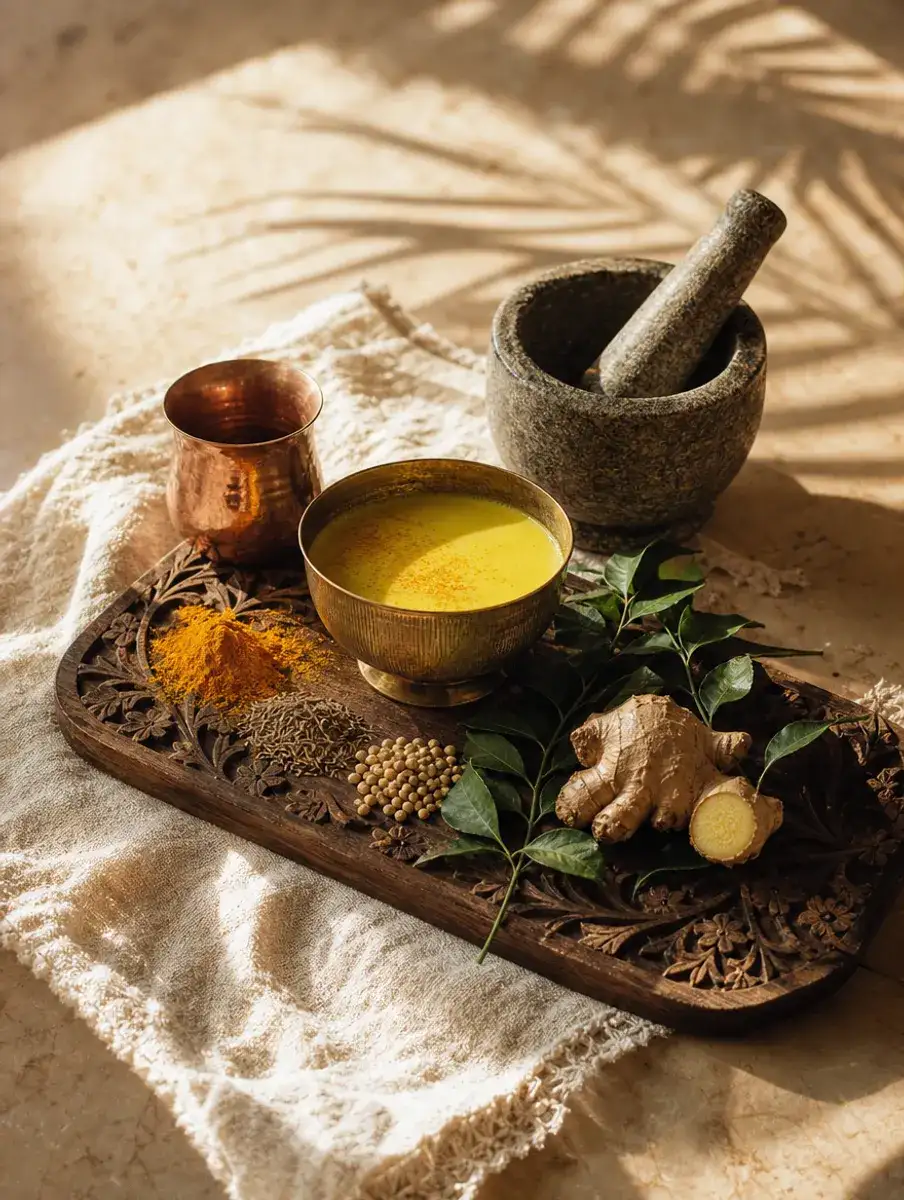
Ayurveda is the traditional medical system of India. Its name joins ayus, life, and veda, knowledge, so it is usually translated as the knowledge of life. Its classical texts date from roughly the last centuries BCE to the seventh century CE. It grew alongside yoga and shares some vocabulary, but it is a separate tradition.
Ayurveda is the traditional medical system of India, and its name means the knowledge (veda) of life (ayus). It is a separate tradition from yoga, with its own texts and its own experts, but the two grew up in the same culture and share part of their vocabulary.
This page covers Ayurveda as history and as a neighbour of yoga. It gives no health or diet advice. Anything about your own health, including Ayurvedic products or therapies, is a question for a qualified doctor.
Where does Ayurveda come from?
Tradition links Ayurveda with the Vedas, and it is often called an upaveda, a supplementary knowledge, connected with the Atharva Veda, which contains many charms and verses about illness. The system as a body of written medicine appears later, in the great compendiums.
The Charaka Samhita focuses on internal medicine and the Sushruta Samhita on surgery. Both were compiled and revised over several centuries, from roughly the last centuries BCE into the first centuries CE, and Charaka’s text was later completed by an editor named Dridhabala. Around the seventh century CE, Vagbhata’s Ashtanga Hridaya drew the two together into one widely studied text.
These works describe the body through three doshas, vata, pitta and kapha, and through the five elements, along with long sections on herbs, surgery, seasons and the conduct of a physician.
Is Ayurveda only a Hindu tradition?
No. Buddhist monasteries were important centres of medical learning, and the monastic rules in the Vinaya include sections on medicines for monks. When Buddhism travelled north, Indian medicine went with it: the Ashtanga Hridaya was translated into Tibetan and became a foundation of Tibetan medicine.
Jain authors also wrote medical works. A well-known example is the Kalyanakaraka, attributed to the ninth-century Jain scholar Ugraditya, which follows Jain rules such as avoiding meat and alcohol in its remedies.
What are the eight branches of classical Ayurveda?
The classical texts divide medicine into eight branches, which is where the name of Vagbhata’s Ashtanga Hridaya, “the heart of the eight limbs”, comes from. They are usually listed as internal medicine, the care of children, conditions attributed to unseen influences, diseases of the head and neck, surgery, toxicology, rejuvenation (rasayana) and the branch concerned with fertility (vajikarana). The list shows how broad the system was meant to be: a full medical tradition, not a set of wellness habits.
Which Ayurvedic words might you hear in a yoga studio?
| Word | What it means in the tradition | Where it comes up |
|---|---|---|
| Dosha | One of the three functional principles, vata, pitta and kapha | Talk of “calming” or “warming” classes |
| Prakriti | A person’s constitution, the balance of doshas at birth | Retreat consultations |
| Agni | Digestive fire, the power of transformation | Cooking and food talk at retreats |
| Dinacharya | A daily routine timed to the day’s cycles | Morning practice and self-care talks |
| Panchakarma | Five classical cleansing procedures carried out by practitioners | Retreat and spa menus |
| Rasayana | The branch concerned with longevity and rejuvenation | Product labels and teas |
Knowing the words helps you follow a conversation. It is not a basis for making choices about your own health.
Is Ayurveda regulated?
Rules differ by country. India regulates Ayurvedic education and practice through national bodies under the Ministry of AYUSH, while many other countries have no licensing for Ayurvedic practitioners at all. Health authorities in several countries have warned that some imported Ayurvedic preparations have been found to contain heavy metals such as lead or mercury.
If you are offered a product or a therapy at a retreat or a shop in the Philippines, check that the product is registered with the Food and Drug Administration of the Philippines, tell your doctor what you are taking, and never stop or change a prescribed medicine without your doctor’s agreement.
How are Ayurveda and yoga related?
They are often called sister sciences today, but historically they are distinct. Patanjali’s Yoga Sutras are about the mind and meditation, not medicine. The two share ideas from the wider Indian philosophy of the time, such as the three gunas, sattva, rajas and tamas, and the five elements, and both speak of prana, the breath as a life force.
The closest overlap comes in the hatha yoga texts. The Hatha Yoga Pradipika, from the fifteenth century, uses Ayurvedic terms such as the doshas when it describes its cleansing practices and diet for the yogi. As the story of how yoga developed shows, hatha yoga drew on many sources, and medical language was one of them.
The firm pairing of the two is largely modern. In the twentieth century, teachers in India and abroad began presenting Ayurveda as the natural partner of yoga practice, and in 2014 the government of India created the Ministry of AYUSH, which groups Ayurveda, yoga and naturopathy, Unani, Siddha and homoeopathy under one ministry.
How does Ayurveda show up in a modern yoga class?
Mostly in words. A teacher may mention vata, pitta or kapha, describe a slow practice as calming or a strong one as warming, or time a practice to the morning and evening the way the classical texts divide the day. Some retreats and studios offer separate Ayurvedic consultations.
None of that is part of a standard posture class, and you do not need any Ayurveda to practise yoga. If the history interests you, the Ashtanga Hridaya is the most readable route into the classical texts, and what yoga is, in the texts and in a class shows where the two traditions part ways.
This page is one of the sources behind the Sanskrit flashcards.
Browse every philosophy guide.
Sources: Mayo Clinic, Fitness program: 5 steps to get started; NCCIH (US National Institutes of Health), Yoga: Effectiveness and Safety. Last reviewed 2 October 2026.
Questions
Is Ayurveda the same thing as yoga?
No. They are two separate traditions with their own texts. Yoga is a discipline of the mind and, in its later forms, the body; Ayurveda is a system of medicine. They share some Sanskrit terms and grew up in the same culture, which is why they are often taught side by side today.
What are the three doshas in Ayurveda?
The classical texts name three doshas, vata, pitta and kapha, as the principles they use to describe the body. This page explains the idea only as history. Questions about your own health or diet belong with a qualified doctor.
How old are the main Ayurvedic texts?
The Charaka Samhita and Sushruta Samhita were compiled and revised over several centuries, roughly from the last centuries BCE into the first centuries CE. Vagbhata's Ashtanga Hridaya, which summarises both, is usually placed around the seventh century CE.
Who wrote the main Ayurvedic texts?
The two oldest classical works are named after their authors: the Charaka Samhita, which deals mainly with internal medicine and is said to revise an earlier work by Agnivesha, and the Sushruta Samhita, known for its sections on surgery. A later summary, the Ashtanga Hridaya attributed to Vagbhata, became the standard textbook in many regions.
What does the word Ayurveda mean in English?
Ayurveda joins two Sanskrit words: ayus, life or lifespan, and veda, knowledge. It is usually translated as the knowledge of life or the science of life, and the name reflects how the tradition saw itself, as a body of knowledge about living well and long, not only about illness.
Is Ayurveda practised in the Philippines?
This site does not list or check Ayurvedic practitioners, so it cannot recommend any. If you are considering any Ayurvedic treatment, check the practitioner's training and talk to your own doctor first, especially about herbal products.
Your yoga calendar
We track every yoga event, workshop and pop-up class so you don't have to.
Updated