Philosophy · reviewed by a teacher
History of yoga
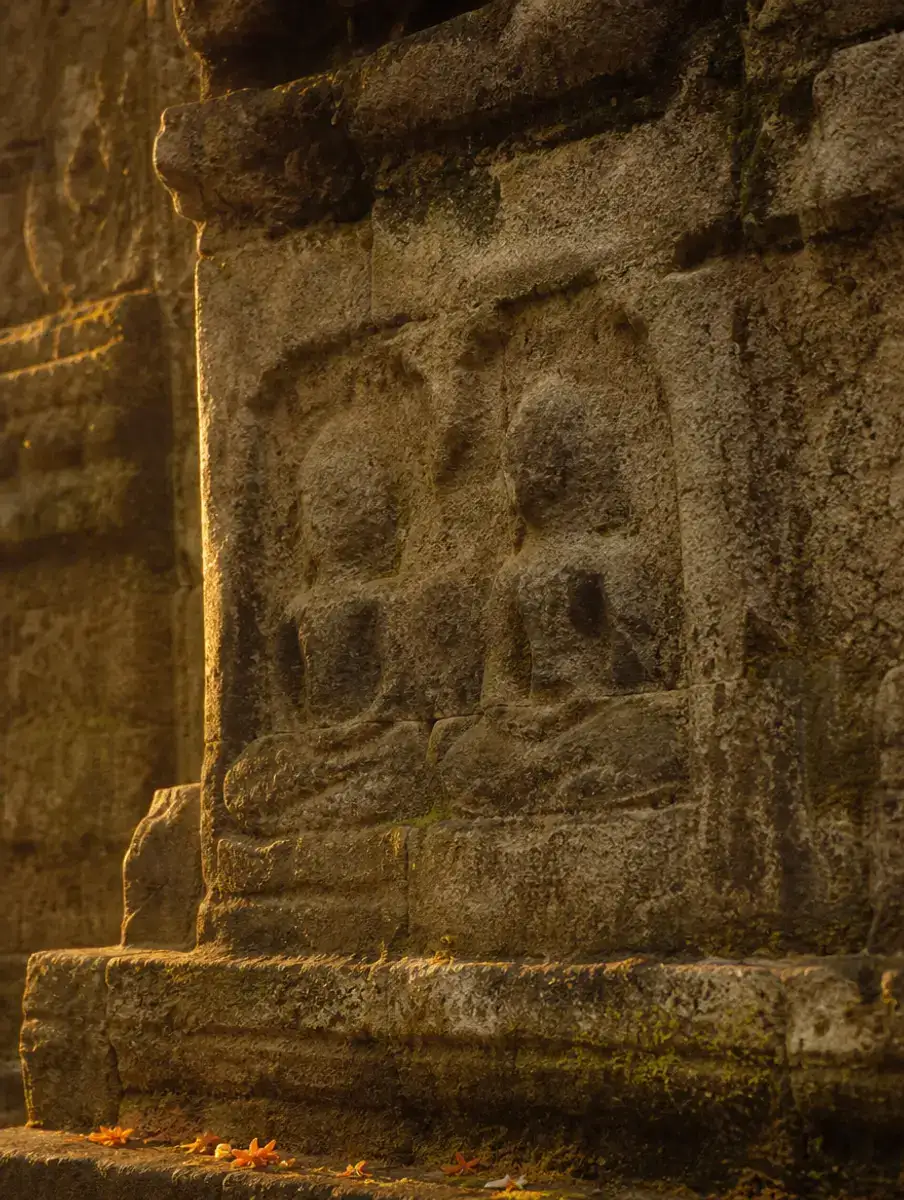
The history of yoga runs from early Indian texts such as the Upanishads, through the Yoga Sutras of Patanjali and the medieval hatha manuals, to the posture-based classes taught around the world today. Its exact beginnings are unknown, and scholars date the first clear written descriptions of yoga practice to the later centuries BCE.
Yoga’s history runs for well over two thousand years, from meditation texts to the posture class you know today.
None of it is required reading before you try a gentle start to yoga, but it explains a great deal about what happens in a class.
Before the texts
Nobody knows exactly when yoga began. Some seals from the Indus Valley civilisation show a figure sitting cross-legged, and these are often held up as the first picture of a yogi.
Scholars are divided on what they show, so they are best treated as an open question rather than proof.
The word yoga does appear in the Rig Veda, the oldest Sanskrit hymn collection, but there it mostly means yoking, as in yoking horses. It is not yet the name of a practice. The Rig Veda’s ten books are themselves called mandalas, the Sanskrit word for circle.
The Upanishads and early meditation
The first clear accounts of yoga as a discipline come in the Upanishads, the philosophical texts that close the Vedas, philosophical texts composed over several centuries BCE. The Katha Upanishad describes yoga as the firm holding of the senses.
The Shvetashvatara Upanishad gives practical advice: sit with the body upright, steady the breath, choose a quiet, clean place.
The same period saw Buddhist and Jain teachers develop their own meditation methods, and historians generally see these traditions shaping one another rather than one simply borrowing from another. Several of the types of meditation taught today, such as breath awareness and loving-kindness, come from these early Buddhist and Jain circles.
The Bhagavad Gita
The Bhagavad Gita, part of the epic Mahabharata and usually dated to the last centuries BCE or the first centuries CE, uses the word yoga in a broad way. It describes paths of selfless action (karma yoga, built on the older idea of karma as action and its results), devotion (bhakti yoga) and knowledge (jnana yoga), along with meditation.
The Yoga Sutras of Patanjali
The Yoga Sutras, Patanjali’s text of short sayings, gathered the ideas into a short, systematic text of about two hundred aphorisms, usually dated to the early centuries CE.
It defines yoga as the stilling of the movements of the mind and sets out the eight limbs of yoga, from ethical restraints to deep meditative absorption.
Posture is only one of the eight, and the text says little about it beyond steadiness and ease.
Who is called the father of yoga?
Patanjali, the compiler of the Yoga Sutras, is the name most often given. The title reflects how central the Yoga Sutras became: from the twentieth century, teachers and books in India and abroad presented the text as the founding statement of classical yoga, and Patanjali became the face of it.
The label is a modern convention rather than a traditional title. Patanjali did not invent yoga. Meditation and discipline of the senses are described centuries earlier in the Upanishads and in early Buddhist and Jain texts, and the Sutras themselves gather and organise ideas that already existed. Little is known about Patanjali as a person, and scholars still debate whether he is the same Patanjali who wrote a famous commentary on Sanskrit grammar.
Other figures get the title in other settings. In yogic lore, Shiva is called Adiyogi, the first yogi. Hiranyagarbha is named in some older texts as the first teacher of yoga. And T. Krishnamacharya, who taught in Mysore in the twentieth century, is often called the father of modern yoga, because many of the best known posture teachers learned from him, including K. Pattabhi Jois and B.K.S. Iyengar.
Hatha yoga and the body
From roughly the eleventh century onward, a new set of texts put the body at the centre. This is the body-centred practice called hatha yoga.
Hatha grew out of tantra, the medieval traditions of ritual, mantra and the subtle body, especially the Nath yogis.
The best known of these manuals is the Hatha Yoga Pradipika, written by Svatmarama in the fifteenth century, which describes postures, breath retention, cleansing practices and seals. Later texts such as the Gheranda Samhita added more postures. These manuals also borrow terms from Ayurveda, the classical medicine of India, such as the doshas, vata, pitta and kapha.
Yoga travels
In 1893 Swami Vivekananda spoke at the World’s Parliament of Religions in Chicago, and his book Raja Yoga (1896) introduced many Western readers to yoga as philosophy and meditation.
Posture practice travelled later. During the twentieth century, Indian teachers blended the hatha texts with ideas from physical culture and gymnastics, and the flowing, posture-based class took shape.
In Mysore, K. Pattabhi Jois taught Ashtanga yoga in a room his students called the shala, the Sanskrit word for a hall. B.K.S. Iyengar’s Light on Yoga, published in 1966, became a standard reference, and in 2014 the United Nations declared 21 June the International Day of Yoga.
How the history shows up in a modern practice
Almost every modern class carries pieces of this history. The Sanskrit pose names come from the hatha manuals. The closing rest and the idea of watching the breath echo the meditation texts. The word namaste at the end is a far more everyday greeting.
History in a class
You do not need any of this history to practise. Still, knowing that postures were first a preparation for sitting still can change how a class feels.
In a small class or one-to-one session there is room to ask where a pose or a word comes from, and to spend a few minutes on breath and stillness rather than moving the whole time. If you are just starting, the guide to your first yoga class covers the practical side.
Browse the yoga philosophy library.
Sources: Mayo Clinic, Fitness program: 5 steps to get started; NCCIH (US National Institutes of Health), Yoga: Effectiveness and Safety. Last reviewed 2 October 2026.
Questions
Where did yoga originate?
In India. The earliest clear descriptions are in Sanskrit texts, and ideas about meditation and discipline developed side by side in Hindu, Buddhist and Jain circles.
How old is yoga?
Written descriptions of yoga as a practice go back well over two thousand years. Claims that it is five or ten thousand years old rest on readings of Indus Valley seals that scholars still dispute.
Who is the father of yoga?
Patanjali is often called that, because the Yoga Sutras are the best known classical yoga text. He is better understood as a compiler who organised ideas that already existed, not the inventor of yoga.
Is yoga religious or spiritual?
Yoga grew inside Indian religious and philosophical traditions, Hindu, Buddhist and Jain, and texts such as the Upanishads and the Yoga Sutras describe it as a path of meditation and self-knowledge. Most posture classes are taught without religious content, though Sanskrit names, chanting and namaste carry pieces of that history. How spiritual it is depends on the class.
Is yoga from Hinduism or Buddhism?
Yoga comes from India, and it grew in more than one tradition. The first clear accounts of yoga as a discipline are in the Upanishads, part of the Hindu tradition, while Buddhist and Jain teachers developed their own meditation methods in the same period. Historians generally see these traditions shaping one another rather than one simply borrowing.
Your yoga calendar
We track every yoga event, workshop and pop-up class so you don't have to.
Updated