Philosophy · reviewed by a teacher
The lotus symbol and what it means
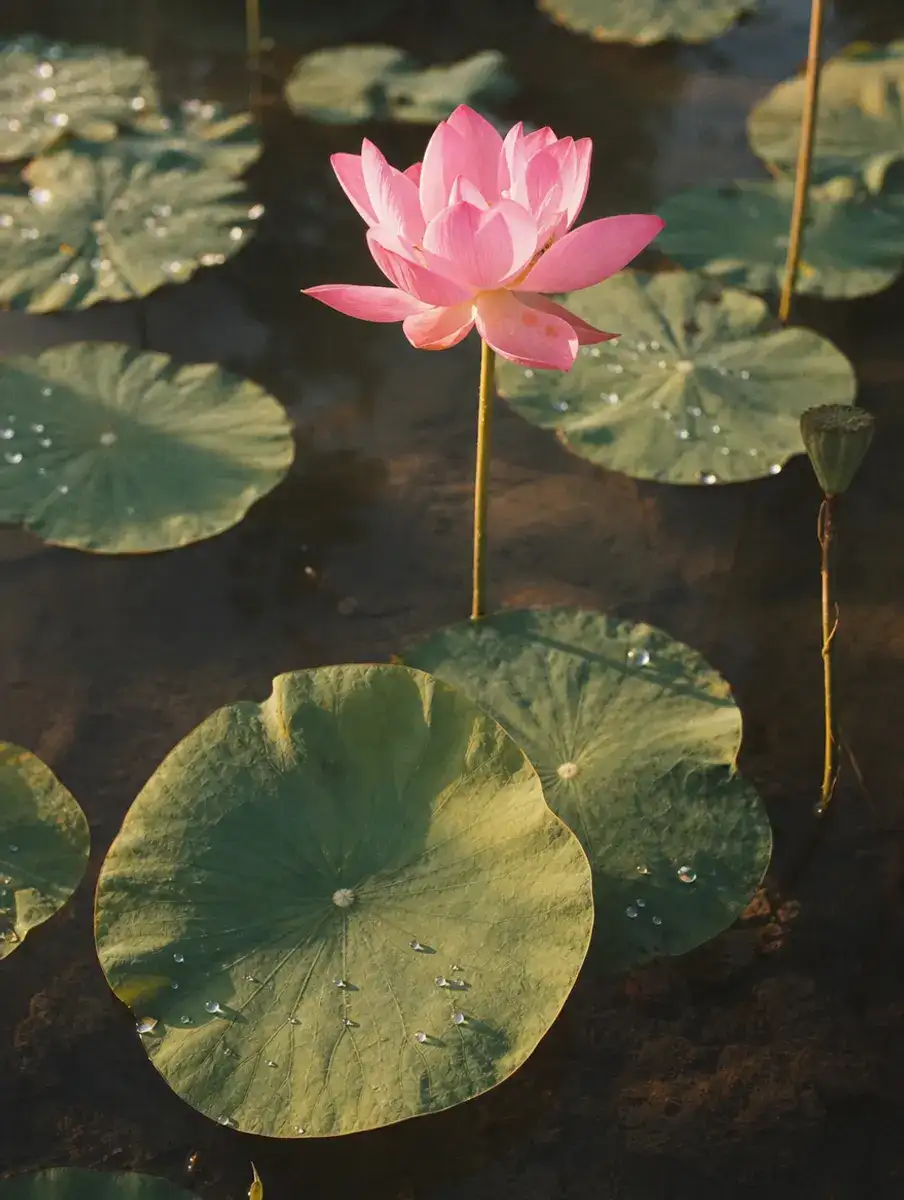
The lotus symbol stands for purity and awakening in Hindu and Buddhist art: the flower roots in mud, rises through water and opens clean above the surface. Gods and the Buddha are shown seated or standing on lotuses, and yoga borrowed the image for its cross-legged seat and its picture of the chakras.
Where does the lotus symbol come from?
The lotus of Indian art is a real plant, a water flower that grows in shallow ponds across South and Southeast Asia. It roots in the mud at the bottom. Its stalks rise through the water, and its large pink or white flowers open above the surface.
Its round leaves shed water in beads, so they stay clean even in a muddy pond.
Every part of the symbol comes from that habit of growth. Mud, water, air: the flower passes through all three and is marked by none of them.
In Sanskrit it has many names, among them padma and kamala, and padma gives yoga the name of its best known seat. The image suits the long, still holds of a slow, propped Yin yoga practice, where staying put is the whole practice.
The lotus in Hindu texts and art
In Hindu stories the lotus is close to the beginning of things. In one account of creation, a lotus grows from the navel of the god Vishnu, and the creator Brahma is born inside it.
Lakshmi, who presides over fortune and abundance, is shown seated or standing on an open lotus and holding lotus flowers. Many other deities are pictured on lotus seats too, a way of saying that they rest above ordinary life.
The Bhagavad Gita uses the plant as a teaching image. In its fifth chapter, a person who acts without clinging to the result is said to be untouched by wrongdoing, as a lotus leaf is untouched by water.
It is one of the clearest pictures in the text of what acting without attachment looks like.
The lotus in Buddhism
Buddhist art uses the lotus everywhere. The Buddha is shown seated on a lotus throne, and a well-known story says lotus flowers sprang up where he took his first steps as a child.
Avalokiteshvara, the figure of compassion, is often shown holding a lotus, and his six-syllable mantra om mani padme hum names the jewel and the lotus together. One of the most influential Mahayana scriptures is called the Lotus Sutra.
For Buddhist writers the lotus in the mud is a picture of awakening. A person lives among confusion and suffering, and the mind can still open clear in the middle of it.
How the lotus shows up in yoga
Yoga took the flower in three places. The first is the seat: Lotus Pose, or Padmasana, crosses the legs with each foot on the opposite thigh, and in old illustrations the folded legs resemble a closed flower with the body rising from it like a stem.
The second is the body map of later hatha and tantric texts, where each of the seven chakras is drawn as a lotus with its own number of petals, up to the thousand-petalled lotus at the crown.
The third is the hands: the lotus mudra opens the fingers like petals with the thumbs and little fingers touching.
The lotus is also the national flower of India, and you will see it on temple walls, in logos and in the decoration of yoga studios worldwide.
Do lotus colours carry different meanings?
Sometimes, though less neatly than modern lists suggest. In Buddhist art the colour often helps identify a figure or a quality: the white lotus is linked with purity of mind, the pink lotus is the one most often shown as the Buddha’s seat, and the blue lotus, the utpala, appears in the hand of Manjushri, the figure of wisdom. In Hindu imagery the pink or red lotus is closely tied to Lakshmi.
Charts that give a fixed meaning to every colour, including purple and gold, are mostly recent, popular writing rather than rules from the texts. If you want to read a particular image, look at who is holding or sitting on the lotus first.
Is the lotus a symbol outside India too?
Yes. In the Egypt of the pharaohs, the blue water lily of the Nile, which opens in the morning and closes at night, was tied to the sun and to rebirth. Botanically that is a water lily, a different plant from the Indian lotus, but the two are often blurred together in art and in writing about symbols.
The Indian lotus also grows in the Philippines, where in Tagalog it is often called baino, and you may see it in ponds at temples, gardens and resorts. Its seed pods, shaped like a shower head, appear in dried flower arrangements.
How it can come up in a class
Full Lotus Pose asks a great deal of the hips and knees, so a careful class works on the hips first, and Half Lotus or a simple cross-legged seat on a folded blanket is always a complete answer. Stop if you feel pain in the knee.
The lotus can stay an image rather than a shape to force. If a student is drawn to the symbol, it can be a quiet theme for the closing rest: rooted, steady, opening a little.
A firm cushion or block makes any cross-legged seat easier; the guide to yoga blocks and straps covers the options. Other words on this page are explained in the glossary of yoga words.
Browse every philosophy guide.
Sources: Mayo Clinic, Fitness program: 5 steps to get started; NCCIH (US National Institutes of Health), Yoga: Effectiveness and Safety; NHS, Knee pain. Last reviewed 2 October 2026.
Questions
Is the lotus symbol the same as the lotus in chakra drawings?
They share the image. Later hatha and tantric texts draw each chakra as a lotus with a set number of petals, from four at the base of the spine to the thousand-petalled lotus at the crown. The single lotus flower as a symbol is older and broader.
What does a lotus symbol tattoo mean?
Usually the ideas the flower carries in art, growth through difficulty, purity and awakening. Because the lotus is a religious image for many Hindus, Buddhists and Jains, it is worth learning what it means first, and pairing it with Hindu or Buddhist figures calls for extra care.
Why is the lotus flower a symbol of purity?
Because of how it grows. The lotus roots in the mud at the bottom of a pond, yet its flowers and leaves sit above the water, and the leaves shed water and dirt instead of holding them. Writers in both traditions used that as a picture of living in the world without being stained by it.
Is the lotus a Hindu or a Buddhist symbol?
Both. It appears in Hindu texts and temple art and in Buddhist art across Asia, and it is also important in Jain art. Each tradition gives it its own stories, though the image of purity rising out of mud is shared.
What is the difference between a lotus and a water lily?
They look alike but are different plants. The lotus usually holds its flowers and round leaves well above the water on tall stalks, while most water lilies float on the surface. The lotus of Indian art is the Indian lotus, Nelumbo nucifera.
What does the lotus emoji mean?
The lotus emoji usually carries the ideas the flower holds in Hindu and Buddhist art: purity, calm and awakening, a bloom rising clean from muddy water. Many people use it for yoga, meditation, spirituality or simply a peaceful mood. As with any emoji, the exact sense depends on who sends it and the conversation around it.
Your yoga calendar
We track every yoga event, workshop and pop-up class so you don't have to.
Updated