Philosophy · reviewed by a teacher
Mudra
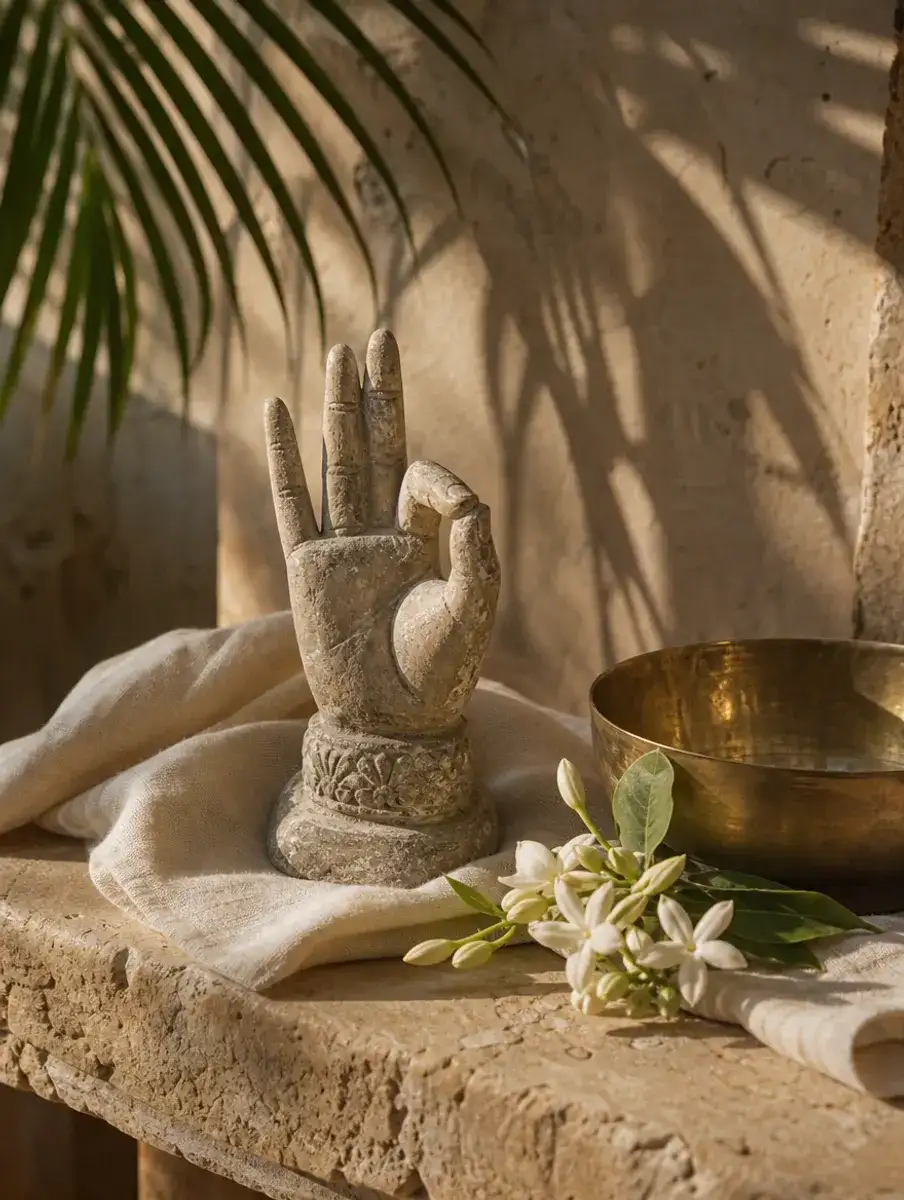
A mudra is a gesture or seal, most often a position of the hands, used in yoga, meditation, Indian dance and religious art. In a yoga class, mudras such as anjali mudra (palms together) and jnana mudra (thumb and index finger touching) give the hands a steady, deliberate shape.
Basahin sa Filipino: ang paliwanag sa Tagalog
The word
Mudra is Sanskrit for a seal, a mark or a gesture.
The same word is used for a signet ring’s impression, which gives a sense of the idea: a shape that is pressed and held with intention.
In a class it is usually a small, quiet detail, especially inside the held shapes of Yin yoga.
Where mudras come from
Hand gestures have a long history across Indian culture. They appear in temple ritual, in classical dance such as Bharatanatyam, where the hand gestures carry meaning and tell a story, and in Hindu and Buddhist art, where the position of a figure’s hands signals a particular quality. Deities in a mandala, a circular diagram of a divine realm, each hold their own gesture.
A raised open palm facing outward, abhaya mudra, is read as a gesture of reassurance, and a hand touching the earth is associated with images of the Buddha.
Buddhist figures often hold objects with their own meaning as well: Avalokiteshvara, the figure of compassion, is shown holding a lotus, the flower that rises clean from mud, and his six-syllable mantra is the chant om mani padme hum.
In the hatha yoga texts the word means something broader. The Hatha Yoga Pradipika, usually dated to around the fifteenth century, describes ten mudras, and most of them are whole-body techniques rather than hand positions: particular postures, locks, the bandhas, and ways of holding the breath, such as mahamudra and viparita karani.
The Gheranda Samhita, a later text, lists a larger set. Both texts present these seals as methods for rousing kundalini, the coiled force of tantric lore. Both draw on tantra, the medieval traditions of ritual and mantra. So when an older hatha text says mudra, it usually does not mean the hands at all.
The simple hand mudras that most people know from classes today are drawn from this wider mix of ritual, art, meditation and modern teaching.
Mudras in Buddhist images
If you have looked closely at a Buddha figure, perhaps in one of the Buddhist temples of Manila’s Chinese-Filipino community, the hands are rarely random. A few of the most common gestures:
| Mudra | The hands | Usually read as |
|---|---|---|
| Bhumisparsha | Right hand reaching down to touch the earth | Calling the earth to witness, at the moment of awakening |
| Dhyana | Both hands in the lap, palms up | Meditation |
| Abhaya | Right hand raised, palm out | Reassurance, fearlessness |
| Varada | Hand lowered, palm out | Giving, generosity |
| Vitarka | Thumb and index finger forming a circle, hand raised | Teaching and discussion |
| Dharmachakra | Both hands at the chest, fingers forming circles | Turning the wheel of teaching |
Readings vary between schools and regions, so take these as the common interpretations rather than fixed rules.
What types of mudra are there?
Modern teaching manuals, notably those of the Bihar School of Yoga, sort mudras into groups: hand gestures, head gestures involving the eyes or tongue, whole-body postures, lock-based mudras that use the bandhas, and gestures focused on the pelvic floor. This is a modern way of organising older material, but it is a useful reminder that the hands are only one part of the picture.
Common mudras in a yoga class
- Anjali mudra: palms together at the chest. The gesture that goes with namaste, and the start of a Sun Salutation, which you can practise with a paced Sun Salutation timer.
- Jnana mudra and chin mudra: the tip of the thumb and index finger touching (see gyan mudra, the seal of knowledge), the other fingers relaxed, hands resting on the thighs in a seated pose.
- Dhyana mudra: hands resting in the lap, one palm on the other, thumbs lightly touching. A common meditation position, used in Zen seated meditation, zazen.
- Adi mudra: the thumb tucked into the palm with the fingers folded over it.
How they show up in a modern practice
In most classes, mudras are small and practical. They give the hands something steady to do in a seated pose so they do not fidget, they mark the start or end of a practice, and they turn up inside postures, such as the palms together in Tree Pose or in a twist.
You will also find books and apps that assign a specific effect to each mudra.
Those claims are modern and not something the hatha texts or this page can vouch for. What a mudra reliably offers is attention: holding a small, deliberate shape is an easy way to notice where your mind has wandered.
How do you practise a hand mudra?
A simple way to try one at home:
- Sit comfortably on a cushion or a chair, spine upright and shoulders soft.
- Form the mudra lightly, with no more pressure between the fingers than you would use to hold a sheet of paper.
- Rest the hands where they fall naturally, usually on the thighs or in the lap.
- Breathe slowly through the nose and keep part of your attention on the feeling in the fingertips.
- Stay for a few minutes, then release the hands and notice any change in where your attention is.
There is no fixed time. Three to five minutes is plenty to start, and it can sit at the end of a home practice before the final rest.
How mudras can come up in a class
In a class, a mudra might appear at the start as the hands settle, during a longer seated pose, or at the close. It is always optional.
If your wrists, thumbs or shoulders are uncomfortable, the hands can simply rest. Slow, held shapes leave the most room for this kind of detail. The Sanskrit yoga glossary explains the other terms on this page.
Browse all yoga philosophy pages.
Sources: Mayo Clinic, Fitness program: 5 steps to get started; NCCIH (US National Institutes of Health), Yoga: Effectiveness and Safety. Last reviewed 2 October 2026.
Questions
What is the most common mudra in yoga?
Anjali mudra, the palms pressed together at the chest, is the one nearly everyone meets first. Jnana mudra and chin mudra, with the thumb and index finger touching and the hands resting on the thighs, are the most common for seated meditation.
What is the difference between jnana mudra and chin mudra?
Both join the tip of the thumb and index finger. Descriptions differ between teachers, but a common convention is that the palms face up in one and down in the other. Different sources swap the names, so do not worry about getting it wrong.
Do you have to use mudras in yoga?
No. Mudras are optional. If a hand position is uncomfortable, resting the hands loosely on the thighs works just as well.
How many mudras are there?
There is no single count. The Hatha Yoga Pradipika lists ten mudras, most of them whole-body or breath seals rather than hand gestures. Indian classical dance and Buddhist art each use their own large sets of hand gestures, and modern books list dozens more, so the number depends on the tradition you look at.
Which mudra is used in meditation?
Two are most common. In jnana mudra the tip of the thumb and index finger touch and the hands rest on the knees. In dhyana mudra, often seen in images of the Buddha, the hands rest in the lap, one on top of the other with the palms up and the thumbs lightly touching.
What is the purpose of a mudra in yoga?
In a yoga class, a mudra gives the hands a steady, deliberate shape. It keeps them from fidgeting in a seated pose, marks the start or end of a practice, and gives the attention something small to rest on. Books that assign a specific effect to each mudra are modern, and this page cannot vouch for them.
Keep reading
Your yoga calendar
We track every yoga event, workshop and pop-up class so you don't have to.
Updated