Philosophy
Gyan mudra, the gesture of knowledge
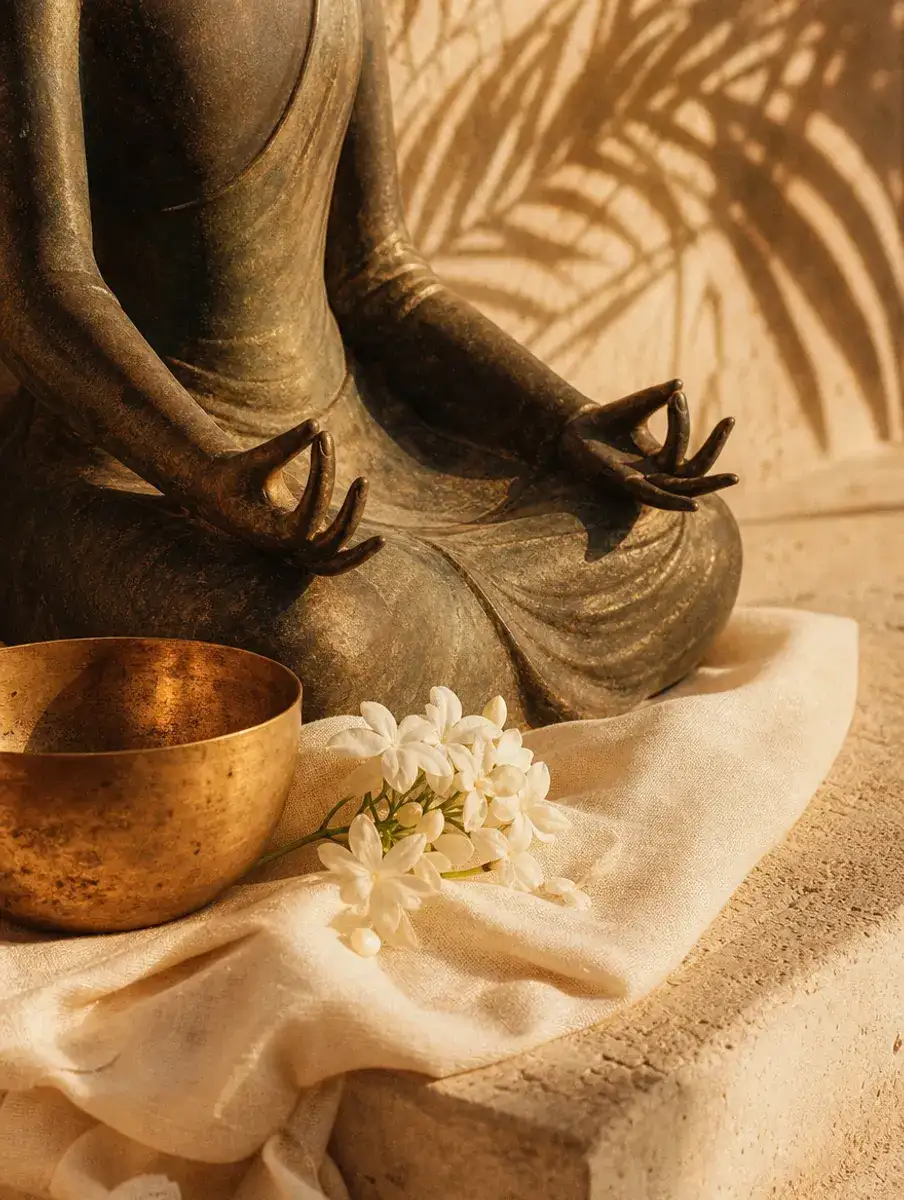
Gyan mudra, also spelled jnana mudra, is a hand gesture in which the tip of the thumb and the tip of the index finger touch while the other fingers stay long. Its name means the seal of knowledge. It is the most common hand position for seated meditation, just as anjali mudra, palms together, is the most common greeting.
Gyan mudra is a gesture of the hand: the tip of the thumb and the tip of the index finger touch to form a small circle, and the other three fingers stay long and relaxed. Gyan, or jnana in Sanskrit, means knowledge, so it is often called the seal of knowledge.
It is the hand position most people picture when they think of someone meditating. Its partner in everyday practice is anjali mudra, the palms pressed together, covered further down this page.
Where does gyan mudra come from?
Mudras, the seals and gestures of Indian practice, appear in temple ritual, in classical dance and in religious art long before they reached modern studios. Gyan mudra has relatives in all of these.
In Hindu art, Shiva as Dakshinamurti, the teacher, is shown seated with one hand in this circle of thumb and finger, often called chin mudra or the gesture of teaching. In Buddhist art a similar circle, held with the hand raised, is vitarka mudra, the gesture of discussion or explanation. In each case the joined fingers are tied to teaching and understanding.
A common explanation in modern yoga gives each finger a meaning. The index finger stands for the individual self, the thumb for the universal, and their meeting for union. The three straight fingers are sometimes said to stand for the three gunas, the qualities of nature in Indian philosophy. This reading is a teaching device handed down by modern teachers rather than something stated in an older text.
How do you hold gyan mudra?
- Sit comfortably, in Easy Pose, on a cushion or on a chair, with the spine tall and the shoulders soft.
- Rest the backs of the hands on the knees or thighs.
- Let the tip of the index finger touch the tip of the thumb, lightly.
- Keep the middle, ring and little fingers long but relaxed, without stiffening them.
- Breathe normally and stay as long as the hands are comfortable.
Teachers differ on the details. A common convention is palms up for jnana mudra and palms down for chin mudra, but some sources swap the names, and some fold the index finger to the base of the thumb instead. None of these choices is a mistake.
What is anjali mudra?
Anjali mudra is the gesture of joined palms. The hands press together in front of the chest, fingers pointing up, thumbs resting lightly near the breastbone. Anjali means an offering made with the hands, and the gesture is one of respect. Its roots in ritual, dance texts and Buddhist and Jain practice are covered on the page about anjali mudra, the gesture of joined palms.
It is the gesture that goes with the greeting namaste, and across India and Nepal the hands alone often say hello or thank you.
In a yoga class you meet it at the start and end of a session, at the beginning and end of a Sun Salutation, and in standing balances such as Tree Pose, where the joined palms may stay at the chest or rise overhead. Some classes also take the palms together behind the back, a variation known as reverse prayer. Skip that one if it strains your wrists or shoulders.
How do these mudras show up in a modern class?
Both gestures are small and optional. Gyan mudra gives the hands a still, deliberate shape during a seated meditation or a breathing practice, so they are less likely to fidget. Anjali mudra marks a beginning or an end.
You may hear claims that a mudra produces a specific effect on the body or the mind. Those claims are modern and unproven. What a mudra reliably offers is a point of attention: when you notice the fingers have drifted apart, you notice your mind has drifted too. If sitting to meditate is new to you, gyan mudra is a simple place for the hands to rest.
Browse the yoga philosophy library.
Sources: Mayo Clinic, Fitness program: 5 steps to get started; NCCIH (US National Institutes of Health), Yoga: Effectiveness and Safety. Last reviewed 2 October 2026.
Questions
Why is it called gyan mudra and not jnana mudra?
They are the same word. Jnana is the Sanskrit spelling, and gyan is closer to how it is said in Hindi and several other modern languages. Both mean knowledge, and both names are used in classes for the same gesture.
Which hand do you use for gyan mudra?
In seated meditation both hands usually take the gesture, resting on the knees or thighs. In some breathing practices one hand forms a different gesture to close the nostrils while the other rests in gyan mudra. Neither hand is wrong.
What does anjali mean?
Anjali means an offering made with the hands, or the cupped hands themselves, as when water or flowers are offered. Anjali mudra is the gesture of joined palms, the shape that goes with the greeting namaste.
Should gyan mudra feel tight?
No. The thumb and finger only need to touch lightly. If you press hard, the hand and forearm tense, which works against a quiet seat. If your hand aches, rest it open on the thigh instead.
What is gyan mudra used for?
Gyan mudra gives the hands a still, deliberate shape during seated meditation or a breathing practice, so they are less likely to fidget. It also works as a point of attention: when the fingers drift apart, you notice the mind has drifted too. Claims of specific effects on the body are modern ideas.
What is the difference between chin mudra and gyan mudra?
They use the same circle of thumb and index finger. A common convention is palms up for gyan, or jnana, mudra and palms down for chin mudra, though some sources swap the names. In Hindu art, Shiva as the teacher Dakshinamurti holds chin mudra, the gesture of teaching. Neither version is a mistake.
Keep reading
Your yoga calendar
We track every yoga event, workshop and pop-up class so you don't have to.
Updated